

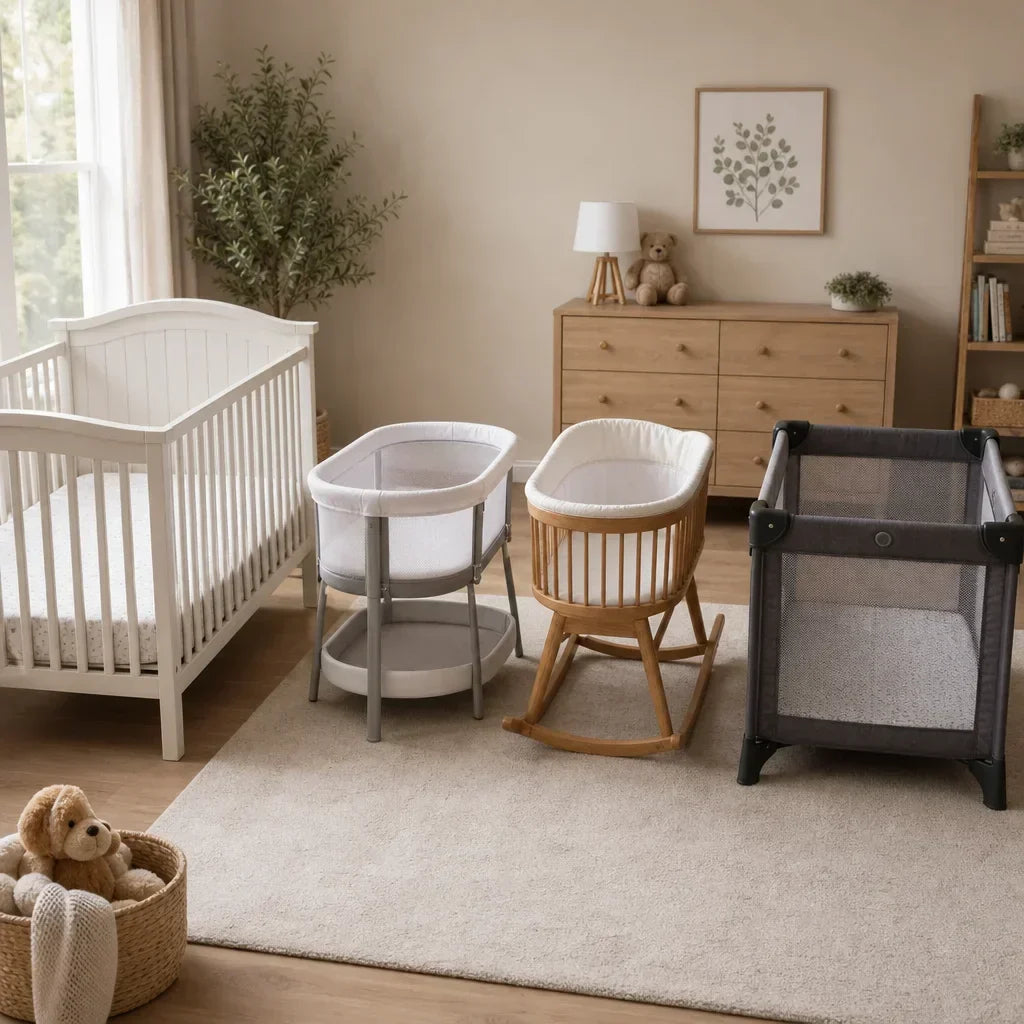
Most people think crib safety standards in Canada are just about buying a new crib. They are not. A safe sleep setup depends on four things: a compliant product, the right mattress fit, correct assembly, and an empty sleep space.
What crib safety standards in Canada actually mean
Cribs, cradles, and bassinets sold in Canada must meet federal product safety rules under the Cribs, Cradles and Bassinets Regulations made under the Canada Consumer Product Safety Act. In plain English, parents are checking whether the product was designed, tested, labeled, and sold for infant sleep in Canada.
Compliance is not just about the day you buy it. It also depends on the product staying in good condition, keeping all original parts, and being used with the mattress and setup the manufacturer intended. That matters whether you are buying in a store, ordering online, or picking up a used crib from a marketplace seller.
Canadian crib regulations: the key rules parents should know
The main Canadian crib regulations are federal, and Health Canada is the government source parents should use to verify the latest rules and recalls. The current regulation parents will usually see referenced is SOR/2016-152, the Cribs, Cradles and Bassinets Regulations. If you want the official text, search Health Canada or Justice Laws for the regulation rather than relying on a reposted crib safety standards Canada PDF.
Those baby crib safety standards in Canada are easier to understand when grouped into five buckets. Design rules address the shape and structure of the product. Materials rules deal with hazards from finishes, components, and construction. Structural rules cover strength and stability. Label rules cover warnings, instructions, and product identification. Testing rules require the product to perform safely under specified conditions.
Canadian crib regulations matter even when a product changes hands. A second-hand crib can still be unsafe because of recalls, missing hardware, wear, damage, or undocumented changes. That is why used purchases need the same level of checking as new ones, and often more.
Crib vs cradle vs bassinet vs play yard: which one is for what stage?
A crib is usually the longest-use sleep space. It is the standard nursery choice for newborns through the early toddler years, depending on the child and the product limits. A bassinet is smaller and usually meant for the first few months, often around birth to 3–6 months, or until the baby reaches the manufacturer's weight, height, or mobility limits.
A cradle is a smaller infant sleep product, often with a rocking or swinging base, and it is also meant for early infancy only. A play yard is mainly a portable play and sleep product, but not every model or accessory is suitable for unsupervised or overnight sleep. The label and instructions decide that, not the marketing photos.
Here is the buyer-focused comparison most parents actually need:
| Product | Best stage | Main advantage | Main limit | What to verify |
|---|---|---|---|---|
| Crib | Newborn to toddler, within product limits | Longest usable option | Takes more floor space | Canadian sale label, model info, manual, mattress fit |
| Bassinet | Birth to about 3–6 months, within manufacturer limits | Easy room-sharing | Outgrown quickly | Intended for infant sleep, weight and mobility limits, stand compatibility |
| Cradle | Early infancy only, within product limits | Compact and convenient | Short use period | Stability, locking features if applicable, full instructions |
| Play yard | Travel or temporary sleep if approved for that use | Portable | Not all attachments are for overnight sleep | Sleep approval for that exact model and accessory |
The safest choice depends less on style and more on stage. For a newborn, many families use a bassinet for room-sharing and a crib for the nursery. For longer-term value, a crib usually covers the widest age range.
How to tell if a crib sold in Canada is compliant

The first things to look for are the product label, manufacturer name, model number, date information, warnings, and assembly instructions. If a crib sold in Canada has no clear identification, no manual, and no parts list, that is a strong reason not to buy it. You need that information to confirm intended use, match replacement parts, and check recalls.
The practical check is simple. Start with the brand and model number. Then search the manufacturer's website, retailer listing, and Government of Canada recall database for that exact model. A proper listing should tell you what the product is, what mattress or accessories fit it, and whether it was sold for the Canadian market.
Voluntary marks can help, but they do not replace Canadian legal compliance. For example, parents may see JPMA on U.S.-market products, but JPMA is not the same thing as proving the product meets crib Canada safety standards for sale here. The Canadian label, instructions, and product identification matter more.
Use this short rule before you buy:
- No label
- No model number
- No manual
- No parts list
- No recall history you can confirm
If you hit even one of those with a used sleep product, walking away is often the safer choice.
Are drop-side cribs legal in Canada?
No. Drop-side cribs are banned in Canada, and families should not use them. If you see a drop side crib Canada listing on a marketplace, treat that as a red flag, not a deal.
The reason is mechanical failure. When the movable side loosens, breaks, or installs incorrectly, it can create a gap. That gap can lead to entrapment, strangulation, or suffocation. A crib can look sturdy and still fail at the exact point that matters most.
This is one of the clearest safety calls parents will make. If the side moves up and down, skip it. There is no practical upside that outweighs the risk.
Are old, vintage, or second-hand cribs safe?
Sometimes not, and age is only part of the problem. The bigger issues are outdated design, weakened parts, missing hardware, repairs with the wrong screws or brackets, old finishes, recalls, and missing documentation. A crib that met standards decades ago may still fail today's crib safety standards Canada expectations.
Health Canada guidance has long warned parents to be cautious with older cribs, especially those made before September 1986. You will also hear an older rule of thumb about avoiding cribs more than 10 years old. That is best treated as a warning sign, not a complete safety test, because a newer modified crib can also be unsafe.
A crib from 1992 is not automatically safe just because it survived this long. A 25-year-old crib is not automatically unsafe just because of the number alone. The real test is whether you can identify it, confirm it was meant for use in Canada, check recalls, verify all original parts, and inspect it for wear or modification. If any of those steps fail, do not use it for infant sleep.
Used crib inspection checklist before you buy

A used crib is only worth considering if you can verify it step by step. Start with identification. Get the brand, model number, and any date code from the label. Without that, you cannot check recalls or confirm the correct parts and mattress.
Then inspect the structure. Look for cracks, split wood, bent metal, enlarged screw holes, wobble, missing fasteners, rough repairs, or drilled holes. Any modification is a problem because crib regulations apply to the product as tested, not the product after someone changed it.
Next, verify the hardware and mattress support. The support platform should sit level and lock where intended. The mattress should fit the model the crib was designed for. Substitute hardware, homemade brackets, extra washers, or zip ties are all reasons to reject the crib.
Finish with paperwork and recall history. Confirm the manual exists, the parts match the manual, and the Government of Canada recall database shows no unresolved safety issue for that model. If the seller says, "It should be fine," but cannot prove what it is, do not buy it.
Use this inspection order:
1. Identify brand and model 2. Check recalls and safety alerts 3. Inspect frame and slats 4. Verify hardware and support platform 5. Test mattress fit 6. Confirm manual and parts list 7. Reject any modified or incomplete product
Crib structure and mattress fit: the safety details that matter most

A crib is only safe when the mattress fits snugly and the structure has no entrapment hazards. The key issue is gaps. If the mattress leaves too much space at the sides or ends, a baby can become trapped. The exact allowed gap should be checked against current Canadian guidance and the crib's own instructions rather than guessed from a tape measure alone.
Slat spacing, side construction, and corner details also matter. Wide slat spacing can allow entrapment. Protruding posts or cutouts can catch clothing or create head and neck hazards. A compliant crib should be designed to avoid those risks, but damage and wear can undo that over time.
The mattress support is one of the most overlooked failure points. If it bows, tilts, or does not sit evenly in its brackets, stop using the crib until the manufacturer confirms the correct fix. Parents often focus on the rail height and miss the platform underneath.
The safest practical test is to use the exact mattress type the manufacturer recommends, install it fully, and check that the fit is even on all sides. If the fit looks uneven, rocks, or leaves visible space, do not improvise with towels, liners, or extra padding.
What should never go in the crib

The safest crib is bare. That means a firm, properly fitting mattress and a fitted sheet made for that mattress. Beyond that, the sleep space should stay empty according to current safe sleep guidance in Canada.
Do not put bumper pads, pillows, loose blankets, stuffed toys, sleep positioners, wedges, nests, pods, or anything with straps or cords in the crib. These add suffocation, entrapment, or strangulation hazards. This applies whether the item is sold in a baby aisle, gifted at a shower, or recommended in a social media video.
Cords near the crib are hazards too. Keep blind cords, monitor wires, chargers, curtain pulls, and decorative strings well away from the sleep space. A crib can be compliant and still become dangerous because of what is hanging beside it.
How to prevent head bumps without crib bumpers
Crib bumpers are not a safe fix. If a baby lightly bumps a head or arm against the side, that is usually less dangerous than adding soft padding that can obstruct breathing or create an entrapment risk. A compliant crib is meant to work without bumpers.
The safer alternative is simple. Keep the crib empty, make sure the mattress fits correctly, and use sleep clothing that matches the room temperature instead of loose blankets. If you are worried because a baby is moving more, focus on the crib meeting current spacing and structural rules rather than adding cushions.
This is one of those places where parents get bad advice online. Softening the crib does not make it safer. It usually does the opposite.
Is a bassinet safe for overnight sleep, and when should baby move to a crib?

A bassinet can be safe for overnight sleep only if that exact product is designed and labeled for infant sleep, assembled correctly, and used within its limits. Those limits are usually tied to age, weight, height, and development, and many bassinets are outgrown around 3–6 months.
The move to a crib should happen as soon as the baby reaches any listed limit or starts showing the mobility the product warns about, such as rolling, pushing up, or sitting attempts. The manual matters more than a general age guess because one bassinet may be outgrown at a very different point than another.
Not every bedside product is a bassinet, and not every bassinet stand works with every basket or attachment. Families run into trouble when they mix components or assume that anything sold for a newborn is safe for unsupervised overnight sleep. The exact label and instructions decide that.
Room-sharing, bed-sharing, and safe sleep basics in Canada

Back sleeping on a separate, safe sleep surface is the basic recommendation for infants in Canada. Room-sharing means the baby sleeps in the same room as the parent, but on a separate crib, cradle, or bassinet. Bed-sharing means the baby sleeps on the same sleep surface as an adult.
Room-sharing is commonly recommended for at least the first 6 months. That is one reason bassinets are popular early on, but a crib in the parents' room can also work if space allows. The goal is a separate approved sleep space close by, not a specific furniture style.
SIDS risk drops as babies get older, but there is no useful hard cutoff that makes sleep safety stop mattering. The biggest practical takeaway is to follow the safe sleep setup from day one and keep following product limits as your baby grows.
How to assemble, inspect, and maintain a crib safely
Correct assembly matters as much as the crib model itself. Follow the manufacturer's instructions exactly, use only the supplied or manufacturer-approved hardware, and confirm every locking point is fully engaged before the crib is used.
After assembly, check for wobble, uneven rails, loose screws, an unlevel mattress support, or any gap that changes when pressure is applied. If the crib squeaks, rocks, or shifts, treat that as a warning sign. A stable crib should feel solid when you test it by hand.
Routine checks should happen regularly, especially after moving the crib, lowering the mattress, or converting any part of the frame. Tighten loose hardware only as directed. If parts are missing, cracked, or warped, stop using the crib until you can get the correct replacement from the manufacturer. DIY repairs and substitute parts are not safe shortcuts.
A simple maintenance checklist helps:
- Recheck all hardware after assembly
- Confirm the mattress support sits level
- Inspect slats and rails for cracks
- Look for wobble after any adjustment
- Replace parts only with manufacturer-approved parts
- Stop use if the fit or structure changes
What to do if a crib has no label, no manual, or no proof of compliance
The safest answer is not to use it for infant sleep. An undocumented crib is hard to trust because you cannot confirm recalls, assembly steps, hardware specifications, or proper mattress compatibility.
This comes up a lot with hand-me-downs and marketplace finds. The seller may be honest and still know almost nothing about the crib's history. It may have been stored in a basement for years, repaired with hardware-store screws, or combined with the wrong mattress.
If you cannot identify the product well enough to verify it, the risk is not worth the savings. That is especially true for newborn sleep, where the setup needs to be predictable and easy to inspect.
Quick buying checklist for a safe crib in Canada
A safe crib purchase starts with verification, not colour or style. Confirm the crib is sold for the Canadian market, has a manufacturer label and model number, includes full assembly instructions, and is not a drop-side design.
Then check the practical details. Make sure the mattress is the one the crib is designed to fit, the structure feels solid, the finish and materials are intact, and the seller or retailer can help you confirm replacement parts if needed. This matters whether you shop online or in a store.
Use this pre-purchase checklist:
- Product sold for the Canadian market
- Clear manufacturer label and model number
- Full warnings and assembly instructions
- No drop-side design
- Properly fitting mattress available
- No recalls or unresolved safety alerts
- No missing parts or undocumented changes
- Intended use clearly stated for crib, cradle, bassinet, or play yard
If you are comparing nursery furniture in person or by virtual consultation, ask the seller to show you the label, manual, and mattress compatibility before you decide. That saves guesswork later.
FAQ: common crib safety questions parents ask
What are the current safety standards for cribs? Current crib safety standards in Canada are federal rules covering design, structural performance, labeling, and safe use for cribs, cradles, and bassinets sold in Canada under the Cribs, Cradles and Bassinets Regulations.
Are there safety standards for cribs? Yes. In Canada, infant sleep products such as cribs, cradles, and bassinets are regulated consumer products, not just furniture.
What are crib regulations? Crib regulations are the legal requirements that control how infant sleep products are designed, tested, labeled, and sold. In Canada, the federal regulation parents usually need is the Cribs, Cradles and Bassinets Regulations.
What certifications should a crib have? A clear Canadian product label, manufacturer identification, model information, warnings, and instructions matter more than a voluntary logo. Marks such as JPMA may appear on some products, but they do not replace Canadian compliance verification.
Are drop-side cribs legal in Canada? No. Drop-side cribs are banned in Canada and should not be used.
Do cribs expire in Canada? Canada does not use a simple legal expiry date for every crib. The real issue is whether the crib is still compliant, complete, undamaged, and verifiable. Older age increases the chance that the answer is no.
Are cribs from 1992 still safe? Not automatically. A 1992 crib may be unsafe because of outdated design, missing parts, wear, or a lack of documentation. Verify the model and recall history before even considering it.
Is it safe to use a 25 year old crib? Usually that is a poor bet for infant sleep unless you can fully identify it, confirm compliance, and verify every original part. In real life, most families are better off choosing a current, documented product.
Are crib bumpers safe in Canada? No. Bumper pads are not a safe sleep item. The safer setup is a bare crib with only a firm fitted mattress and fitted sheet.
What is a safe alternative to crib bumpers? There is no padded substitute you need. The safer approach is an empty crib, correct mattress fit, and a crib that meets current spacing and structural rules.
How do I know if a bassinet is safe for overnight sleep? Check that the exact product is labeled and instructed for infant sleep, assembled correctly, and used within its weight, height, and mobility limits. If the label or manual is unclear, do not assume it is suitable.
When should a baby move from a bassinet to a crib? Move as soon as the baby reaches any manufacturer limit or shows the mobility listed in the instructions, often around 3–6 months depending on the product.
Is a crib mandatory in Canada for newborns? A separate nursery crib is not the only safe option, but a newborn does need a separate, approved sleep space such as a crib, cradle, or bassinet intended for infant sleep.
At what age is SIDS no longer a risk? The risk goes down with age, but there is no single age where safe sleep practices stop mattering. Keep using a safe, separate sleep surface and follow the product limits throughout infancy.
What is the 5 8 5 rule for babies? What about the 10-10-10 or 3-6-9 rule? These are not standard crib safety rules in Canada. If you see them online, do not treat them as official Canadian sleep-product guidance unless a trusted public health source explains them in context.
The simplest takeaway is this: verify the product, verify the fit, keep the crib empty, and skip anything old, modified, or undocumented. If you are shopping for a crib or nursery set, it helps to compare models with the label, instructions, and mattress fit in front of you, whether online, by virtual consultation, or in a showroom.


