

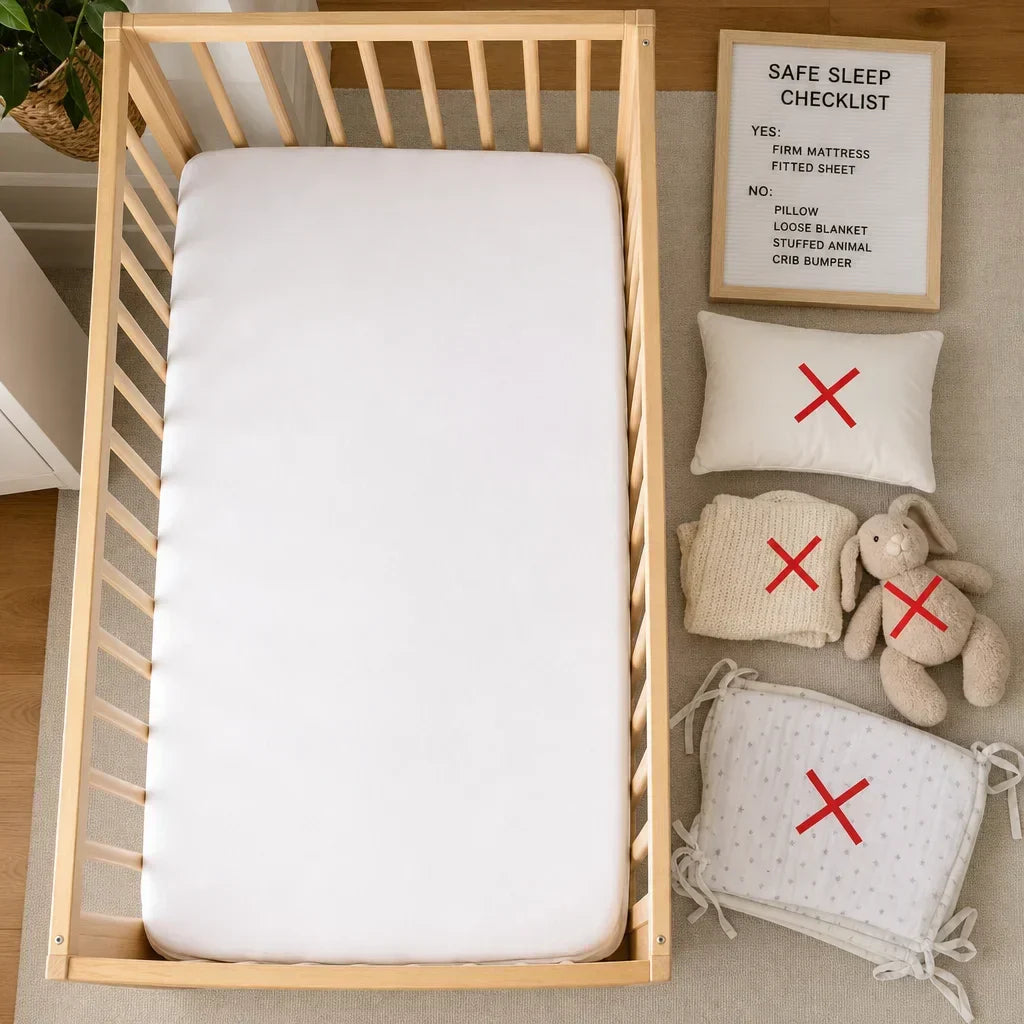
Most common crib mistakes are not complicated. They usually come down to adding too much, trusting a bad fit, or using a crib setup that was never meant to go together.
Common crib mistakes at a glance
A safe sleep setup is simple: baby on their back, on a firm crib mattress, with a fitted sheet only, in an otherwise empty crib.
The most common crib mistakes are easy to list, and they are worth catching early:
- Adding pillows, blankets, crib bumpers, or stuffed animals to the crib.
- Using a crib mattress with visible gaps or too much side-to-side movement.
- Assuming “standard size” always means a safe crib mattress fit.
- Using an old, damaged, missing-part, or second-hand crib without checking it carefully.
- Letting a baby sleep on their side or stomach instead of placing them on their back.
- Waiting too long to lower the mattress support as the baby gets more mobile.
- Placing the crib near cords, blinds, shelves, mobiles, or wall decor that can reach the sleep space.
- Adding wedges, positioners, extra padding, rail extenders, or homemade gap fillers.
- Reassembling a crib after a move without rechecking hardware and mattress fit.
- Ignoring recall notices or assuming a popular crib is automatically safe forever.
Four things that should not be in a crib are pillows, blankets, crib bumpers, and stuffed animals. Those all add soft material or entrapment risk to a space that should stay bare.
> Do not add: bumpers, pillows, quilts, loose blankets, stuffed toys, sleep positioners, wedges, extra foam, towels, pool noodles, or aftermarket crib accessories.
Viral phrases like the “90 minute crib rule” and the “5 8 5 rule” are not Canadian crib safety standards. They may show up in sleep-training talk online, but they are not a substitute for the crib manual, Health Canada product rules, or safe-sleep guidance.
What belongs in a crib and what should never be added

The crib should contain only the baby, a firm mattress, and one properly fitted crib sheet. That is the whole setup.
Crib bumpers are not part of a safe crib. They add padding where a baby can press their face, get trapped, or later use the bumper as a climbing aid.
Loose blankets, quilts, and pillows do not belong in the crib because they add soft bulk around the baby's face and body. If warmth is the goal, a sleep sack or other wearable layer is the safer alternative to loose bedding.
Stuffed animals and plush comfort items should stay out of the crib during sleep. They look harmless, but they add soft objects to a space that works best when it stays empty.
Sleep positioners, wedges, loungers, and extra mattress pads should not be added unless the product is specifically supplied and approved for that exact sleep product by its manufacturer. Aftermarket add-ons are a common source of unsafe setups.
A fitted crib sheet should sit flat and tight over the mattress without pulling corners upward. If the sheet is so tight that it curls the mattress edges, the sheet is wrong for that mattress.
Darkening the room is fine, but hanging decor over the crib is not. If you want a calmer room, use curtains, dimmable lighting, or a wearable sleep layer instead of putting anything inside or directly above the crib.
How to check crib mattress fit: the pass/fail test every parent should do

A crib mattress fits properly when it sits flat, fills the crib evenly, and does not leave a concerning gap along any side or corner. The check takes about 2-5 minutes.
Place the mattress flat in the crib with no topper or padding underneath. Then push it firmly to one long side and look at the gap on the opposite side, then repeat on all four sides and corners.
A pass looks boring, and that is good. The mattress stays flat, the edges stay square, and you do not see a large open space between the mattress and crib frame after shifting it side to side.
A fail looks obvious once you know what to watch for. If pushing the mattress to one side leaves a wide visible channel, exposes too much space at a corner, or lets the mattress slide around easily, stop using that setup until the fit problem is fixed.
The widely repeated “two-finger rule” is best treated as a rough shorthand, not official Canadian wording unless the governing source says so. If you can easily fit more than a small fingertip-width gap along the edge, or the gap looks visibly open, treat that as a red flag and verify against the crib manual and manufacturer guidance.
The fitted sheet check matters too. Once the sheet is on, the mattress corners should stay down and the mattress should not bow, buckle, or distort. A sheet that changes the fit is a fail even if the bare mattress looked acceptable.
Gap fillers should never be used to fix poor crib mattress fit. Towels, foam inserts, folded blankets, and pool noodles do not turn a bad match into a safe one.
Why a crib mattress can feel loose even if it says standard size

A mattress can feel loose because “standard” does not guarantee every crib and mattress pairing will match safely. Small manufacturing tolerances, different brands, and frame wear can all change the final fit.
The most common causes are a mini crib versus standard crib mismatch, the wrong mattress orientation, a warped crib frame, bowed sides, worn mattress edges, missing hardware, or an aftermarket crib mattress that was not designed for that crib. Those are all specific, fixable checks.
The first step is to stop using the setup until you know why it feels loose. A nursery shortcut is not worth the risk when the sleep space itself is the problem.
The right troubleshooting order is simple: re-measure the sleep surface, check the crib manual, confirm the mattress model, reassemble the crib carefully, tighten hardware, inspect for warping, and then contact the manufacturer or retailer if the fit still fails. That sequence catches most problems without guesswork.
A crib that passed before can fail later. Moves, partial disassembly, seasonal humidity, worn support hardware, and replacing the original mattress with a different model can all change the fit enough to matter.
Legal standard vs guideline vs best practice: how to read crib safety advice without confusion

Crib safety advice makes more sense when you split it into three levels: legal standards, expert guidelines, and store or household best practices. They are not the same thing.
| Level | What it means | Example |
|---|---|---|
| Legal standard | A product rule set by government regulation | Canadian crib product requirements under the Cribs, Cradles and Bassinets Regulations, SOR/2016-152. |
| Guideline | Sleep advice from medical or public-health bodies | Back sleeping, empty crib setup, and avoiding soft items. |
| Best practice | Extra checking habits that help prevent mistakes | Rechecking hardware after a move and testing mattress fit again after reassembly. |
Health Canada is the key source for Canadian crib product regulation. The Canadian Paediatric Society is one of the recognized sources parents often look to for safe-sleep guidance.
U.S. names like CPSC, ASTM, AAP, and JPMA may come up in product research, but they are reference points, not Canadian law. If you are shopping or troubleshooting in Canada, start with Canadian rules and the product's own manual.
The practical takeaway is straightforward. A crib can be legally sold and still be used unsafely if it is assembled wrong, paired with the wrong mattress, or filled with soft extras.
Used, antique, damaged, or recalled cribs: when not to take the risk
Used crib safety starts with skepticism, not nostalgia. Older or second-hand cribs can fail because of outdated design, hidden damage, missing hardware, unknown repairs, or a history you cannot verify.
Drop-side cribs should be avoided. They are exactly the kind of older design that raises immediate concern when a crib comes from storage, a hand-me-down, or an online marketplace listing.
A crib should be retired if you find cracks, loose joints, broken slats, stripped screws, bent mattress supports, unstable legs, warped rails, peeling finishes of unknown origin, or any missing part. One missing fastener is enough to stop use.
If a crib has broken or missing parts, do not improvise with hardware-store substitutions unless the manufacturer confirms the replacement is correct. Cribs are engineered systems, not mix-and-match furniture.
A crib recall check starts with the brand, model name or number, and date label if present. Then search official Canadian recall sources and the manufacturer's own recall page before putting the crib into service.
If a recall applies, stop using the crib and follow the remedy listed by the manufacturer or regulator. That may mean a repair kit, part replacement, refund, or full disposal depending on the notice.
Antique cribs deserve extra caution because age alone tells you almost nothing about compliance or structural condition. Decorative value does not make a crib safe for actual sleep.
When to lower the mattress and when to move out of the crib

The safest crib mattress height guide starts with the manual, then follows the child's milestones rather than a rigid age. Different crib models use different rail heights and mattress support positions.
Most families lower the mattress in stages as the baby becomes more mobile. The usual triggers are pushing up strongly, sitting, pulling to stand, or making climbing attempts.
| Watch for this milestone | Action to take |
|---|---|
| Baby is no longer a quiet newborn and starts pushing up with more force | Review the manual and consider moving from the highest setting to a lower one. |
| Baby can sit or is trying to sit steadily | Lower the mattress support if your crib manual calls for a lower stage. |
| Baby is pulling to stand | Use a lower mattress setting right away if available for your model. |
| Child leans, reaches high, or looks close to getting over the rail | Reassess crib safety immediately and prepare for the next sleep stage. |
| Child is climbing or near the manual height limit | Move out of the crib once the manual says the crib no longer contains the child safely. |
A broad industry reference point for moving out of the crib is around 35 inches or 89 centimetres, but that is not universal and should never override the manufacturer's stated limit.
The crib height guide for parents is simple in practice: if the rail no longer feels meaningfully higher than your child's standing reach or climbing effort, you are near the end of safe crib use even if the birthday says otherwise.
Safe sleep position, room setup, and nursery placement

Babies should be placed on their back for sleep unless a healthcare professional has given different instructions for a specific medical reason. Back sleeping is the standard safe starting position.
Side sleeping is not the stable middle ground some families assume it is. A baby placed on the side can roll into a less safe position, which is why back sleeping remains the usual guidance.
The safest nursery temperature is usually described as a comfortable room for a lightly clothed adult, often around 20-22°C.
Lighting can stay low and calm, but anything with a cord, battery pack, hanging loop, or fall risk should stay well away from the crib. Mobiles, cords, and wall decor should be positioned so the child cannot reach them as they grow and pull up.
The crib should sit away from blind cords, curtain pulls, heaters, radiators, shelves, framed art, lamps, and furniture that could tip or drop items into the sleep space. The safest nursery layout is the one with the fewest reachable hazards.
SIDS risk is highest in the first months of life, with a peak commonly described around 2-4 months. Risk drops with age, but safe-sleep habits still matter throughout infancy.
Crib vs bassinet vs play yard vs mini crib: where parents make the wrong setup choice

The safest product is the one used exactly as intended, with the correct mattress or pad, the correct age and milestone range, and no extra add-ons. That matters more than the label on the box.
Mini crib versus standard crib is not just a size issue. Their mattresses are not interchangeable, and forcing one into the other is one of the easiest ways to create a dangerous gap.
Bassinet versus crib versus play yard decisions usually go wrong when parents assume all flat sleep surfaces work the same. They do not. A play yard should use only the sleep surface supplied or approved for that model, and a bassinet should be retired once the child reaches the maker's limit or mobility milestone.
| Sleep space | Best for | Common mistake | What to check | When to stop using |
|---|---|---|---|---|
| Standard crib | Long-term infant sleep and later transition period | Using the wrong mattress or delaying mattress-height changes | Mattress fit, hardware, manual limits | When the child reaches the manual limit or can no longer be safely contained. |
| Mini crib | Smaller rooms or temporary nursery layouts | Assuming a standard crib mattress will fit | Exact mattress compatibility | When the manual says the child has outgrown it. |
| Bassinet | Early newborn stage | Keeping baby in it after mobility or size limits | Weight and milestone limits | When baby reaches the manufacturer's limit or becomes more mobile. |
| Play yard | Travel or secondary sleep space if approved for sleep | Adding a separate mattress or extra padding | Only use the included or approved sleep surface | When the model instructions say to stop. |
IKEA cribs can be safe if assembled correctly and used with a compatible mattress that fits properly. The same rule applies to any crib brand: correct assembly and correct mattress pairing matter more than internet opinions about the logo.
Printable crib safety checklist for daily use
A short crib safety checklist catches the same 8-12 setup errors that cause most problems. Print it, tape it inside a closet, or keep it on your phone for naps and bedtime.
Daily crib safety checklist
- Baby sleeps on their back.
- The crib contains only baby, mattress, and fitted sheet.
- No pillows, blankets, stuffed animals, bumpers, wedges, or positioners.
- The crib mattress sits flat with no concerning side or corner gaps.
- The fitted sheet is snug and does not pull corners upward.
- The mattress height matches the child's current mobility.
- The crib is away from cords, decor, shelves, lamps, and heaters.
- Rails, slats, and mattress support look stable and intact.
- No missing screws, brackets, or loose hardware.
- The crib has not been affected by a recall.
After moving or reassembly
- Retighten all hardware.
- Recheck the crib mattress fit on all four sides.
- Inspect the mattress support and slats again.
- Confirm the crib sits level on the floor.
Quick answers to confusing crib questions parents see online
Some popular Reddit threads and parenting posts mix real crib safety with routines, hacks, and wishful thinking. The safest filter is simple: if advice conflicts with the manual, recognized safe-sleep guidance, or basic fit checks, ignore the post.
A crib rail height extender is not a safe fix for a child who is outgrowing the crib. If a child is climbing or nearly over the rail, the answer is transition planning, not an aftermarket attachment.
The “90 minute crib rule” is not an official crib safety rule in Canada. It is usually sleep-routine shorthand online, not a product safety standard.
The “5 8 5 rule for babies” is also not a recognized crib safety standard. If you see it in a forum, treat it as internet shorthand unless a qualified pediatric source defines it clearly.
Canadian crib safety should come from the product manual, Canadian regulations, and recognized safe-sleep guidance. Social posts are useful for hearing common mistakes, not for settling what is actually safe.
How to choose a crib and mattress that make safe setup easier
The easiest safe sleep setup starts with a crib and mattress chosen as a pair, not as two separate bargains. Compatibility removes one of the biggest sources of avoidable fit problems.
A crib is easier to use safely when it has clear assembly instructions, sturdy construction, adjustable mattress height, replacement part availability, and a mattress that is meant to work with it. Those boring details matter more than trendy extras.
A crib mattress should feel firm, fit properly, and accept a fitted sheet that stays smooth. Waterproof surfaces or a waterproof cover are practical for hygiene, but they should not change the mattress fit or add loose layers.
If you are comparing brands, including IKEA, the right question is not whether one name is magically safer. The right question is whether the crib is assembled exactly as directed and paired with the right mattress for that model.
If you want a second set of eyes, a good nursery retailer can help match a crib with the right mattress and flag obvious compatibility mistakes before the room is set up. That is often the simplest way to avoid buying twice.
FAQ
What are four things that should not be in a crib?
Pillows, blankets, crib bumpers, and stuffed animals should not be in a crib. Soft items and extra padding do not improve a safe sleep setup.
How do I know if a crib mattress fits properly?
A proper crib mattress fit sits flat, looks even on all sides, and does not leave a visible open gap when you push it to one side or corner. Check it with and without the fitted sheet.
How many fingers should fit between a crib mattress and the crib frame?
The “two-finger” idea is widely repeated, but it is better treated as a rough shorthand than as official Canadian wording unless the source says so. In practical terms, a visibly open gap or easy side movement means the fit is not good enough.
Can I use crib bumpers in a crib?
No crib bumper is needed for a safe crib. Bumpers add material along the edge of the sleep space and are better left out.
Can I put blankets or stuffed animals in a crib?
No. Loose blankets and stuffed animals should stay out of the crib during sleep. Use a sleep sack or wearable layer instead of loose bedding.
Should my baby sleep on their back, side, or stomach?
Back sleeping is the usual safe position unless a healthcare professional has advised otherwise for a specific reason. Side and stomach positioning are not the default safe setup.
Is it safe to use an old or second-hand crib?
It can be unsafe if the crib is damaged, missing parts, recalled, poorly repaired, or built to older standards. Check the model, hardware, structural condition, and recall history before use.
How do I know if a crib has been recalled?
Find the brand and model information, then search official Canadian recall listings and the manufacturer's recall page. If a recall applies, stop use and follow the listed remedy.
When should I lower the crib mattress height?
Lower it based on mobility milestones and the crib manual, not just age. Pushing up, sitting, pulling to stand, and climbing attempts are the big triggers.
When should I move my child out of the crib?
Move out of the crib when the manual says the child has reached the limit, or when climbing and rail height tell you the crib no longer safely contains them. Broad reference points like 35 inches or 89 cm are secondary to the manufacturer's limit.
Are mini crib mattresses interchangeable with standard crib mattresses?
No. Mini crib and standard crib mattresses are not interchangeable. Using the wrong one is a direct path to unsafe gaps.
Should I use a crib rail height extender?
No. A rail extender is not the safe answer to an outgrowing crib. When a child can climb or nearly get over the rail, it is time to reassess the sleep setup.
What is the 90 minute crib rule?
It is not an official crib safety rule. It is usually internet shorthand about sleep routines, not a Canadian product or safe-sleep standard.
What is the 5 8 5 rule for babies?
It is not a recognized crib safety standard. Treat it as online shorthand unless a qualified pediatric source clearly defines it in another context.
At what age is SIDS no longer a risk?
Risk is highest in early infancy and falls with age, but the practical message for parents is to keep following safe-sleep habits throughout infancy rather than looking for one magic cutoff.
If you are setting up a nursery and something looks off, trust that instinct. Bring the crib manual and mattress details before you buy a replacement or try a workaround.


