

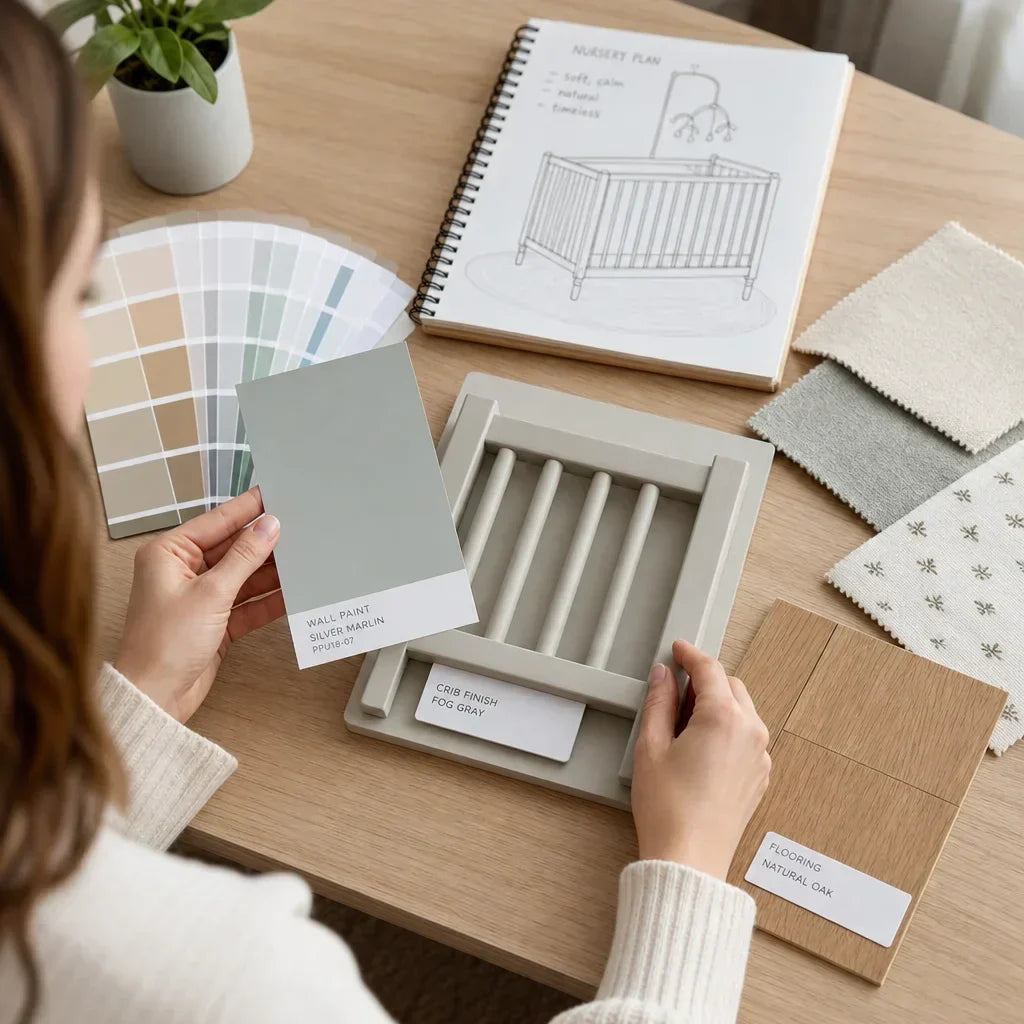
Most people think crib color ideas are mostly about taste. They are not. The best crib colour usually comes down to four things first: light, room size, finish, and how long you want the room to work before you redecorate.
Crib Color Ideas at a Glance: How to Pick the Best Option for Your Nursery
White, natural wood, and soft gray are usually the safest starting points because they work with the widest range of nursery paint colors and decor styles. A white crib helps a dark or small nursery feel lighter. A wood crib adds warmth and hides style changes well. A gray crib sits between warm and cool palettes. A black crib gives strong contrast, but it needs more balance around it.
Neutral crib finishes also tend to be easier to reuse through toddler years, future siblings, and room updates. If you are unsure, keep the crib timeless and bring colour in through an accent wall, wallpaper, bedding, rugs, and art instead of permanent furniture.
How to Choose the Right Crib Color: A 5-Step Decision Framework
Start with the crib finish you actually want to live with for years, not the wall colour you saw in one photo. A crib is the visual anchor of the room, and it usually stays longer than paint, curtains, or decor.
Check the room's natural light before you choose contrast. North-facing or low-light rooms usually suit warm whites, light woods, and softer neutrals better than stark dark contrasts. Bright rooms can handle deeper finishes more easily.
Decide early whether you want a neutral nursery or a more playful one. A gender-neutral nursery often starts with cream, oat, sage, mushroom, soft gray, or pale wood, then adds colour through textiles and artwork. A playful room can still keep the crib neutral.
Coordinate the crib with the dresser, glider, flooring, and rug so the room feels connected. The common 60-30-10 decorating rule can help: about 60% dominant colour, 30% secondary colour, and 10% accent colour. It is a guide, not a law.
Think about reuse before you commit. White, natural wood, and gray usually adapt more easily than trend-led painted finishes if you plan to use the room for more than 2–5 years.
The Best Crib Colors by Finish: White, Natural Wood, Gray, Black and More

A white crib is the easiest option for making a nursery feel bright, classic, and flexible. It works especially well in a small nursery, in a darker room, or in spaces where you want wallpaper or wall colour to stand out. White can show scuffs or chips on painted edges more clearly than mid-tone finishes, depending on sheen and use.
A natural wood crib feels warm and grounded, and it suits Scandinavian, boho, earthy, and timeless rooms particularly well. It pairs easily with warm whites, soft greens, oatmeal, clay, and muted blues. Wood tones vary a lot by stain, so pale oak and rich walnut should not be treated as the same colour family.
A gray crib is one of the most flexible in-between choices because it can lean warm or cool. That makes it useful when you want options later, but undertones matter. A cool gray crib can clash with creamy beige walls if the gray has a blue cast.
A black crib creates a sharper, more modern look than any other standard finish. It works best with lighter walls, simple textiles, and enough visual breathing room. It can show dust, fingerprints, and lint more readily than lighter finishes.
Other finishes like greige, washed oak, walnut, or two-tone cribs can work beautifully, but they should be treated as style variations of the same main families: painted light, painted dark, or natural wood.
What Wall Colors Go Best with Each Crib Color

The best wall colour is the one that matches the crib's undertone, not just its general name. Warm whites pair best with creamy neutrals, oat, sand, sage, muted blush, and greige. Cooler whites can suit dusty blue, misty gray, or soft lavender-gray better.
| Crib finish | Wall colours that usually work | Overall effect | Watch for |
|---|---|---|---|
| White crib | Warm white, sage, greige, dusty blue, blush, wallpaper | Airy, bright, flexible | Stark white walls can feel flat with a bright white crib |
| Natural wood crib | Oatmeal, warm white, clay, olive, soft green, muted blue | Warm, organic, relaxed | Red-toned wood can clash with pink-beige walls |
| Gray crib | Cream, mushroom, muted green, mauve, lavender-gray, soft navy accents | Soft, adaptable, modern | Warm beige and cool gray can fight if undertones differ |
| Black crib | Warm white, taupe, pale gray-green, mushroom, subtle wallpaper | Crisp, dramatic, modern | Too much dark colour can make the room feel heavy |
Bold walls usually work best as one accent wall or a wallpaper feature when the crib already has a strong presence. If the crib is black or a deep walnut, keeping the other three walls soft usually gives the room more balance.
Colour Ideas for Boys, Girls and Gender-Neutral Nurseries

Crib color ideas for boys do not need to stop at navy and powder blue. A crib color ideas boy palette can start with a white crib and add sage, denim blue, sand, forest accents, or muted teal. A baby boy crib color ideas scheme can also use a natural wood crib with oatmeal walls, olive accents, and a patterned rug for a softer look.
A baby girl crib color ideas palette does not need to rely on pink alone. A white crib or gray crib works well with peach, mauve, lavender-gray, warm beige, terracotta accents, or floral wallpaper. Nursery color schemes girl readers often like can feel feminine through texture and pattern, not just colour.
A gender-neutral nursery usually works best when the base colours stay soft and flexible. Cream, oat, sage, olive, mushroom, pale yellow, and dusty blue-green are strong options. These tones work equally well with a white crib, gray crib, or wood crib.
These palette examples are easy to build from:
- White crib + sage walls + cream rug + oak dresser
- Natural wood crib + warm white walls + olive accents + linen curtains
- Gray crib + mushroom walls + mauve details + brass lighting
- White crib + pale peach walls + floral wallpaper niche + soft beige textiles
- Wood crib + sand walls + denim blue accents + woven storage
Calming vs Stimulating Nursery Colours: What Parents Should Know
Soft, muted colours usually make a nursery feel calmer, but colour alone does not make babies sleepy. Routine, sound, light control, room temperature, and temperament matter far more than paint. The colours most people perceive as calming are soft blue, gentle green, warm white, muted lavender, and low-contrast neutrals.
Brighter, higher-contrast colours usually feel more stimulating, so they are better used in accents than on every wall if you want a restful room. That can mean a patterned rug, a few prints, toy storage, or one small wallpaper area instead of a fully saturated room.
There is no universal pair of colours that should never be seen together. What usually fails is undertone conflict or too much contrast in a small room, like an icy gray beside a yellow-beige or several bright primary colours competing at once.
Crib Color Ideas by Nursery Style

Scandinavian nurseries usually look best with a natural wood crib or white crib paired with soft white, pale sage, oat, or misty gray walls. The style depends more on restraint and texture than on strong colour.
Farmhouse nurseries often suit a white crib, black crib, or weathered wood look with warm neutrals, simple stripes, or board-and-batten details. If the room already has rustic flooring, a crisp white crib can keep it from feeling too heavy.
Minimalist nurseries work best with a white crib, greige crib, or black crib and a tight palette of 2–4 colours. Texture from wool, linen, wood, and matte finishes does most of the work.
Boho or nature-inspired nursery spaces usually come together fastest with a wood crib, sage or clay accents, cane or woven details, and layered textiles. This is one of the easiest styles to make feel warm without spending heavily on trendy furniture.
Vintage-inspired rooms often suit a white crib or soft gray crib with floral wallpaper, dusty rose, muted lavender, or antique brass lighting. The room feels softer when the crib finish is quiet and the pattern carries the character.
Modern nurseries and more tailored looks often pair well with a black crib or walnut-toned crib, creamy walls, and simpler graphic shapes. If you want the style to last, put the boldest trend choices into wallpaper, lamps, and art rather than the crib itself.
How to Coordinate Your Crib with Flooring, Rugs, Curtains and Lighting

Floor tone should help decide the crib colour before you buy paint. Cool gray or ash-toned floors usually sit more easily with white crib and gray crib finishes, while honey, oak, or warmer brown floors often pair better with creamy whites and natural wood cribs.
A rug can bridge two finishes that are close but not identical. If your dresser is oak and your crib is white, a rug with cream, tan, and sage can visually connect both pieces. This matters more than trying to match every wood exactly.
Curtains change the feel of the palette as much as wall paint does. Airy linen panels support a soft, relaxed room, while blackout drapery looks more tailored and visually heavier. In a nursery, both can work if the colour supports the crib instead of competing with it.
Lighting changes paint and furniture colour throughout the day, so test everything in morning, afternoon, evening, and lamp light, or about 3–4 different lighting conditions. Warm bulbs can make white paint look creamier and green paint look muddier.
Small Nursery and Low-Light Solutions: Crib Colours That Make the Room Feel Better

A white crib usually works best in a small nursery because it reflects more light visually and feels less heavy than darker finishes. A light wood crib can do nearly the same job while adding more warmth.
Low-light rooms usually benefit from warm whites, pale woods, oatmeal, greige, and other soft neutrals instead of sharp black-and-white contrast. These colours make the room feel more open even when natural light is limited.
A black crib can still work in a small nursery if the rest of the room stays light, the furniture profile is streamlined, and the layout is not crowded. In tight rooms, scale matters almost as much as colour, so a mini crib or a clean-lined convertible model may improve the room more than a new paint shade.
Depth is often better added through textiles or one accent wall than through all-dark furniture in a darker room. That gives you contrast without shrinking the space visually.
Accent Wall and Wallpaper Ideas That Work with Your Crib

An accent wall works best when it supports the crib instead of trying to outshine it. In most nurseries, the strongest placement is the wall behind the crib or the wall you see first when entering the room. That keeps the feature intentional and helps anchor the furniture.
A white crib works especially well with patterned wallpaper because the furniture does not fight for attention. A wood crib pairs nicely with botanical murals, earthy prints, or subtle nature motifs. A gray crib often suits soft textured prints, while a black crib tends to look best with minimalist wallpaper and plenty of negative space.
Painted features like arches, stripes, board-and-batten, or slatted wood details can add interest without covering the entire room. In a small nursery, restraint usually looks better than one bold finish plus one bold wallpaper plus one dark crib.
Safety and Paint Finish Tips for Nurseries
Low-VOC paint and zero-VOC paint are common options parents look for when choosing nursery paint colors, but the safer choice still depends on following the manufacturer's instructions for application, ventilation, and drying. VOC means volatile organic compounds, which are chemicals that can be released into the air from some paints and finishes.
Good airflow matters during and after painting, no matter which product you choose. Product labels and manufacturer guidance should lead the timeline, because drying and curing can differ by formula, humidity, temperature, and sheen.
A washable matte, eggshell, or satin wall finish is often easier to live with than a very flat finish in a nursery, especially near a changer or high-touch area. The right choice depends on the paint line and the amount of wipeability you want.
Refinishing or repainting a crib is not something we would treat casually in a buying guide. Manufacturer guidance should come first for any crib finish questions, because coatings, curing, and product safety can vary.
Before You Commit: How to Test Crib and Paint Colours at Home
Paint samples should be tested beside your actual crib finish, flooring, and fabric swatches, not judged from a phone screen alone. Online photos often distort undertones and brightness.
Large paint swatches, peel-and-stick samples, or painted sample boards usually give a clearer read than tiny chips. If you are comparing a white crib to several whites on the wall, small differences in warmth become obvious only at a larger scale.
Check your samples in at least 3–4 conditions: morning light, afternoon light, evening light, and with nursery lamps on. That is the fastest way to catch a gray that turns blue or a beige that suddenly looks pink.
It also helps to place samples near the exact crib wall if possible. A colour that looks calm across the room can read very differently once it sits beside a black crib, wood crib, or patterned wallpaper.
Which Crib Colours Age Best, Reuse Best and Hide Wear Best?
White, natural wood, and soft gray usually age best because they can move across more design styles with fewer changes. They are the most practical choices if you want to reuse the crib for future children or update the room without replacing major furniture.
Natural wood often hides everyday dust and small visual wear better than very dark painted finishes. White can brighten a room for years, but chips and edge wear may show more clearly on some painted surfaces. Black can look striking for a long time, though dust, lint, and fingerprints are usually easier to spot.
For twins or shared sibling rooms, flexible finishes usually save the most hassle later. Matching white crib or wood crib finishes can unify the room, while individual personality can come through in bedding, wall art, baskets, and rugs.
If long-term value matters most, choose a crib colour that is less specific than the theme. A woodland nursery can become a toddler room more easily if the crib is oak or white rather than a very trend-driven painted shade.
Crib and Nursery Colour Trends for 2026
The strongest nursery direction for 2026 looks less like a strict trend and more like a continued shift toward warm neutrals, earthy greens, natural wood, layered texture, and wallpaper with softer character. Storybook prints, botanical patterns, and less stereotyped pink-blue splits also continue to feel current.
The part likely to last is the move toward warmer, calmer bases rather than colder all-gray rooms. The part more likely to date quickly is highly specific themed decor used across every surface.
If you like trend-forward rooms, keep the crib timeless and add trend through an accent wall, wallpaper, art, lamp shades, and textiles. That is usually the easiest way to refresh the room later without replacing core furniture.
FAQ: Quick Answers About Crib Colour Ideas
What color crib is best for a baby?
White, natural wood, and soft gray are usually the most versatile choices. The best one depends on room light, wall colour, and whether you want a classic or higher-contrast look.
What wall color goes best with a white crib?
Warm white, sage, greige, dusty blue, blush, and subtle wallpaper usually work well with a white crib. The main thing to watch is whether the white crib reads warm or cool.
Is a wood crib or white crib more versatile?
Both are versatile, but they solve different rooms. A white crib brightens small or darker spaces more easily, while a wood crib adds warmth and often adapts well across changing styles.
What colors make a nursery feel calm and soothing?
Soft blue, gentle green, warm white, muted lavender, mushroom, and low-contrast neutrals usually feel the calmest. They influence mood, but they do not guarantee better sleep.
Should a nursery be colorful or neutral?
Either can work. Neutral rooms usually age better, while colourful rooms feel more playful. A balanced middle ground is a neutral crib with colour in accents.
How do I choose a nursery color palette that grows with my child?
Pick a flexible crib finish, use timeless wall colours, and place trendier colours in decor you can swap out. White, gray, and wood cribs usually make that easier.
What paint type is safer for a nursery?
Many families look for low-VOC or zero-VOC paint and follow the manufacturer's ventilation and drying guidance carefully. Product instructions matter more than marketing language alone.
How should I test nursery paint colors before painting?
Use large samples, compare them to the crib and floor, and check them in 3–4 lighting conditions before you commit.
What crib color works best in a small nursery?
A white crib usually works best, with light wood close behind. Both feel less visually heavy than darker finishes.
Which crib colors are easiest to reuse for future children?
White, natural wood, and soft gray are usually the easiest to reuse because they suit the widest range of room styles and ages.
If you are narrowing down finishes now, it helps to compare the crib first, then look at matching [nursery furniture sets](/collections/nursery-furniture-sets), [baby dressers and changers](/collections/dressers-changers), and later-stage [kids furniture](/collections/kids-furniture). You can also browse our [crib collection](/collections/cribs) or book a consultation if you want a second set of eyes on your room, palette, and layout before you commit.


