

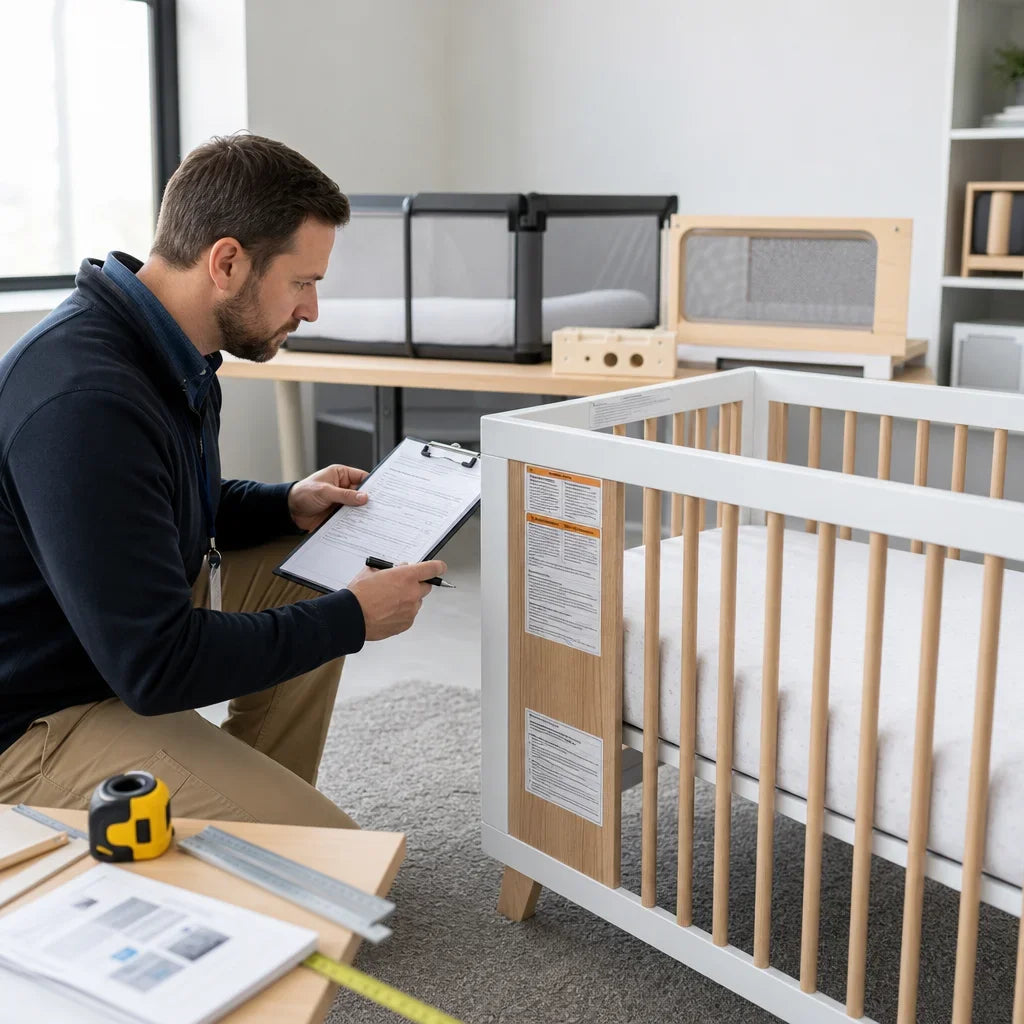
Most people think a crib is safe if it looks sturdy. They’re wrong. Consumer Product Safety Commission crib standards are about far more than solid wood or a familiar brand name. They cover how a crib is built, how it holds up in testing, what warnings and labels it carries, and whether it creates entrapment, fall, or suffocation risks. In the U.S., parents usually see these rules through federal citations like 16 CFR 1219 for full-size cribs and related ASTM updates that CPSC adopts into law . In Canada, families also need to consider Health Canada rules, because U.S. and Canadian requirements are related but not identical .
What the current CPSC crib standards mean in plain English
The current CPSC rules are mandatory U.S. safety requirements for cribs sold commercially, not just suggestions from a trade group . For parents, that means a compliant crib should meet rules for structural strength, side and end panel safety, mattress support performance, hardware security, warnings, labels, and hazard testing intended to reduce entrapment, falls, and other preventable risks .
The reason shoppers see both CPSC and ASTM names is simple. CPSC often makes an ASTM standard legally binding by incorporating it into a federal rule . That is why a product page might mention ASTM F1169, while a regulation summary refers to 16 CFR 1219 for full-size cribs .
The practical takeaway is narrow but useful. A crib should not be judged by looks alone. Parents should look for a current model from an established brand, clear assembly instructions, permanent product labels, registration information, and traceable model details that make recalls and safety checks possible .
What changed in the latest crib standard
The latest update parents may see discussed is an ASTM revision process for full-size cribs, often cited in search results as ASTM F1169-25 or earlier as ASTM F1169-19, but the exact version in force depends on what CPSC has formally incorporated and when that update takes effect . Because those dates and incorporations can change, we would treat the governing CPSC rule or Federal Register notice as the final word rather than relying on retailer summaries alone.
What tends to change in these updates is not the basic idea of crib safety. The updates usually tighten definitions, clarify warning language, refine marking and labeling rules, and add or revise performance tests for newer crib designs and materials .
For parents, the most important part of a newer standard is usually better hazard control. These revisions are aimed at reducing structural failure, falls, entrapment, snagging, and sleep-space problems that can come from weak components, poor fit, or unclear instructions .
Mesh or fabric-sided crib designs can need different performance requirements than fully rigid-sided cribs because the hazard pattern is different . A rigid slat crib is checked for one set of issues. A fabric or mesh-sided design may need added attention to side performance, attachment integrity, and how the sleep space behaves in real use .
When shopping, the update matters less as a code number and more as a signal. Newer compliant models are generally built and tested against more current expectations than second-hand cribs with unknown history or outdated instructions .
Old vs new crib rules: the biggest differences parents should know

The biggest difference between older and newer crib rules is that modern standards are stricter about repeat-use durability, hardware retention, warnings, and known hazard patterns than many older cribs were designed for . A crib can feel heavy and still fail a modern safety expectation.
Drop-side cribs are the clearest example. They are not allowed for sale as compliant cribs under modern U.S. crib rules because the moving side and its hardware created serious failure risks . If you already have one, it is not a good candidate for continued use.
Older cribs also often predate stronger mandatory rules introduced in the early 2010s for both full-size and non-full-size cribs . That matters because even a well-kept hand-me-down may have outdated spacing, weaker hardware design, or incomplete warnings by current standards.
| Older crib design or rule | Current expectation | Risk addressed | What parents should do |
|---|---|---|---|
| Drop-side design | Fixed-side compliant crib | Side failure, entrapment, falls | Do not use or buy second-hand |
| Unknown hardware or replacement parts | Original hardware and intact assembly system | Structural loosening or collapse | Skip cribs with missing parts |
| No traceable labels or model info | Permanent labels and model identification | Recall checks become difficult | Avoid if you cannot identify it |
| Antique or pre-modern design | Current compliant design tested to modern rules | Outdated spacing, fit, and durability expectations | Do not assume “solid wood” means safe |
| Aftermarket add-ons | Manufacturer-approved setup only | Entrapment, suffocation, instability | Remove add-ons and reassess safety |
A common mistake we see with nursery buying is giving vintage quality too much credit. Solid wood, deep stain, or hand-me-down sentiment does not prove compliance with current crib safety standards 2025 expectations or any earlier mandatory crib rule .
How to tell if a crib is full-size or non-full-size

A full-size crib and a non-full-size crib are different legal product categories, and that difference affects mattress fit, testing, and which rule applies . In U.S. regulations, full-size crib definitions sit under 16 CFR 1508, while non-full-size crib definitions sit under 16 CFR 1509 .
The safest way to classify a crib is to start with the manufacturer’s own label or product listing, not the way it looks in a photo . Many parents guess based on appearance alone, and that is where buying mistakes start.
A standard full-size crib is the common nursery crib most parents picture. A non-full-size crib is a smaller or differently sized crib, which can include mini cribs and some portable crib styles, depending on the design and how it is marketed .
Use a simple four-step check before you buy. Read the product description, inspect the permanent product label, confirm the mattress type the manufacturer specifies, and match the crib category to the applicable rule or standard listed in the paperwork .
The reason this matters is mattress fit. A crib and mattress are tested as part of a system expectation, not as random pieces of nursery furniture thrown together . Guessing the crib type can leave parents with the wrong mattress size and an unsafe fit.
How to check if a crib is safe before you use or buy it
A safe crib should have fixed sides, intact structure, traceable labels, correct parts, and a mattress that fits as the manufacturer intended . That is the baseline before you even think about style or colour.
Use this inspection checklist before setting up a new crib or accepting a used one:
- fixed sides, not a drop-side design
- no missing screws, brackets, or support hardware
- no cracked wood, bent metal, broken slats, or loose joints
- no wobbling after assembly
- permanent manufacturer label with model details
- registration information and instruction manual if available
- no aftermarket parts, wedges, liners, or improvised repairs
- proper mattress type for that exact crib model
Shoppers often ask about crib safety standards slat spacing. That detail matters, but we would only use the official regulator or manufacturer guidance for the exact requirement rather than guessing at a number here, because spacing limits are accuracy-sensitive and should come from the governing standard.
The same goes for mattress fit. The right standard is a snug, manufacturer-specified fit with no obvious side gaps, not a “close enough” mattress from another crib or another brand .
Stop using a crib immediately if it wobbles, has broken or missing parts, shows makeshift repairs, lacks enough information for a recall check, or appears in a recall notice .
Are old cribs safe? What parents should know about 30-, 40-, and pre-2000 cribs

A 30- or 40-year-old crib is usually a poor safety choice, even if it looks clean and sturdy today . That does not mean every old crib fails in the same way. It means age adds too many risk factors at once.
The first problem is standards drift. A crib from the 1980s, 1990s, or even early 2000s may predate major mandatory rule changes, updated hazard testing, stronger hardware expectations, and modern label requirements . That includes the period before the tougher crib rules introduced in the early 2010s .
The second problem is wear history. Old hardware loosens. Wood can split around fasteners. Parts get replaced with lookalikes. Assembly instructions disappear. A crib with unknown storage and assembly history is harder to trust than a current crib with full documentation .
That is why the answer to are 30 year old cribs safe or are cribs from 1992 still safe is usually no for practical family use . A 1992 crib came from a period before key modern crib rule changes, and that alone should make parents cautious .
Canadian parents also ask, do cribs expire in Canada. There is no universal consumer “expiry date” stamped across all cribs as a single legal rule we can point to here, but age, damage, recalls, and missing parts can absolutely make a crib unsafe to keep using .
If a crib is antique, inherited, repainted, repaired, or missing original hardware, we would not give it a pass for a baby’s everyday sleep space . Sentimental value belongs in the nursery as decor, not as a substitute for a current safe crib.
What certifications and labels should a crib have?

The most important thing is legal compliance and traceable product information, not a badge on a box . Parents should treat crib certifications as helpful signals, not absolute guarantees.
A crib sold in the U.S. may reference mandatory federal compliance, ASTM testing, and supply-chain paperwork tied to children’s product rules, while shoppers may also see voluntary programs such as JPMA mentioned in marketing . Those are not all the same thing.
The useful distinction is this. Mandatory rules tell you what the crib must meet. Third-party testing helps support that compliance. A voluntary seal may add confidence, but it does not replace the underlying legal standard .
For parents, the labels that matter most are practical ones. Look for a permanent manufacturer label, model number, date or batch information if provided, registration details, and a manual that clearly states the mattress and assembly requirements .
If a seller cannot tell you what standard a crib is built to, cannot identify the model, or cannot help you verify the documentation, that is a reason to keep shopping .
CPSC vs Canada: how crib safety standards compare

CPSC is the U.S. regulator. In Canada, crib rules and recalls are handled through Health Canada and Canadian product regulations . That is the first distinction Canadian families need to know.
A crib that meets U.S. rules from a reputable brand may still need to satisfy Canadian sale requirements before it should be sold in Canada . Parents should not assume a U.S. listing, marketplace import, or cross-border deal automatically fits Canadian requirements.
That is why buying through a Canadian retailer matters. A retailer selling nursery furniture in Canada should understand the local compliance context, available documentation, and where to direct families for Canadian recall information .
| U.S. term or body | Canadian equivalent or context | What shoppers should verify |
|---|---|---|
| CPSC | Health Canada regulator context | Which country the crib is approved for |
| 16 CFR crib rules | Canadian crib and children’s product requirements | Whether the crib is sold for the Canadian market |
| U.S. recall notice | Health Canada recall notice | Check both if product history is unclear |
| ASTM reference in listing | Canadian-compliant sale documentation and product info | Ask retailer for the model’s Canadian status |
For Toronto and GTA families, the practical rule is simple. If you are shopping in Canada, verify Canadian sale suitability first and treat imported used cribs with extra caution .
Recalls, used cribs, and what to do if you already own one
The fastest way to check a crib recall is to search by brand and model number through the manufacturer, the CPSC recall database, and Health Canada recall resources . If one source comes up blank, keep checking the others.
To run a proper recall search, gather the brand name, model number, manufacture date if listed, SKU if available, and clear photos of any labels or hardware . Missing labels do not make a crib safe. They just make the safety check harder.
If your crib is recalled, stop using it right away and isolate it so nobody keeps using it by mistake . Then follow the official remedy instructions from the manufacturer or regulator. That may mean repair parts, replacement, refund, or disposal directions.
If a crib has missing parts or a mystery repair, treat it the same way. Stop using it until the manufacturer confirms the exact replacement path, if one exists .
Do not resell, donate, or post an unsafe crib as “good for cottage use” or “just needs a screw.” Passing along an unsafe crib simply moves the risk to another family .
Hotels, rental properties, child care settings, and other businesses can face different compliance obligations than a parent using a crib at home . For those situations, the governing rule and facility requirements matter even more, and the operator should verify the current official standard directly.
Official places to start:
- U.S. CPSC recalls database
- Health Canada recalls and safety alerts
- the crib manufacturer’s recall or support page
Testing, documentation, and labels behind a compliant crib
A compliant crib is expected to go through testing for structural integrity, mattress support performance, hardware security, and hazard prevention, even though parents usually never see the lab itself . What families do see is the paper trail and product markings.
That means a crib should come with instructions, warnings, model identification, and registration information that lets the product be traced if a safety issue appears later . Clear labeling is not filler. It is part of safe ownership.
Here is a simple checklist of what should come in the box or on the crib:
- assembly instructions
- warning labels and use guidance
- manufacturer name and model identifier
- registration information for future safety notices
- mattress compatibility details or specifications
Parents usually will not review a Children’s Product Certificate or lab report themselves, and that is normal . The realistic consumer move is to buy from established retailers and brands that can identify the crib, its paperwork, and the support path if questions come up later.
Safe crib buying tips for Canadian families
The safest crib to buy is a current model from a reputable brand sold through a retailer that can clearly identify the product, its documentation, and the right mattress pairing . That matters more than trend features.
When comparing cribs, focus on the basics first. Confirm the crib type, dimensions, mattress compatibility, conversion options if relevant, and whether the retailer can help you match the crib to the rest of the nursery without pushing unsafe add-ons .
Accessories deserve extra caution. Add-ons that did not come with the crib or are not approved by the manufacturer can change fit, airflow, or entrapment risk . That includes improvised inserts, unapproved barriers, and decorative extras inside the sleep space.
Bassinets and play yards are not covered by the exact same crib rule, even though parents often group them together . They are separate product categories with their own standards and intended-use limits.
For Canadian families comparing online listings, showroom models, and marketplace finds, a little guidance can prevent the most expensive mistake: buying the wrong crib type, the wrong mattress, or a used crib with no safe paper trail . If you need help sorting through full-size versus mini crib options, matching nursery furniture, or checking what information should come with a crib, a Canadian retailer with showroom or virtual support can make that process much clearer.
FAQ
What are the CPSC standards for cribs?
They are mandatory U.S. federal safety rules for commercially sold cribs, covering structure, hardware, mattress support, warnings, labels, and hazard testing .
How do I know if my crib meets current safety standards?
Check for a permanent manufacturer label, model information, original instructions if possible, registration details, intact hardware, and recall status through the manufacturer, CPSC, and Health Canada resources .
Are drop-side cribs illegal or just unsafe?
For practical parent use, treat them as unsafe and not compliant with modern sale expectations. They are not a good crib choice under newer standards .
Is it safe to use a 40 year old crib?
Usually no. A crib that old likely predates major modern safety rules and may also have wear, missing parts, or an unknown repair history .
Are cribs from 1992 still safe?
Usually not the best choice for active use. A 1992 crib came before key modern mandatory crib changes and should be approached with strong caution .
Do cribs expire in Canada?
There is no single universal expiry rule we can safely cite for all cribs here, but age, recalls, damage, and missing hardware can make a crib unsafe even without an expiry label .
What certifications should cribs have?
Look first for compliance with the applicable crib regulations, then for clear labels, model information, and reputable brand documentation. Voluntary seals can help, but they do not replace legal compliance .
How do I check if a crib has been recalled?
Search the manufacturer’s website, the U.S. CPSC recall database, and Health Canada recalls using the crib’s brand, model number, and any date or batch details you can find .
What is the difference between a full-size and non-full-size crib?
They are different regulated crib categories with different classification rules and mattress-fit implications. Full-size cribs fall under one U.S. definition, and non-full-size cribs fall under another .
Are bassinets and play yards covered by the same rules as cribs?
No. They are separate product categories with different standards and intended uses .
If you are deciding between a used crib, a mini crib, or a current full-size model, start with the safest next step: verify the exact model, paperwork, and recall status before you bring it into the nursery.


