

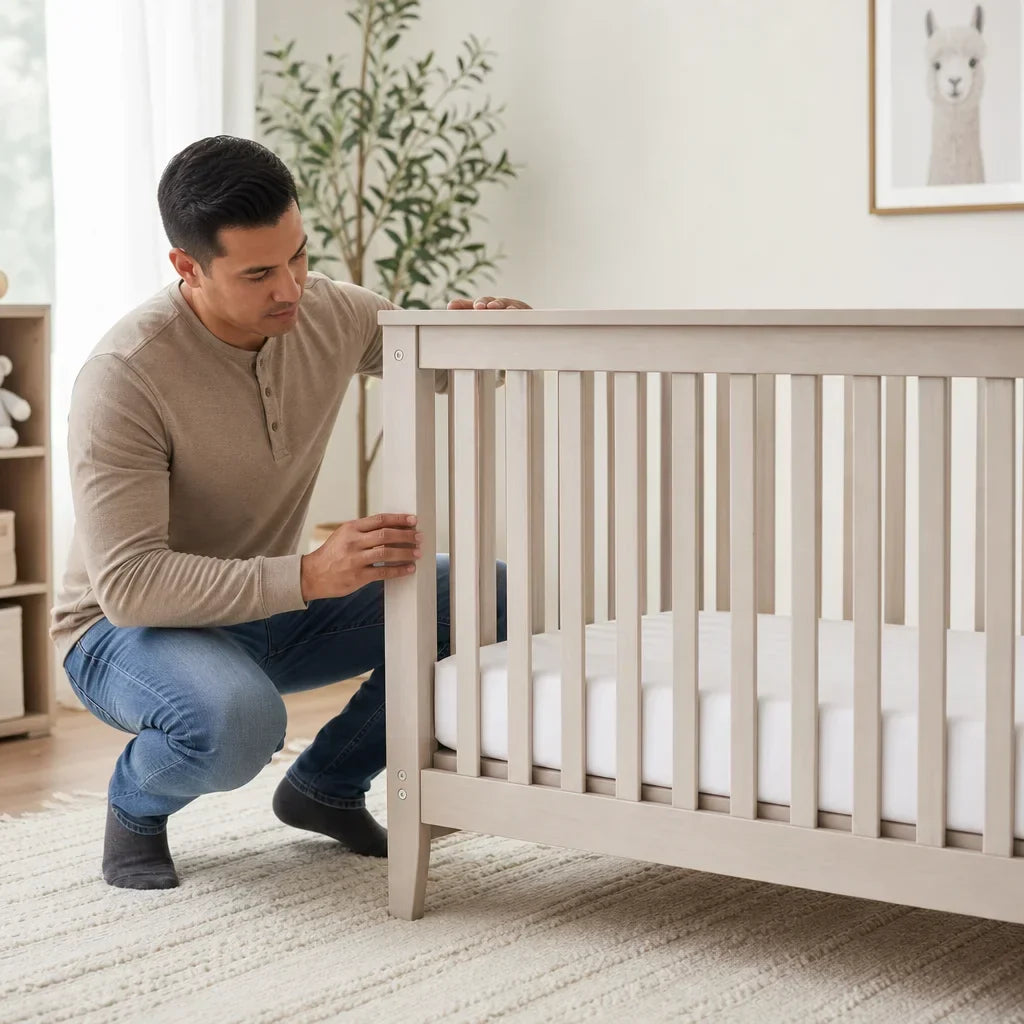
The prettiest crib is not always the right crib. When parents ask us about things to consider when buying a crib, we tell them to start with safety, fit, and daily use, then compare style and price.
Quick answer: the most important things to consider when buying a crib
A good crib meets current applicable safety requirements in Canada, fits your room, works with a firm compatible mattress, and suits how your family will actually use it. That is the short answer to what to look for when buying a crib.
The fastest crib-buying checklist is this:
- Choose safety before colour or trend.
- Pick the right crib type for your space and routine.
- Check assembled dimensions, not just mattress size.
- Confirm a snug crib mattress fit.
- Look for sturdy construction and secure hardware.
- Prefer practical features, not feature overload.
- Set a realistic budget by value, not hype.
- Read the manual before assembly and before conversion.
Canadian shoppers will usually see Health Canada guidance, and may also see U.S. references like ASTM, CPSC, or AAP on product pages. Those can help with context, but safe setup, correct assembly, and proper mattress fit still matter just as much.
Start with safety: what makes a crib safe
A safe crib has a stable frame, fixed sides, secure hardware, and a firm mattress that fits properly. That is the core of any useful crib safety checklist.
A beautiful finish does not make a crib safe. Safe use depends on current applicable standards, correct assembly, no missing parts, and a sleep space kept clear of soft items.
The simplest inspection list is short and practical: no cracks, no rough edges, no loose parts, no wobble, and no hardware that looks stripped or partly installed. Those are concrete signs to stop and recheck the manual before use.
The items to keep out of the crib are the same ones that create soft bedding or entrapment risks: pillows, quilts, loose blankets, crib bumpers, stuffed toys, sleep positioners, and loose accessories. If parents ask what should I avoid in a baby crib, that is the list we give first.
The four big categories that should not be in the crib are soft bedding, padded accessories, toys, and anything loose enough to shift around baby. That answers the common search about what are four things that should not be in a crib without overcomplicating it.
Safety standards and certifications to look for in Canada
The first thing to look for is compliance with current applicable crib requirements for products sold in Canada. Optional labels and certifications can be helpful, but they do not replace proper assembly or safe sleep setup.
Health Canada crib safety guidance matters most for Canadian families because it speaks to the Canadian market and safe sleep use. Product pages may also mention ASTM, CPSC, or JPMA, which are commonly referenced in North America as manufacturing or certification benchmarks.
Third-party labels like GREENGUARD Gold can be useful as low-emission signals when a brand provides them, but they do not make a crib automatically safe on their own. A crib still needs correct hardware, a proper mattress fit, and safe placement in the room.
The best wording to trust on a product page is specific wording about meeting current applicable standards, tested materials, or documented certifications. Broad claims like “safest cribs” mean very little without those details.
Crib types compared: standard, convertible, mini, portable, and play yard

The right crib type depends on room size, how long you want to use it, and whether portability matters. That is what to consider when buying a baby crib before you compare finishes.
A standard crib is usually the simplest long-term choice because it is made for everyday nursery use and works well for families who want a straightforward setup. It tends to be easier to match with dressers and full nursery furniture sets too.
A convertible crib can offer better long-term value if you plan to keep the furniture for years and want the room to evolve. The tradeoff is a higher upfront cost and the need to think ahead about rails or conversion kits.
A mini crib suits smaller bedrooms, condos, and room-sharing setups where every inch counts. The tradeoff is shorter usable life and more care needed around exact mattress compatibility.
A portable crib is useful when mobility matters, such as moving sleep space between rooms or setting up for occasional travel. It is not the same product as a standard nursery crib, so parents should check how the manufacturer describes intended use.
A play yard may appear in the same comparison shopping path, but it should not be treated as interchangeable with every crib product without checking the manufacturer instructions and current Canadian guidance. That matters when parents see mixed advice online.
Crib type comparison table
| Type | Best for | Room size | Lifespan | Portability | Pros | Tradeoffs | Budget tier |
|---|---|---|---|---|---|---|---|
| Standard crib | Everyday nursery use | Medium to larger rooms | Longer nursery use | Low | Simple, sturdy, easy to shop for | Takes more floor space | Budget to mid-range |
| Convertible crib | Families planning long-term use | Medium to larger rooms | Longer use across stages | Low | Better long-term value, coordinated look | Higher upfront cost, conversion parts may be separate | Mid-range to premium |
| Mini crib | Condos, small bedrooms, room sharing | Small rooms | Shorter use | Low to medium | Compact footprint | Outgrown sooner, mattress fit matters more | Budget to mid-range |
| Portable crib | Flexible or occasional room-to-room use | Small to medium rooms | Varies by model | High | Easier to move or store | Less furniture-like, check intended use | Budget to mid-range |
| Play yard | Secondary sleep/travel use | Small spaces | Varies by model | High | Multi-use, travel-friendly | Not a direct substitute for every nursery crib decision | Budget to mid-range |
Crib vs bassinet: which should you buy first?
A bassinet is usually about early convenience and room sharing, while a crib is usually about longer value. That is the plain answer to crib vs bassinet.
Parents who want a compact bedside setup for the first stage often start with a bassinet, then move to a crib later based on the product’s own weight, height, or mobility limits. Those limits are manufacturer-specific, so we would not treat one online age estimate as universal.
Parents who want one main sleep purchase from day one often choose a crib immediately, especially if they already have the nursery space or plan to room share with a crib setup. That can be the simpler path if you want to avoid buying two separate sleep products.
The better choice depends on bedroom space, whether you want a staged setup, and how soon you want the nursery ready. If you are asking should I buy a crib or a bassinet first, start with your room layout and routine, not trends.
How to measure your space before buying a crib
Measure the room first, then shop. That one step prevents a lot of crib returns and a lot of awkward nursery layouts.
Start with wall length and usable floor area, then note baseboards, radiators, heaters, vents, and low windows. Those fixed room details affect where the crib can actually sit.
Measure the assembled crib footprint, not just the mattress size shown in a product title. The outer frame, leg design, and any attached drawers can change the real floor space needed.
Check the full delivery path too: doorway width, hall turns, stair clearance, elevator space, and tight condo entries. That matters in Toronto and GTA homes where room access can be tighter than the nursery itself.
Keep the crib away from window coverings, reachable cords, heaters, shelves, and nearby furniture a child could use for climbing. The goal is safe access around the crib, not wedging it into the only open corner.
Room measuring checklist
- Measure wall-to-wall usable space.
- Note baseboards, heaters, vents, and radiators.
- Check window reach and blind cord hazards.
- Measure the crib’s assembled exterior dimensions.
- Leave walking space for caregiver access.
- Check door swing and closet clearance.
- Measure hallways, stairs, and elevators if needed.
- Avoid placing the crib near climbable furniture.
Crib mattress fit, firmness, and what to buy with the crib

Many cribs do not come with a mattress, so parents should always check the product listing before they order. That is one of the most missed details in online crib shopping.
A safe crib mattress fit is snug, firm, and matched to the crib model or compatible size listed by the manufacturer. If the mattress shifts easily, leaves visible gaps, or makes the fitted sheet bunch, stop and recheck compatibility.
A crib mattress should be chosen for fit first, then for material and cover features. Foam, innerspring, waterproof covers, and removable covers can all be reasonable options if the mattress is firm and made for that crib size.
A fitted sheet should be made for that exact mattress size and sit flat without loose fabric. If the sheet wrinkles heavily or pulls the mattress upward at the corners, that is a fit problem, not a style issue.
The best add-ons to buy with a crib are the essentials you know you need: a compatible mattress, properly sized fitted sheets, and any conversion kit required for a future stage. That is a better use of budget than loading up on decorative accessories.
Best crib materials and finishes for safety and durability
Good crib materials are the ones that stay sturdy over time, use well-finished surfaces, and come with clear product information. That is what makes for a good crib from a durability standpoint.
Solid wood is popular because it can feel sturdy and hold up well, but build quality still matters more than wood species alone. A poorly built solid wood crib can be a worse choice than a well-made crib using mixed materials.
Engineered wood can be a practical value option when the construction is sound and the finish is smooth and durable. Parents should look at hardware quality, joinery, and overall stability, not just the material label.
Metal cribs can work well too if the frame is stable and the finish is smooth with no chips or sharp points. The right answer is not wood versus metal. It is quality versus weak construction.
For families focused on a non-toxic crib, look for specific material details, low-emission claims where documented, and third-party testing information where a brand provides it. We would not assume one species, one finish, or one buzzword is automatically safer than another without product-level proof.
Features worth paying for and features you can skip
The features worth paying for are the ones that improve safety, daily use, or long-term value. Everything else is optional.
Adjustable mattress height is one of the most useful features because it affects both caregiver comfort and safe setup as baby becomes more mobile. Higher settings can make newborn care easier when the manufacturer allows them, but the mattress must be lowered as mobility changes.
Conversion capability is worth paying for if you expect to keep the furniture for years and want a consistent room design. It is less valuable if you expect to move soon, switch styles later, or prefer a simpler lower-cost crib now.
Teething rails can help protect the crib edge from bite wear on models that include them, which can matter for durability. They are a nice feature, not the first feature to chase.
Wheels can help in specific homes where you truly need to reposition the crib for cleaning or room use, but locking hardware and overall stability matter more than mobility. That is why best cribs with wheels is a niche answer, not a universal one.
Built-in drawers or attached changers can save floor space in some nurseries, but they can also add bulk and reduce layout flexibility. In small rooms, a separate dresser may actually make the room easier to use.
Feature value table
| Feature | Worth it when | Skip it when | Main tradeoff |
|---|---|---|---|
| Adjustable mattress heights | You want easier newborn access and safer progression later | Rarely a skip if available | None, if used correctly |
| Convertible design | You want longer use and coordinated furniture | You want the lowest upfront cost | Higher price, future parts |
| Wheels | You truly need to move the crib | The crib will stay in one place | Stability matters more |
| Under-crib storage | You need extra nursery storage | Room flow matters more than built-ins | Added bulk |
| Attached changer | You want a compact all-in-one setup | You want flexible room layout | Larger footprint |
| Teething rails | You care about finish protection | Budget is tight | Smaller value add |
Is a convertible crib worth it?
A convertible crib is worth it when you want longer furniture life and are comfortable paying more upfront. That is the honest answer.
The value comes from extending use beyond the crib stage and keeping a coordinated look in the room. Families who plan ahead often like that the furniture can grow with the child.
The tradeoffs are real: convertible models usually cost more at the start, take more floor space, and may need separate rails or conversion kits later. Missing that future parts step is one of the most common buying mistakes.
If you know you want a convertible model, buying the conversion kit early can be smart when the finish or hardware may be harder to match later. Parents should confirm that on the product page or with the retailer before assuming it is included.
A standard crib can still be the better value if your priority is a safe, durable crib at a lower upfront spend. We tell families to compare total use, total room impact, and future parts, not just the word “convertible.”
Buying new vs used crib: how to decide safely

Buying new is usually the simpler, lower-risk choice because the condition, instructions, parts, and current product details are clearer. That matters a lot with furniture used for infant sleep.
A used crib can still be considered, but only if you can verify the model, inspect the condition carefully, and confirm that no parts are missing or altered. A cheap price is not enough.
If you are checking a secondhand crib, inspect the frame for cracks, instability, rough edges, damaged finish, missing hardware, and any DIY repairs. Any repair that changes original parts is a stop sign.
A used crib should also come with a model number, manual if possible, and clear answers on where it was purchased, whether any parts were replaced, and how it was stored. Damp storage and mystery parts are both reasons to walk away.
Parents should be especially cautious with older hand-me-downs that have no paperwork and no clear brand or model details. If you cannot verify what it is, you cannot verify whether it is still appropriate to use.
For recall checks, use official Canadian recall resources and the manufacturer’s own recall information for the exact model. That is the safest way to answer how do I know if a crib has been recalled.
New vs used crib checklist
If buying new:
- Confirm current product specs.
- Check what is included.
- Read mattress compatibility details.
- Save the manual and purchase record.
If buying used:
- Get the model number and brand.
- Ask for the manual or assembly instructions.
- Confirm all hardware is present.
- Check for cracks, wobble, paint damage, or repairs.
- Ask whether any parts were replaced.
- Ask how and where it was stored.
- Check official recall sources before use.
How to shop for a crib online without making a mistake

The safest way to shop online is to read the specs like a checklist, not like a photo gallery. A crib photo shows style. The spec sheet shows whether it will work in your home.
Check assembled dimensions, mattress compatibility, included parts, conversion kit availability, finish name, material details, and assembly requirements before you place the order. Those details affect both safety and total cost.
Zoom in on product photos and look at slat spacing, hardware quality, finish consistency, and the mattress support design. That can tell you a lot about build quality before the box arrives.
If the manual or downloadable spec sheet is available, read it before buying. That is often where families catch key details like separate conversion parts or special mattress requirements.
Large furniture orders also need delivery planning. For Canadian shoppers, that means checking shipping areas, condo delivery limitations, room-of-choice details, and whether assembly is your job after delivery.
If you are choosing between two or three models, compare them side by side on dimensions, features, and included parts. That is one of the simplest tips for buying a crib in Canada without getting lost in marketing language.
How much should you spend on a baby crib?
You should spend enough to get a safe, sturdy crib that fits your room and your plan, not enough to impress the internet. That is the budget answer most parents actually need.
A practical crib budget usually works best in tiers: entry-level for basic function, mid-range for better materials or design, and premium for upgraded finishes, larger furniture presence, or broader conversion options. That is more useful than pretending there is one perfect number.
Price is usually driven by materials, construction, finish quality, brand positioning, conversion capability, and whether key parts are included. A higher price does not automatically mean better daily value.
A good-quality crib does not have to be the most expensive option. For many families, the sweet spot is the model that gets the safety basics right, feels sturdy, fits the room, and does not force extra purchases they do not need.
If you are comparing cost, compare the full package: crib, mattress, fitted sheets, delivery, and any conversion kit. That is the real answer to how much should you spend on a baby crib.
Budget tier breakdown
| Tier | What you usually get | Best for |
|---|---|---|
| Entry-level | Basic safe crib design, fewer extras, simpler finishes | Budget-focused families |
| Mid-range | Better finish options, stronger furniture feel, more style choice | Most families balancing quality and cost |
| Premium | Higher-end materials, stronger design presence, more conversion or matching options | Long-term furniture planners |
When should you buy a crib during pregnancy?
The practical time to buy a crib is when you still have room for delivery delays, assembly, and mattress shopping. Leaving it to the last minute creates stress you do not need.
For many families, the second trimester into the early third trimester is a comfortable planning window . That gives time to compare models, prepare the room, and handle stock or delivery issues without rushing.
Buying earlier is not automatically too early if you are spreading out costs, shopping a sale, or planning a nursery renovation. If someone asks whether 18 weeks or 22 weeks is too early, the honest answer is no, not if the purchase fits your budget and storage plan.
The main reason not to wait too long is simple: large furniture can face backorders, shipping delays, and assembly bottlenecks. A crib is easier to choose calmly than under deadline pressure.
Mattress height changes, crib longevity, and when to transition
Adjustable mattress height matters because it affects both caregiver comfort and safe use as baby develops. It is one of the most practical crib features to compare.
Many cribs offer more than one mattress position, but the exact number depends on the model and manufacturer. Parents should check the product page and manual rather than assuming every crib works the same way.
The highest approved mattress setting is generally for the earliest stage only, when the manufacturer allows it. Once a baby becomes more mobile, the mattress should be lowered according to the crib manual.
The signs that it is time to lower the mattress are not based on a trendy rule name. They are based on real developmental changes like pushing up, pulling up, standing, or climbing attempts, plus the manufacturer’s stated limits.
Babies outgrow a crib based on the crib’s own limits and the child’s development, not one internet age target. If you want the exact timing for your crib, the manual is the source that counts.
Crib placement and safe nursery setup
A crib should be placed where the sleep space stays clear of cords, windows, heaters, shelves, and climbable furniture. Safe placement is about reducing nearby hazards and giving caregivers proper access.
The reason parents hear warnings about placing a crib against a wall is usually not the wall by itself. The real issue is avoiding awkward gaps, trapped cords, nearby hazards, or setups that make access and monitoring harder.
A safe nursery setup keeps the crib on a stable floor surface, away from hanging decor within reach, and with enough clearance for an adult to lift baby in and out comfortably. Good placement makes daily care easier and safer.
For room-sharing in smaller spaces, prioritize a clear path to the crib and keep bedside furniture from crowding it. That matters as much in a condo bedroom as it does in a full nursery.
Safe nursery setup checklist
- Keep the crib away from windows and blind cords.
- Avoid heaters, radiators, and shelves overhead.
- Do not place climbable furniture right beside the crib.
- Leave enough access space for daily lifting and care.
- Keep hanging decor out of reach.
- Recheck hardware after assembly and moves.
Common crib-buying mistakes and simple troubleshooting
The most common mistake is buying for looks first and function second. That is how families end up with a crib that does not fit the room, the mattress, or their routine.
Other frequent mistakes are forgetting mattress compatibility, skipping the delivery-path measurement, assuming a conversion kit is included, and buying used without model documentation. Each of those can cost more later than checking once at the start.
If a fitted sheet looks loose, the answer is not to tuck it harder. Stop and check whether the sheet and mattress are the correct size for that crib setup.
If the crib squeaks, wobbles, or feels uneven after assembly, stop using it until you recheck the hardware and the manual. A structural concern is never a “good enough for now” issue.
If hardware is missing, damaged, or substituted with something from a hardware store, do not improvise. Use only the correct parts from the manufacturer or confirmed replacement source.
How to choose the right crib for your family: a final decision checklist
The best way to choose is to narrow your options to 2 to 3 cribs and compare them on safety, room fit, mattress compatibility, usability, and total value. That turns a huge category into a manageable decision.
For a condo family, a mini crib or a compact standard model may make the most sense because floor space and delivery access are tight. For value-focused first-time parents, a simple sturdy standard crib may beat a feature-heavy model.
For grandparents setting up a second nursery, ease of use, straightforward assembly, and room layout may matter more than conversion. For families planning long-term furniture use, a convertible crib can be worth the larger upfront spend.
Final decision checklist
- Does it meet current applicable standards for Canada?
- Does the frame feel sturdy and well finished?
- Does the crib type match your room and routine?
- Have you checked the assembled exterior dimensions?
- Have you confirmed compatible mattress sizing?
- Are the useful features worth the extra cost?
- Do you need the conversion kit now?
- Have you checked the full delivery path into the room?
- Are you comparing 2 to 3 final options side by side?
If you want to compare crib sizes, finishes, and nursery layouts in real space, it helps to see them in person or talk them through with someone who knows the product details. A showroom visit or virtual consultation can make the short list much easier, especially for small rooms and shared spaces.
FAQ
What should I look for when buying a crib?
Look for current applicable safety compliance, sturdy construction, fixed sides, secure hardware, proper mattress compatibility, and dimensions that fit your room. Style matters after those basics.
What crib features are most important?
The most useful features are adjustable mattress heights, sturdy mattress support, and conversion capability if you truly plan to use it later. Extra storage and wheels are more situational.
What should I avoid in a baby crib?
Avoid soft bedding, pillows, loose blankets, crib bumpers, stuffed toys, sleep positioners, and any loose accessories in the sleep space.
How much should you spend on a baby crib?
Spend enough for safety, stability, and fit. Entry-level, mid-range, and premium tiers are more useful than chasing one “correct” price.
Should I buy a convertible crib?
Buy one if you want longer-term furniture use and are comfortable with the larger upfront cost and future conversion parts. Skip it if your priority is lower cost and simpler setup.
Should I buy a crib or a bassinet first?
Buy a bassinet first if you want compact early room sharing. Buy a crib first if you want one main sleep setup with longer value.
Is it safe to buy a secondhand crib?
It can be, but only if you can verify the model, inspect the condition, confirm all original parts, and check recall information. New is usually simpler and lower risk.
Do cribs come with a mattress?
Many do not. Always check the product listing to see what is included before ordering.
When should you buy a crib during pregnancy?
A practical planning window is the second trimester into the early third trimester , but earlier can still make sense if you are budgeting gradually or preparing the room.
When should I lower the crib mattress?
Lower it when your baby becomes more mobile, according to the crib manufacturer’s instructions. Do not rely on a generic internet milestone over the manual.
When do babies outgrow a crib?
They outgrow it based on the crib’s own limits and the child’s mobility and size. Check the manual for the exact rule for your model.
Why can't you put a crib against a wall?
The concern is usually not the wall alone. The concern is nearby hazards, awkward gaps, poor access, and unsafe placement near cords, windows, heaters, or furniture.
What is the 90 minute crib rule?
That term is not a standard crib-buying or crib-safety rule in this context. If you saw it online, treat it carefully and check whether it refers to a specific sleep-training method rather than crib safety.
What is the crib 45 method?
That is not a standard crib selection or safety standard. It sounds like an online routine or parenting method, not a product-buying rule.
What is the 3 6 9 rule for babies?
That is outside the scope of crib buying and is not a crib safety standard. For this page, the better focus is product safety, mattress fit, room setup, and manufacturer instructions.


