

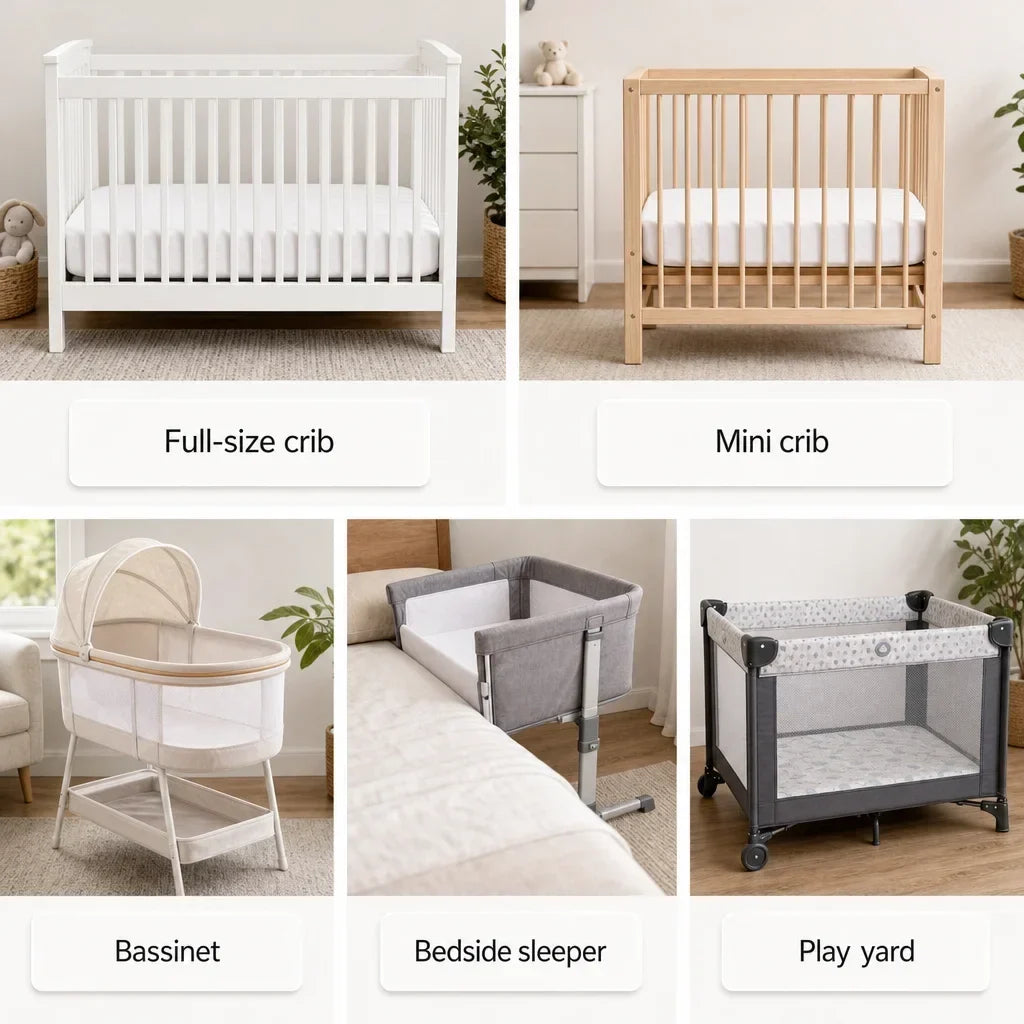
The best cribs for newborns are not always the most expensive or decorative. The right choice is a separate sleep space with a firm, flat surface, a correctly fitted mattress, and a setup that follows the product manual and current Canadian safe-sleep guidance.
Quick Answer: The Best Newborn Bed Depends on Where and How You Will Use It
A full-size crib is usually the best infant bed when you want one nursery sleep space for the longest practical use. A convertible crib can add later bed stages if the required rails and conversion kits remain available. A mini crib suits a compact nursery, condo, shared room, or grandparents’ home. A bassinet or bedside sleeper can suit short-term room sharing only when it is marketed for infant sleep in Canada and used within its own manufacturer limits.
The safest baby cribs are safe because of their complete setup, not their price tag. Health Canada advises placing babies on their backs on a firm, flat sleep surface and keeping the sleep area free of pillows, loose blankets, bumper pads, and soft toys. <https://www.canada.ca/en/public-health/services/publications/healthy-living/safe-sleep-your-baby.html>
A bedside sleeper is not the same as bed sharing. Room sharing means the baby sleeps in the same room in a separate approved sleep space, while bed sharing means the baby sleeps on an adult sleep surface. The Canadian Paediatric Society recommends room sharing for the first 6 months. <https://cps.ca/en/documents/position/reducing-the-risk-of-sudden-infant-death-syndrome>
Best Cribs for Newborns by Situation
The best baby crib for a newborn is the one that fits your room, mattress, budget, and intended use without shortcuts. Rather than treating one model as universally best, compare current crib inventory by the job it needs to do. Product specifications, finishes, included parts, and availability can change, so confirm the product page and manufacturer manual before ordering.
Best overall long-term nursery choice: Full-size crib
A full-size crib is the practical choice for families building a dedicated nursery and expecting to use the crib beyond the newborn stage. It gives the child more sleeping space than a compact crib, but you still need to measure the wall, door swing, dresser clearance, hallway, and elevator before delivery.
Browse the current [all baby cribs collection](/collections/cribs) and confirm the mattress model specified by the manufacturer before adding a crib to your cart. A crib frame and a mattress are one sleep system, not two separate style purchases.
Best convertible crib: Families planning for later bed stages
A convertible crib can become a toddler bed, daybed, or full-size bed only if that exact model supports those stages. Some conversion rails are included, while others are separate purchases, and a full-size conversion may require a separate kit and mattress. Check each model’s conversion chart before you buy.
The best convertible cribs make sense when you value a consistent furniture style, documented replacement-part availability, and a conversion path you expect to use. They are not automatic value if you will move soon, need a smaller footprint, or do not plan to use the later stages.
See current options in the [convertible cribs collection](/collections/convertible-cribs), then confirm whether the toddler rail or full-size bed kit is included or sold separately. That one detail can change the total ownership cost substantially.
Best for a small nursery: Mini crib
A mini crib is the better fit when floor space is tight and a full-size crib would block storage, walking space, or the nursery door. It still requires the exact mini crib mattress specified for that frame, plus a fitted sheet made for that mattress.
A mini crib becomes too small when your child reaches the manufacturer’s stated limit or reaches a developmental milestone that ends use under the manual. Do not rely on a generic age limit, because child size, mobility, mattress height, and product instructions differ by crib.
The [mini cribs collection](/collections/mini-cribs) is a useful starting point for condo nurseries, room-sharing setups, and occasional overnight spaces. Measure the assembled crib footprint, not just the mattress dimensions shown online.
Best for grandparents’ homes or occasional sleepovers: Compact sleep space
A compact crib or purpose-built portable sleep product can work well for occasional overnight use when it is intended for infant sleep and assembled exactly as directed. A folding product is not automatically suitable for every sleep stage, so follow the product manual rather than choosing solely by portability.
A bassinet may be convenient near the caregiver’s bed, but it is usually a short-term solution because every bassinet has its own weight, age, movement, and developmental limits. Stop using it when the manufacturer says to stop, even if it still fits the room.
Side-by-Side Newborn Sleep Space Comparison
| Sleep space | Best for | Main advantage | Main trade-off | Mattress requirement | What to confirm before buying |
|---|---|---|---|---|---|
| Full-size crib | Dedicated nursery and longer use | Largest long-term nursery option | Requires more floor space | Exact crib mattress specified by the manufacturer | Exterior dimensions, delivery path, mattress compatibility |
| Convertible crib | Families considering later bed stages | May convert beyond the crib stage | Rails or kits may cost extra | Exact crib mattress at the crib stage | Conversion path, included parts, kit availability |
| Mini crib | Small nursery, condo, shared room | Smaller footprint | May need an earlier transition | Exact mini crib mattress specified by the manufacturer | Mattress size, use limits, room access |
| Bassinet | Short-term room sharing | Easy bedside placement | Product-specific limits can end use quickly | Only the supplied or approved sleep pad | Sleep approval, limits, replacement parts |
| Bedside sleeper | Room sharing with a separate sleep surface | Close caregiver access | Must never be treated as adult-bed sharing | Only the manufacturer-approved mattress or pad | Canadian intended use, attachment instructions, limits |
| Play yard | Travel or portable use | Folds for transport | Not every accessory is approved for sleep | Use only sleep surface supplied for approved sleep use | Canadian instructions and approved sleep configuration |
Exterior crib measurements do not tell you whether the product will reach the nursery. Check the doorway width, condominium elevator, turns in the hall, parking access, and the delivery route before ordering.
Crib vs Bassinet vs Mini Crib vs Bedside Sleeper vs Play Yard
Choose a full-size crib when you need one primary nursery sleep space and have room for it. This is usually the simplest path because you avoid an early product transition from a smaller sleep space to a crib.
Choose a mini crib when the nursery must share space with a bed, desk, dresser, or changing station. The right mini crib is still a crib used with its exact compatible mattress, not a workaround using extra padding or an undersized mattress.
Choose a bassinet or bedside sleeper when short-term room-sharing convenience is the priority. Health Canada’s safe-sleep guidance supports a separate, firm, flat sleep surface and does not support improvised sleep arrangements on adult beds, sofas, chairs, or soft surfaces. <https://www.canada.ca/en/public-health/services/publications/healthy-living/safe-sleep-your-baby.html>
Choose a play yard for travel only when the manufacturer identifies the exact configuration as suitable for sleep in Canada. Accessories can have different instructions from the main play yard, so read the manual for the specific bassinet insert, mattress, and level being used.
Newborn Crib Safety: Non-Negotiables Before Style or Price

A newborn sleep space needs a firm, flat mattress or sleep surface with a fitted sheet designed for that exact product. Health Canada advises against loose bedding, pillows, quilts, comforters, stuffed toys, bumper pads, and other soft items in the baby’s sleep area. <https://www.canada.ca/en/public-health/services/publications/healthy-living/safe-sleep-your-baby.html>
Correct assembly matters as much as the crib design. Use every supplied fastener, follow the manual in order, keep the instructions, and inspect hardware as directed by the manufacturer. Do not drill, modify, repair with substitute parts, or add aftermarket attachments to a crib.
A crib mattress must fit the exact crib model as instructed by its manufacturer. Never fill a gap with towels, foam, rolled blankets, mattress toppers, or homemade inserts, because those additions change the intended sleep surface.
GREENGUARD Gold certification can be relevant when a specific crib has documented lower chemical-emissions certification. It does not replace Canadian product compliance, correct assembly, proper mattress fit, or safe-sleep practices.
Avoid used cribs with missing hardware, missing manuals, damaged mattress supports, altered parts, or an unknown recall history. Health Canada maintains a recall database where families can search children’s products before using or buying them second-hand. <https://recalls-rappels.canada.ca/en>
This guide is general furniture and product information, not medical advice. Speak with a qualified healthcare provider about your baby’s individual health or sleep questions, and use Health Canada and Canadian Paediatric Society guidance for current safe-sleep information.
How to Choose the Right Crib Size and Mattress

A full-size crib provides more nursery sleeping space, while a mini crib reduces the footprint in smaller rooms. Neither is safer simply because of its size; safe use comes from choosing the compatible mattress, assembling the frame correctly, and following the model’s instructions.
Measure the nursery before shopping. Record the available wall length, door swing, closet clearance, dresser depth, window access, outlet location, and space needed for an adult to reach the crib comfortably.
Confirm five details before buying a crib mattress: the crib make and model, the approved mattress size, mattress firmness, the matching fitted sheet, and the manufacturer’s installation instructions. The [crib mattresses collection](/collections/crib-mattresses) can help you compare compatible options alongside your crib selection.
A mattress cannot prevent SIDS. The safer approach is a complete sleep setup that follows authoritative guidance: back sleeping, a firm flat surface, a fitted sheet, and an empty sleep area. <https://cps.ca/en/documents/position/reducing-the-risk-of-sudden-infant-death-syndrome>
Are Convertible Cribs Worth It? Calculate the Real Long-Term Value

A convertible crib is worth considering when its later stages match your likely furniture plan and its conversion parts are available. The conversion path may include crib-to-toddler bed, crib-to-daybed, or crib-to-full-size bed, but each model has its own documented options.
Compare the full cost, not only the crib price. Add the crib, compatible mattress, toddler rail, full-size conversion kit, replacement parts, delivery, and any assembly service before deciding which option is better value.
A simpler crib can be the stronger budget pick when you need a compact footprint, expect to move, or do not expect to use later conversion stages. A higher-priced convertible can make more sense when durable construction, coordinated furniture, documented materials, and future conversion parts matter to your plan.
Check conversion-kit availability when you buy the crib, even if you do not purchase the kit immediately. A future conversion is only useful if the compatible rail or hardware remains available when you need it.
Materials, Certifications, Assembly and Everyday Usability
Material labels should tell you what the crib is made from and how to care for it. Compare solid wood and engineered-wood components, finish disclosures, manufacturer care instructions, and documented certifications instead of relying on vague labels such as “eco-friendly.”
A non-toxic crib claim should be supported by manufacturer documentation for that product. If a crib has GREENGUARD Gold, FSC, low-emissions, or finish information, read the product documentation to understand exactly what the certification or claim covers.
Assemble the crib before the baby arrives, while you have time to check each part against the manual. Two adults may make large furniture assembly easier, but follow the manufacturer’s instructions for the specific crib rather than assuming every model needs the same tools or process.
Tall caregivers should assess rail height, mattress-height adjustment, and reach before ordering where possible. An in-person visit can help you compare crib scale and access more accurately than product photos alone.
Best Crib Buying Checklist for Toronto and Canadian Families
Use this checklist before placing an order for baby furniture in Toronto or anywhere in Canada:
- Measure the nursery wall, doorway, hallway, elevator, and delivery path.
- Choose the sleep-space category before choosing colour or style.
- Confirm the crib’s compatible mattress and fitted-sheet requirements.
- Review the manufacturer’s assembly instructions and safety warnings.
- Check whether a convertible crib’s rails or kits are included or separate.
- Search Health Canada’s recall database before buying second-hand furniture. <https://recalls-rappels.canada.ca/en>
- Keep the manual, proof of purchase, and product registration information where applicable.
Toronto and GTA families should also plan for condominium elevators, loading areas, narrow entries, and room dimensions. Seeing a crib in person can help you judge finish, drawer quality, rail height, and overall scale before ordering.
Baby Warehouse has served families since 1995 and offers a Toronto showroom, virtual consultations, and Canada-wide delivery options subject to the current shipping policy. Confirm service to your postal code, delivery access, and current product availability before ordering.
Explore [nursery furniture sets](/collections/nursery-furniture-sets), [baby dressers and changing tables](/collections/dressers-changing-tables), and [kids beds](/collections/kids-beds) when you are planning the full room rather than the crib alone.
Frequently Asked Questions About Newborn Beds and Cribs
What is the best bed for a newborn?
The best bed for a newborn is a separate approved sleep space with a firm, flat surface, a properly fitted sheet, and no loose bedding or soft objects. A full-size crib works well for a dedicated nursery, while a bassinet, mini crib, or bedside sleeper may suit different space and room-sharing needs when used according to its manual. <https://www.canada.ca/en/public-health/services/publications/healthy-living/safe-sleep-your-baby.html>
What is the safest bed for a newborn?
The safest setup is not a particular brand or price point. It is an intact, correctly assembled product intended for infant sleep, used with the specified mattress, a fitted sheet, and an empty sleep area.
Should a newborn sleep in a crib or bassinet?
Either can be suitable when it is intended for infant sleep and used within its product instructions. A crib usually offers a longer-term nursery solution, while a bassinet is commonly chosen for short-term room sharing and must be retired when its manufacturer limits are reached.
What type of bed is best for newborns?
A crib, bassinet, mini crib, or approved bedside sleeper can suit a newborn if it provides a separate firm, flat sleep surface and is used as directed. Adult beds, couches, recliners, nests, and improvised surfaces are not replacements for an approved infant sleep space. <https://www.canada.ca/en/public-health/services/publications/healthy-living/safe-sleep-your-baby.html>
What is the best mattress for a baby to prevent SIDS?
No mattress prevents SIDS. Choose the exact firm mattress specified or approved for the crib, use the fitted sheet intended for it, and follow current safe-sleep guidance from Health Canada and the Canadian Paediatric Society.
Why is SIDS highest at 2-4 months?
SIDS risk is concentrated in early infancy, including the period from 2 to 4 months, which is why consistent safe-sleep practices matter from the first day. This is a medical topic, so parents should use current guidance from the Canadian Paediatric Society and speak with a healthcare provider about personal concerns. <https://cps.ca/en/documents/position/reducing-the-risk-of-sudden-infant-death-syndrome>
At what age is SIDS no longer a risk?
SIDS is defined as the sudden unexpected death of an infant under 1 year of age. Safe-sleep guidance should be followed throughout the first year, and a healthcare provider can address questions about a specific child. <https://cps.ca/en/documents/position/reducing-the-risk-of-sudden-infant-death-syndrome>
What is the 5 8 5 rule for babies?
The “5 8 5 rule” is not a recognized Canadian safe-sleep recommendation from Health Canada or the Canadian Paediatric Society. It should not replace official guidance on back sleeping, a firm flat surface, and an empty sleep area.
Do I need a mini crib or a full-size crib?
Choose a mini crib when space is the main constraint and choose a full-size crib when you want the largest long-term nursery option. In both cases, use only the exact mattress type and dimensions specified for that crib.
Are convertible cribs worth it?
Convertible cribs can be worth it when the conversion stages match your plan and the required rails or kits are available. Compare the full purchase cost, including the crib, mattress, conversion parts, and delivery, before treating a convertible model as the better value.
What should I look for in a crib mattress?
Look for the mattress specified for the exact crib model, a firm sleep surface, compatible fitted sheets, and clear manufacturer instructions. Do not add toppers, gap fillers, extra padding, or a mattress that was not made for that crib.
Does GREENGUARD Gold certification matter for a crib?
GREENGUARD Gold may matter if indoor-air emissions are a priority and the specific crib has documented certification. It is one product-information factor, not a substitute for product compliance, correct assembly, mattress fit, or safe-sleep practices.
The best next step is to compare crib size, mattress compatibility, and conversion parts before you compare finishes. You can browse cribs online, book a virtual consultation, or visit the Toronto showroom to see scale and materials in person, then confirm delivery options for your Canadian postal code.


