

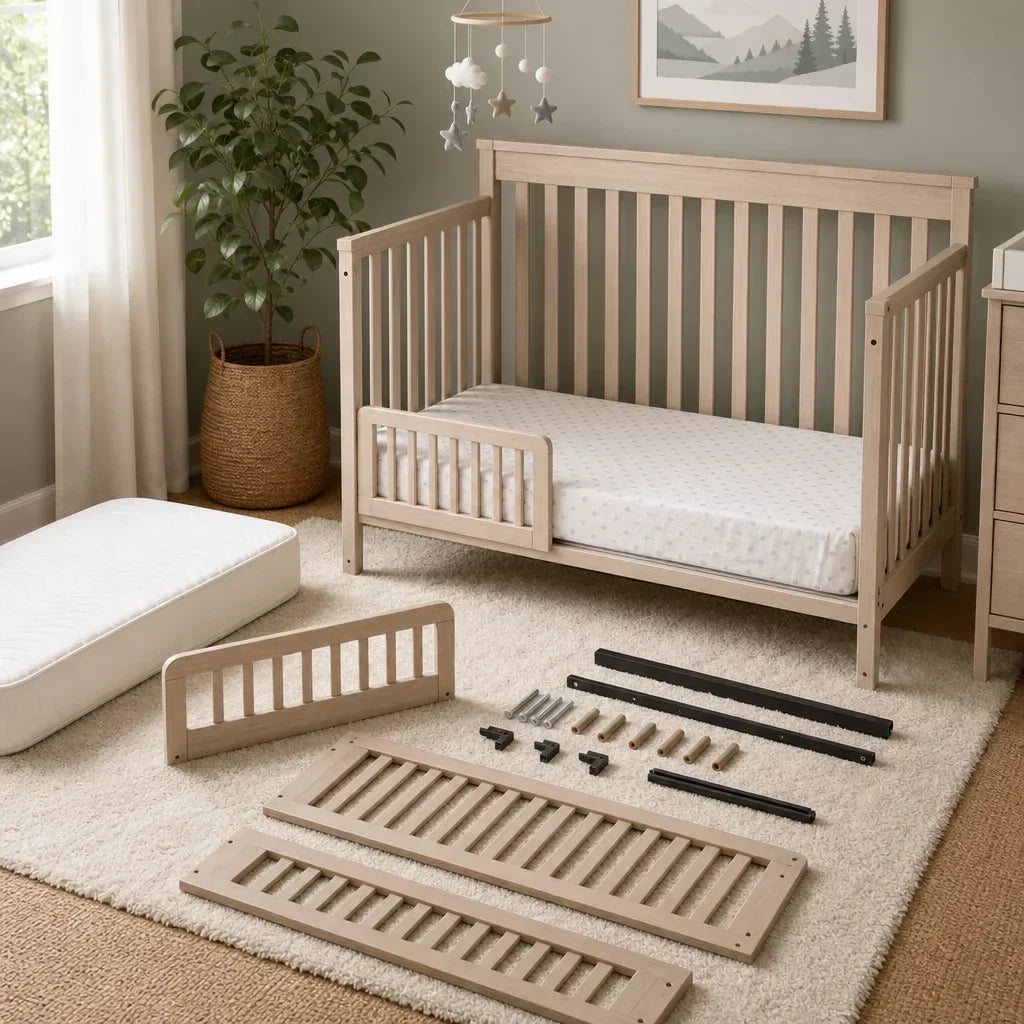
A convertible crib full size bed setup is only possible if the crib was built for that final stage. The same goes for a convertible crib to twin bed setup. The biggest mistake we see is assuming any crib can take a bigger mattress with a few rails. It cannot.
What this guide answers: can a convertible crib become a twin, full, or queen bed?
Many convertible cribs end as a toddler bed, daybed, or full bed, while some convert to twin and queen conversion is uncommon and model-specific. The final bed size depends on the crib's design, its original hardware points, and the matching kit made for that model.
A crib does not become a bigger bed by mattress swap alone. A crib mattress is not the same size as a twin, full, or queen mattress, and the frame needs the right rails, supports, and hardware to carry that larger sleep surface safely.
A 4-in-1 crib does not always mean the same thing across brands. In plain terms, one model may go crib to toddler to daybed to full bed, while another may stop at toddler or daybed unless a separate kit is offered.
The costliest mistakes are usually simple ones. Parents buy the wrong conversion kit, guess at model compatibility, or try unsupported DIY methods when the manual or original parts are missing.
What is a convertible crib, and what sizes can it become?
A convertible crib is a crib designed to change into later bed stages using manufacturer-approved parts. Those stages commonly include crib, toddler bed, daybed, and then a twin or full bed depending on the model.
A 3-in-1 crib usually covers three stages, while a 4-in-1 crib usually covers four stages. The exact stages are set by the manufacturer, not by the label alone, so a 4-in-1 can mean different final outcomes on different product lines.
A standard convertible crib is still a crib first, not a full-size bed in nursery form. When parents ask whether a convertible crib is a full-size crib, the plain answer is that it uses a crib mattress at the crib stage and may convert later to a larger bed size if the design allows it.
A mini crib may follow a different conversion path than a standard crib. In practice, a mini crib to twin bed path is more common than full-bed conversion, but it is still model-specific and needs the right kit.
Twin vs full vs queen: which conversion is actually possible?

Most standard convertible cribs are built to end at a full-size bed more often than a twin, while mini cribs are more likely to offer a twin conversion path. Queen conversion exists only on specific models where the manufacturer explicitly offers it.
Here is the practical comparison most parents need before ordering parts.
| Crib type | Common final bed size | Typical kit needed | Mattress change needed | Best use case |
|---|---|---|---|---|
| Standard convertible crib | Full-size bed more often than twin | Full-size bed conversion kit | Yes | Longer use in one bedroom |
| Standard convertible crib with twin option | Twin bed | Crib to twin bed conversion kit | Yes | Smaller rooms or simpler upgrade |
| Mini convertible crib | Twin bed more often than full | Convertible crib to twin bed conversion kit | Yes | Condo rooms and compact layouts |
| Select model-specific crib | Queen bed, uncommon | Manufacturer queen kit if offered | Yes | Only if the manual clearly allows it |
| Non-convertible crib | No larger bed conversion | None | Yes, with separate bed frame instead | Replace furniture later |
A full mattress measures 54 by 75 inches. A twin mattress measures 38 by 75 inches. A queen mattress measures 60 by 80 inches. Those size jumps are why the original crib mattress cannot be reused for a twin, full, or queen conversion.
The right choice usually comes down to room size, how long you want the furniture to last, and whether the room may later work for siblings or guests. A full bed takes more floor space than a twin, but it can stretch the useful life of the furniture.
Can you go straight from crib to twin or full-size bed?
Yes, some families can go straight from crib to twin or full-size bed if the crib model allows that stage and the child is ready for it. The manual has to lead that decision, because some designs expect a toddler or daybed stage first.
Many transitions happen between about 18 months and 3.5 years, but readiness matters more than the birthday. Climbing out, repeated attempts to escape, and the ability to understand simple sleep boundaries matter more than forcing a date on the calendar.
Skipping stages is not always the safest or easiest move. A bigger bed usually means lower containment, more room to roll, and a greater need for a fully childproofed room from day one.
A direct crib full bed conversion can make sense for families who want one long-term piece and have the space for it. A direct twin move can make more sense in smaller rooms where a lower-footprint setup is easier to manage.
How to identify your crib model and find the right conversion kit

The correct conversion kit must match the crib's brand, model number, and intended conversion stage. Collection name, finish, and hardware revision can matter too, especially on older or discontinued models.
The model number or SKU is usually found on a product label attached to the underside, back panel, mattress support area, or inside face of a crib component. It may also appear in the instruction manual, receipt, retailer order history, or original carton label.
A safe match check includes six points: brand, model number, manufacture date if shown, current setup, target setup, and whether any original hardware is missing.
A so-called universal full size bed conversion kit or crib to twin bed conversion kit should be treated carefully. Universal language does not mean every hole pattern, rail height, or support layout will fit every crib.
Buying the kit when you buy the crib is often the safest move if you already know your long-term plan. Styles change, finishes get discontinued, and older collections can become harder to match a few years later.
What parts you need for a crib-to-full or crib-to-twin conversion

Most conversions need more than side rails. Common parts include conversion rails, support slats or a support deck, a hardware pack, and the original headboard and footboard from the crib.
A toddler guard rail is not the same thing as a full size bed conversion kit. A guard rail usually helps convert the crib into a toddler bed by replacing one side safely, while a full or twin conversion kit is built to create a larger bed frame.
Some kits include bolts, brackets, and support pieces, while others include rails only. If the listing does not clearly include hardware or mattress support, assume you need to verify that before ordering.
A convertible crib full bed conversion may also require separate slats, a platform insert, or another support system depending on the brand. A convertible crib to twin bed conversion kit can have the same issue, especially on mini cribs and all-stages designs.
Conversion kit compatibility checklist

Use a written checklist before you order any kit. That step avoids most return headaches and almost all unsafe fit guesses.
- Confirm the exact brand and model number from the crib label.
- Confirm whether the crib is standard or mini.
- Confirm the target stage: toddler, daybed, twin, full, or queen if offered.
- Confirm finish name if visible parts need to match.
- Confirm whether hardware is included in the kit.
- Confirm whether slats, deck boards, or support rails are included.
- Confirm whether the manual allows direct conversion or requires an intermediate stage.
- Confirm the retailer or manufacturer return policy before opening parts.
Step-by-step: how to convert a crib to a full-size bed
A safe convertible crib into full size bed conversion starts with compatibility, not tools. Confirm that your exact crib model supports a full bed stage and that you have the matching rails, support parts, hardware, and manual before disassembly begins.
Most straightforward conversions take about 20 to 60 minutes once the correct parts are on hand. Two adults make the job easier, especially when aligning side rails and lifting larger panels into place.
Before you start, clear enough floor space to lay out the rails, hardware, and existing crib pieces without mixing parts. Keep the manual open, use the exact bolts listed for that stage, and stop if any hole pattern or rail length does not match the instructions.
- Remove the crib mattress and mattress support platform. Keep all original hardware sorted in small groups.
- Remove the front and side panels as directed by the manual. Some models reuse the headboard and footboard only.
- Attach the full-size conversion rails to the original crib ends using the exact hardware points provided by the manufacturer.
- Install any center support, slats, support deck, or brackets required for the mattress base.
- Tighten hardware fully, but only after the frame is square and all connections are started correctly.
- Place the full-size mattress on the approved support system, not directly on rails unless the manual says that support is built in.
- Check for wobble, gaps, protruding bolts, or missing support pieces before your child uses the bed.
Stop the conversion if rails feel short, holes do not line up, or the mattress support is not clearly defined. That usually means the wrong kit, a missing part, or a mismatch between model years.
Step-by-step: how to convert a crib to a twin bed

A turning a crib into a twin bed project needs an extra compatibility check because twin conversion is more model-specific than full conversion. The first thing to verify is whether the crib is a standard crib or a mini crib, because that changes the available kits and final setup.
The original crib mattress will not work for this stage because a twin mattress measures 38 by 75 inches. That length and width change is why a crib to twin bed conversion kit needs dedicated rails and support pieces rather than a simple side swap.
- Check the manual or manufacturer listing to confirm the crib can become a twin. If the manual does not show that stage, do not force it.
- Confirm the exact convertible crib to twin bed conversion kit for your model and finish. Avoid generic assumptions across similar-looking collections.
- Remove the crib mattress, platform, and any panels the manual says are not reused. Keep bolts separated by step.
- Attach the twin rails to the approved mounting points on the crib ends. Use only the hardware listed for that conversion stage.
- Install the required slats, support deck, or center supports before placing the mattress.
- Add the twin mattress and check that it sits level across the support system with no unsupported span.
- Shake the frame lightly to test for movement and recheck every fastener after the first few nights of use.
A twin size convertible crib setup is usually a good fit for smaller bedrooms because the mattress is narrower than a full. It is also a practical choice when families want to preserve floor space for play, a dresser, or a desk later on.
Mattress and support requirements: slats, platform, bunkie board, or box spring?

The support base depends on the conversion kit and bed design, not just on whether you are using a twin or full mattress. Some converted beds use slats, some use a platform-style support deck, and some need an added support board or other manufacturer-approved component.
A bunkie board is a low-profile support board used when extra mattress support is needed without the height of a box spring. A box spring is a taller foundation and may or may not be appropriate depending on the rail height, mattress height, and manual for that converted bed.
Do not place a mattress on a converted frame unless the support system is complete. Rails alone are not a sleeping surface, and an unsupported mattress can sag, shift, or create unsafe gaps.
If you are planning a crib full bed conversion, confirm whether the kit includes slats or center support. If you are planning a twin conversion, confirm whether the crib to twin bed conversion kit includes the full mattress base or only the visible side rails.
When should you transition out of the crib?
There is no single right age, but many crib-to-bed transitions happen between about 18 months and 3.5 years. The better guide is readiness: climbing out, repeated escape attempts, potty training needs, and whether your child understands simple bedtime limits.
A 2.5-year-old can still be in a crib if the setup is safe and the child is sleeping well. A 4-year-old can also still be in a crib in some cases, but climbing risk, height, and manufacturer limits need a close look. Your manual and product limits matter more than online opinions.
A toddler bed stage can feel easier for children who need a lower, more familiar setup. A twin or full-size move can make sense when the child adapts well to space, the room is fully childproofed, and the crib model supports that direct conversion.
Is a full-size bed too big for a toddler or preschooler?
A full-size bed is not automatically too big for a toddler, but the room setup matters more than the mattress width. A full bed gives more room for bedtime cuddles, longer use, and possible future guest use, but it takes more floor space than a twin.
For a toddler, the bigger concern is often height, open access, and how the rest of the room is secured. If the frame sits high or the child moves heavily in sleep, parents may prefer a lower setup or temporary rail support where the manufacturer allows it.
A full bed can work well for a 5-year-old if the room still has safe circulation space and anchored furniture. The bed size itself is less important than clear walking space, stable furniture, and no access to cords, windows, or climbing hazards.
Can a child sleep in a queen bed after a crib conversion?
A child can sleep in a separate queen bed, but that is different from a crib to queen size bed conversion. Most convertible cribs do not become queen beds, and a queen size convertible crib is not the standard product path most families will find.
If a manufacturer does not offer a queen conversion kit for that exact model, do not improvise one. A larger mattress does not create safe support, safe spacing, or safe rail attachment on its own.
A 3-year-old may sleep in a queen bed if the room is safe and the bed height is manageable, but that says nothing about whether the crib itself converts to queen. Those are two separate questions, and only the manual answers the conversion one.
Room safety after conversion: rails, baby-proofing, and setup tips

A converted bed works safely only inside a safe room. Once crib walls are gone, the whole bedroom becomes part of the sleep environment.
Anchor dressers and bookcases to the wall, cover outlets, secure blind cords, move climbing items away from windows, and keep the floor clear of hard trip hazards. Those steps matter whether you are turning crib into twin bed mode or moving to a full bed.
A temporary bed rail can help some children with the transition, but it is not a substitute for the proper conversion kit. The bed still needs the correct rails, supports, and mattress fit before any added rail is considered.
Keep the room simple for the first few weeks. A predictable layout, a low-clutter path to the door, and a stable bedtime routine usually make the transition easier than adding too many new sleep changes at once.
Post-conversion room safety checklist
Run a full safety check before the first night in the new bed. That final walk-through catches the small things that usually cause problems later.
- Test the frame for wobble from the head, foot, and side.
- Recheck every visible bolt and bracket after assembly.
- Confirm the mattress is fully supported with no sagging center span.
- Confirm there are no sharp edges, exposed threads, or unused holes with loose inserts.
- Anchor nearby furniture to the wall.
- Remove cords, strings, and climbable items near the bed.
- Keep the bed away from windows where possible.
- Use a simple night light only if cords and placement are safe.
Troubleshooting: missing parts, discontinued models, and conversion problems
If holes do not align, hardware lengths look wrong, or rails seem too short, stop the assembly. That usually points to a model mismatch, a missing revision part, or a kit meant for a different stage or production year.
If the manual is missing, look for the model number first and then contact the retailer or manufacturer for the correct instructions. The underside label, back panel label, and original order history are still the best starting points.
If the model is discontinued, the safest path is to ask for verified parts lookup rather than guessing from photos. Discontinued collections often look similar across years while using different hardware spacing.
Do not drill new holes, force bolts, sand rails, or try to make a near match work. Once you change the structure, you leave the tested design behind, and that is where safety problems start.
If the correct kit cannot be sourced, moving to a separate bed frame is often the better answer. That is usually safer and cheaper than buying multiple incorrect kits or trying unsupported modifications.
Are convertible cribs worth it? What to look for before you buy
Convertible cribs are worth a close look when you want one piece to last through several stages. They spread furniture cost over more years and reduce the need to replace the whole bed after the crib stage.
They are less ideal when you know you will want a very different style later, when kit availability is uncertain, or when you do not want to store extra rails and hardware between stages. Conversion only saves money if the future parts remain available and actually fit your plan.
The best convertible cribs are not just the ones with the longest feature list. We would compare the final conversion goal, kit availability, support system, finish continuity, material safety, and whether you can still get help in Canada if a part goes missing.
For Canadian families shopping a convertible crib full size bed Canada option, it helps to confirm the future kit path before you buy. A showroom visit or virtual consultation can save the wrong purchase, especially if you are choosing between full-bed and twin-bed conversion paths.
Buyer’s checklist for choosing a convertible crib
Choose the crib based on the final bed you actually want, not just the nursery look on day one. That one decision prevents most long-term regret.
- Confirm whether the crib ends as toddler, daybed, twin, or full.
- Confirm whether queen conversion is truly offered or just assumed.
- Confirm whether the matching kit is sold now and can be reordered later.
- Confirm whether the kit includes hardware and support pieces.
- Confirm whether the crib is standard or mini.
- Confirm the mattress support style for the later bed stage.
- Confirm the room has space for the final bed size.
- Confirm the finish and collection name so future parts match.
- Confirm you are buying from a retailer that can help identify parts and model numbers later.
Quick comparison table: crib conversion options at a glance
This table sums up what each conversion stage usually means in real life.
| Conversion stage | Who it suits | Mattress needed | Kit needed | Room-space impact | Common cautions |
|---|---|---|---|---|---|
| Toddler bed | Younger toddlers leaving crib walls behind | Crib mattress | Toddler rail on many models | Low | Not all children stay contained well |
| Daybed | Families wanting an open low stage | Crib mattress | Usually no large rail kit | Low | Very open access for active toddlers |
| Twin bed | Smaller rooms, mini crib owners, later kid-room flexibility | Twin mattress | Twin conversion kit | Moderate | Highly model-specific |
| Full-size bed | Longest in-room use, guest flexibility, more sleep space | Full mattress | Full-size bed conversion kit | Higher | Needs more floor space |
| Queen bed | Rare crib-conversion case | Queen mattress | Manufacturer-specific queen kit only | Highest | Not standard, do not improvise |
FAQ
Can you go from crib to full size bed?
Yes, if the crib model allows direct full-bed conversion and the manual shows that stage. Not every convertible crib does.
Can you go straight from crib to twin bed?
Yes, on some models, especially certain mini cribs and select multi-stage designs. You need the exact approved kit and the manual must support that stage.
What size bed do most cribs convert to?
Most standard convertible cribs more commonly end at a full-size bed, while mini cribs more commonly end at a twin. Both are still model-specific.
Do convertible cribs convert to twin or full?
Some convert to twin, some to full, some to both, and some stop at toddler or daybed. The model number decides it, not the word convertible alone.
Can a mini crib convert to a twin bed?
Yes, some mini cribs can, but only if the manufacturer offers that path and the correct kit. Do not assume all mini cribs share the same hardware.
Do I need a conversion kit to turn a crib into a full-size bed?
In almost every proper full-bed conversion, yes. The kit provides the rails and often the support pieces needed for a larger mattress and frame span.
Can I convert a crib to a full-size bed without a conversion kit?
That is generally not a safe plan unless the manufacturer specifically designed the crib to reuse parts without a separate kit. A bigger mattress alone does not create a safe bed frame.
At what age should a toddler transition to a twin bed?
Many transitions happen between about 18 months and 3.5 years, but readiness, room safety, and the child’s sleep habits matter more than age alone.
Can my toddler sleep in a full-size bed?
Yes, if the room is fully childproofed, the bed setup is safe, and the child is ready for the change. Bed size matters less than support, height, and room safety.
Can a crib convert to a queen-size bed?
Some specific models may, but queen conversion is not standard. If the manual and manufacturer do not offer that stage, do not try to create one.
Is a convertible crib worth it?
It can be, especially if you want durable furniture that lasts through several stages and you confirm the future kit path before buying.
Should I buy the conversion kit when I buy the crib?
If you know you want the later stage, buying early is often smart. It reduces the chance of finish mismatch, discontinued parts, or hard-to-find hardware later.
If you are comparing a convertible crib full size bed option against a convertible crib to twin bed path, the safest next step is simple: confirm the exact model, confirm the kit, then confirm the support base before you buy anything else. Families around Toronto often find it easier to do that in person or through a virtual consultation when they want to avoid a costly compatibility mistake.


