

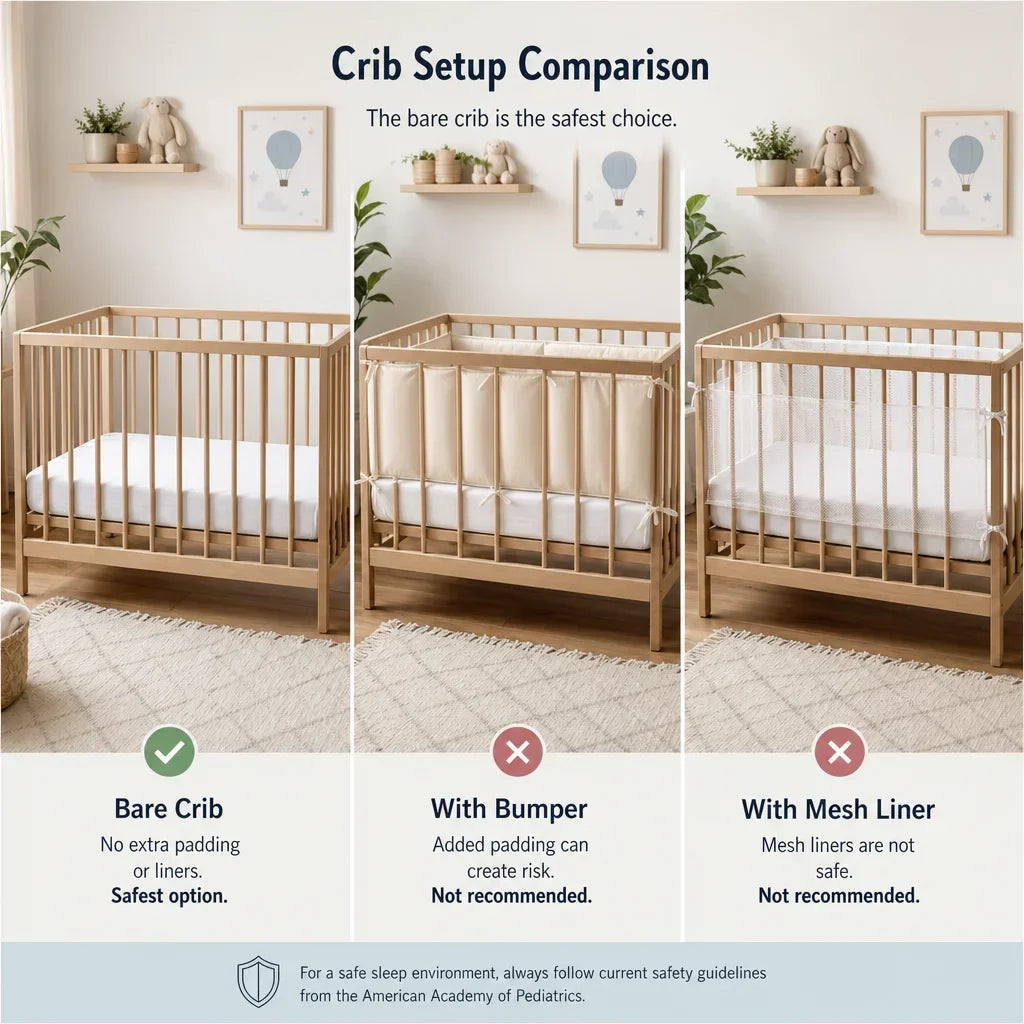
A lot of nursery products look helpful and still do not belong in a sleep space. Crib bumpers are they safe? For infant sleep, padded crib bumpers and cot bumpers are not recommended, and the safest setup is a bare crib with a firm mattress and a fitted sheet only, with current Canada guidance checked before you buy or use any accessory.
The short answer: are crib bumpers safe?
Padded crib bumpers are not recommended for safe sleep, whether you call them crib bumpers, cot bumpers, or bumper pads. The safest mainstream setup is a firm crib mattress with one fitted sheet and no added padding, pillows, toys, quilts, or liners .
Crib bumper pads safe is the wrong standard to use because the product is meant to solve minor bumps but can add more serious hazards in the sleep space. The main safety concerns experts raise are suffocation, strangulation from ties or loose sections, entrapment against the side of the crib, and climbing or fall risk as babies get more mobile .
If you already have one, remove it from the crib and set it aside while you check current Health Canada guidance and the product's own instructions. That is a practical next step, not a judgment on you.
What are crib bumpers, cot bumpers, and mesh liners?
A crib bumper is usually a padded fabric panel that ties around the inside of a crib to cover the slats. A cot bumper is the same idea under a different name, and crib liner safety questions usually refer to thinner fabric or mesh barriers fastened to the crib sides .
Mesh or so-called breathable liners are different from padded bumpers in construction, but they still add material to the sleep space and still have to be attached to the crib. Braided bumpers, cot wraps, and similar decorative products belong in the same general category because they place soft barriers around the baby's sleep area .
Crib bite guards are a separate product category from bumper pads in cribs are they safe searches. They are usually made to cover a rail edge for teething, not to line the inside of the crib, so they need to be evaluated under their own instructions and safety guidance.
Why experts warn against crib bumpers
Crib bumpers dangerous is not just a slogan; it reflects how the product changes the sleep environment. Soft padding can press against a baby's face, ties or loose fasteners can create entanglement hazards, and added material can create trapped positions that a young baby cannot fix alone .
Bumper pads dangerous also because the risk is not limited to one age or one style. As babies grow, the same bumper that looked protective can become something they push against, pull on, or use as a step when standing, which adds climbing and fall concerns .
Cot bumpers dangerous for the same reasons as crib bumpers because the hazard comes from the barrier itself, not the label on the packaging. Even when a product claims cushioning, airflow, or comfort, those claims do not automatically solve strangulation, entrapment, or climbing risk.
The key trade-off is simple: light bumps against crib slats are usually less serious than adding soft or attached material around a sleeping infant. That is why crib bumper pads dangerous remains the safer bottom line than trying to judge one soft bumper against another.
Padded bumpers vs mesh liners vs no bumper: which is safest?
No bumper is the clearest recommended option for infant sleep because it avoids adding loose or attached barriers inside the crib. Mesh liners may seem better than padded bumpers, but safer than padded is not the same as safe or recommended.
| Option | What it is | Main risks | Claimed benefit | What the claim does not solve | Overall recommendation |
|---|---|---|---|---|---|
| Padded crib bumpers | Soft padded panels tied to crib sides | Suffocation, strangulation, entrapment, climbing/fall risk | Cushions bumps, covers slats | Does not remove attachment, trapped-position, or climbing hazards | Not recommended for infant sleep |
| Mesh or breathable liners | Thin mesh or fabric barrier attached to slats | Entrapment, entanglement, attachment-related risk, possible climbing aid | May reduce direct contact with slats | Does not make the crib risk-free and does not make added accessories necessary | Not the same as risk-free; check current Canada guidance |
| Braided bumpers / wraps | Decorative padded barrier around edges | Suffocation, entrapment, climbing risk | Styling, cushioning | Soft material still adds hazard in the sleep space | Not recommended for infant sleep |
| No bumper | Firm mattress plus fitted sheet only | No added bumper-specific risk | Follows bare crib guidance | Does not stop every minor bump or limb poke through slats | Safest option for infant sleep |
Are mesh crib bumpers safe is best answered cautiously. Mesh crib bumper safety claims focus on airflow or thinner fabric, but crib liner safety still depends on the fact that a liner is another attached item inside the crib, and that changes the sleep space.
How do I stop my baby from hitting their head on the crib without bumpers?

Minor head bumps against crib sides are common, and in a properly assembled crib they are usually a lower-risk issue than adding padded barriers. Modern crib design standards are meant to reduce dangerous gaps, which is why bumpers are usually not the answer .
The practical fix is to check setup, not add padding. Use a properly fitting mattress, keep only a fitted sheet on it, and make sure the crib is assembled exactly to the manufacturer's manual with all hardware secured .
Mattress height should be lowered by developmental stage, not by guessing an age. Once a baby can sit up, pull up, or shows they can climb, the sleep setup needs a fresh look because mobility changes fall risk even without bumpers .
Repeated hard impacts, unusual movements, or a child who seems to be getting injured should be discussed with a pediatrician. For a very active older baby or toddler, the answer is usually an age-appropriate sleep transition plan, not more padding inside the crib.
What to use instead of crib bumpers

The safe alternative to crib bumpers depends on the problem you are trying to solve, and most of those problems have a safer answer than padding the crib sides. For warmth, use age-appropriate sleep clothing or a wearable blanket; for bedding simplicity, use a firm mattress and fitted sheet only; for nursery style, keep decorative items out of the sleep space .
What to use instead of crib bumpers starts with bare-cradle basics, not accessories. A safe alternative to a cot bumper is not another liner but a properly set up crib, correctly sized mattress, and sleep clothing that does not leave loose fabric near the face .
What to use instead of bumper pads in a crib is usually a sleep sack once a baby is no longer being swaddled. Swaddling guidance changes once rolling begins, so families should follow current pediatric guidance and the product instructions for that stage .
Decorative bedding bundles can include pieces that look coordinated but are not safe-sleep essentials. That matters because what to use instead of cot bumpers is usually less, not more.
If you are building a nursery from scratch, shop safe essentials first: a crib, mattress, fitted sheets, dresser or changing storage, and sleep sacks. If you want help comparing practical setups for small rooms or first nurseries, a virtual consultation or showroom visit can help you skip accessories you do not need.
How to choose a safe sleep sack or wearable blanket

A sleep sack or wearable blanket is usually the most practical safe alternative to cot bumpers when parents are really trying to keep baby warm without loose blankets. The right choice is stage-based: newborn, rolling baby, sitting or pulling up, and toddler transition all have different fit and mobility needs .
Fit matters more than marketing language. The neck and arm openings should follow the product's instructions, the fabric should stay away from the face, and the design should allow healthy hip movement rather than forcing the legs into a tight position .
Product instructions matter because wearable blankets are not one-size-fits-all. Follow the size chart, stop using any product that no longer fits as designed, and use current pediatric guidance if you are moving from swaddling to a sleep sack.
What should be in a baby's crib for safe sleep?

A baby's crib for sleep should contain only a firm mattress and a fitted sheet. Bare crib guidance means no bumpers, no loose blankets, no pillows, no stuffed toys, and no soft positioners .
Here is the short checklist parents usually need:
- Firm crib mattress
- One fitted crib sheet
- No crib bumpers or cot bumpers
- No pillows
- No loose blankets or quilts
- No stuffed animals or toys
- No sleep positioners or extra padding
If you remember just one line, make it this: nursery décor and sleep safety are not the same thing. A crib can look simple and still be the safer setup.
What age is it safe to use crib bumpers?
There is no general safety rule that turns crib bumpers into a good choice at 6 months, 10 months, 1 year, or 2 years. More mobility can reduce some concerns and increase others, especially entanglement and climbing, so age alone does not make bumper pads safe .
Are crib bumpers safe for newborns is the easiest version of this question to answer: no, they are not recommended for infant sleep. Newborns need the simplest sleep space because they have the least ability to move away from hazards .
Are crib bumpers safe for a 1 year old and are cot bumpers safe for 1 year old are still not questions with a clean yes. At that stage, babies may pull to stand or climb, and any attached barrier can become something to grab, lean against, or step on .
Are cot bumpers safe for 2 year old is usually the point where parents should separate crib questions from toddler bed questions. Once a child is outgrowing the crib, the safer conversation is about transition timing, mattress height, and the right next bed, not about adding bumper-style products inside the crib.
Are crib bumpers illegal in Canada?
Not recommended, recalled, banned, and illegal to sell do not mean the same thing, and parents often see those terms mixed together online. The safest Canadian answer is to check current Health Canada guidance and current product listings before buying or using any bumper-type item, because legal status and enforcement language can change over time.
Are crib bumpers banned in Canada should not be answered with a casual yes unless a current government source says exactly that. Crib bumper safety Canada questions are best handled by looking at the latest Health Canada safe-sleep guidance, recall notices, and product-specific rules rather than assuming retail availability proves safety.
For context only, some U.S. rules have moved against padded crib bumpers in recent years, but Canadian parents should still use Canadian guidance first. A product being sold somewhere else, or on a marketplace site, is not proof that it belongs in your baby's crib.
Why "breathable," "non-toxic," and "tested" claims can still mislead
Breathable crib bumper safe is a marketing phrase, not a full safety verdict. Breathable usually refers to airflow through a material, but airflow alone does not answer entanglement, attachment failure, trapped positioning, or climbing risk .
Non-toxic claims address chemical exposure, not safe-sleep suitability. A product can use materials a parent likes and still be a poor choice for an infant crib because the main concern is what the product adds to the sleep environment .
Tested is another word that gets stretched. Testing can refer to a limited lab method, internal quality checks, or a category standard, and none of that automatically means the item is recommended for overnight infant sleep .
Are breathable crib bumpers safe and are breathable cot bumpers safe should still be answered with the same caution. Marketing terms do not overrule current safe-sleep guidance.
Are bumpers ever safe on a bassinet, mini crib, or cot bed?
A smaller sleep space does not make bumper products safer. Bassinets, mini cribs, standard cribs, and cot beds all need to be used according to their own manuals, and adding padded barriers to any infant sleep space should not be assumed safe just because the product name changes .
Bumpers for cot beds safety is not different in principle from crib-bumper safety while the child is still sleeping in an enclosed sleep space. The main issue is still added material, attachment points, and whether the item changes the hazard profile of the bed .
Once families move to toddler beds, they should treat toddler accessories as a separate category rather than assuming crib bumpers carry over. The right answer comes from the bed manufacturer's instructions and current child-safety guidance, not from reusing nursery accessories in a new setup.
What if I already bought crib bumpers or got them as a gift?
If you already own crib bumpers, do not use them in the crib for sleep. That includes new products, gift items, registry bundles, and secondhand sets.
The next step is to check for a recall or safety notice through Health Canada and then review the retailer's return window or registry return policy. Keep the packaging if you still have it, because model information makes recall checks and returns easier .
If a return is not possible, the safest choice is still to keep the item out of infant sleep spaces. Do not repurpose it anywhere a baby may sleep, nap, or be left unattended.
Secondhand crib bumpers and older bedding sets need extra caution because older products may not match current guidance, may have worn ties or missing labels, and may have been stored in ways that affect condition. Hand-me-down availability is not a safety standard.
Do not use secondhand bumpers, old nursery sets, or registry bundles without checking current guidance
Secondhand sleep accessories carry two separate problems: age and wear. Older crib bumper pads can reflect outdated advice, and used products can have stretched seams, damaged fasteners, or unclear instructions that make safe use even harder to judge .
Registry bundles can also create false confidence because they make decorative pieces look essential. In practice, the safer registry includes the crib, mattress, fitted sheets, storage, and wearable sleep basics, while bumpers and similar accessories stay off the must-have list.
If relatives want to help, point them toward practical nursery items that support safe sleep without adding clutter. That keeps gift giving useful and keeps the crib simple.
FAQ
Are crib bumpers safe for newborns?
No. Newborns need a bare crib setup with a firm mattress and fitted sheet only .
Are crib bumpers safe for a 1 year old?
Age does not make crib bumpers a clear yes. By 1 year, climbing and entanglement concerns can still matter .
Are cot bumpers safe for toddlers?
Not as a blanket rule. Separate crib use from toddler bed products and follow the bed manufacturer's instructions plus current safety guidance .
Are breathable crib bumpers safe?
Breathable claims do not make a bumper risk-free or automatically recommended. They address airflow claims, not every hazard pathway .
Are mesh crib liners safe?
Mesh may be different from padded bumpers, but different is not the same as recommended. Check current Canadian guidance before using any liner .
Are crib bumpers banned in Canada?
Do not assume the answer from social posts or retailer listings. Check current Health Canada guidance, recalls, and product rules for the latest Canada-specific answer.
What can I use instead of crib bumpers?
Use a firm mattress, fitted sheet, and age-appropriate sleep clothing or a sleep sack instead of adding padding to the crib .
How do I stop my baby from hitting their head on the crib without bumpers?
Check crib assembly, mattress fit, and mattress height, and remember that minor bumps are usually less risky than adding padding .
Should I use secondhand crib bumpers?
No. Older products and used accessories can have outdated guidance, wear, missing labels, or damaged fasteners .
Are bumpers for cot beds any safer than crib bumpers?
Not in principle while the child is still in an enclosed sleep space. The same added-material and attachment concerns still apply .
The practical takeaway is simple: skip bumpers, keep the crib bare, and focus your nursery budget on true essentials. If you are comparing cribs, mattresses, nursery sets, or small-room layouts, our guides on cribs, mattresses, and nursery furniture can help you build a safer room without unnecessary accessories.


