

The safest way for newborn to sleep in crib is on their back, on a firm flat mattress, in a clear sleep space with only a fitted sheet. Safe sleep lowers risk, but it cannot guarantee 100% prevention, so this Canada-focused guide covers practical setup, product choices, and questions to review with your healthcare provider too.
Quick answer: the safest way for a newborn to sleep in a crib
A sleep safe crib setup means back sleeping, a firm flat sleep surface, and nothing loose or padded around the baby. Public health guidance in Canada consistently centres on a safety-compliant crib, bassinet, or play yard used exactly as the manufacturer instructs, with no pillows, blankets, quilts, bumpers, toys, nests, pods, wedges, or positioners in the sleep space.
A newborn can sleep in a crib from day one if the crib, mattress, and sheet are made for safe infant sleep and fit properly. A crib is not too big to be safe, but the setup must be right: flat mattress, snug fitted sheet, and no add-ons that can cover the face or create gaps.
Back sleeping is the standard starting position for every sleep, including naps. Side sleeping is not considered stable for newborns, and tummy sleeping should not be used for routine sleep unless a clinician has given specific medical guidance for that child.
Room sharing is generally recommended, while bed sharing carries added risk and is especially unsafe on a couch, sofa, recliner, or armchair. Guidance commonly refers to keeping the baby on a separate sleep surface in the caregiver's room for at least the first 6 months .
Is it okay to let a newborn sleep in a crib? Crib vs bassinet vs play yard
Yes, it is okay to let a newborn sleep in a crib if the product is approved for infant sleep and assembled correctly. The safest bed for a newborn is not one specific category but a flat, firm, safety-compliant sleep space that matches the baby's size and the manufacturer's limits.
A crib usually offers the longest value because many families use it from birth into the toddler stage, often for 2 years or more depending on the model and the child's growth. A bassinet usually takes less floor space and works well for room sharing, but it is typically outgrown sooner because manufacturers set lower size and mobility limits than full cribs.
A portable play yard can be a practical sleep option if that exact model is approved by its manufacturer for infant sleep. Not every playpen or travel product is meant for routine unsupervised sleep, so the label and manual matter more than the product category name.
Supervised loungers and newborn nests are not the same as sleep spaces, even if babies seem comfortable in them. Products meant for soothing, propping, or daytime lounging do not replace safe cribs for babies when a caregiver is not actively watching.
| Sleep space | Best use | Main advantage | Main limit | Good fit for |
|---|---|---|---|---|
| Crib | Day and night sleep from birth | Longest usable life | Larger footprint | Long-term value, main nursery |
| Bassinet | Early months near parents | Compact and easy for room sharing | Outgrown faster | Small bedrooms, bedside setup |
| Portable play yard | Home or travel sleep if approved for sleep use | Portable, multipurpose | Must follow model-specific instructions | Travel, second sleep space |
| Moses basket or cradle | Only if specifically sold and approved for infant sleep in your region | Small and portable | Limits vary and need close product review | Short-term use only if guidance and labeling support it |
How to set up a newborn crib safely step by step
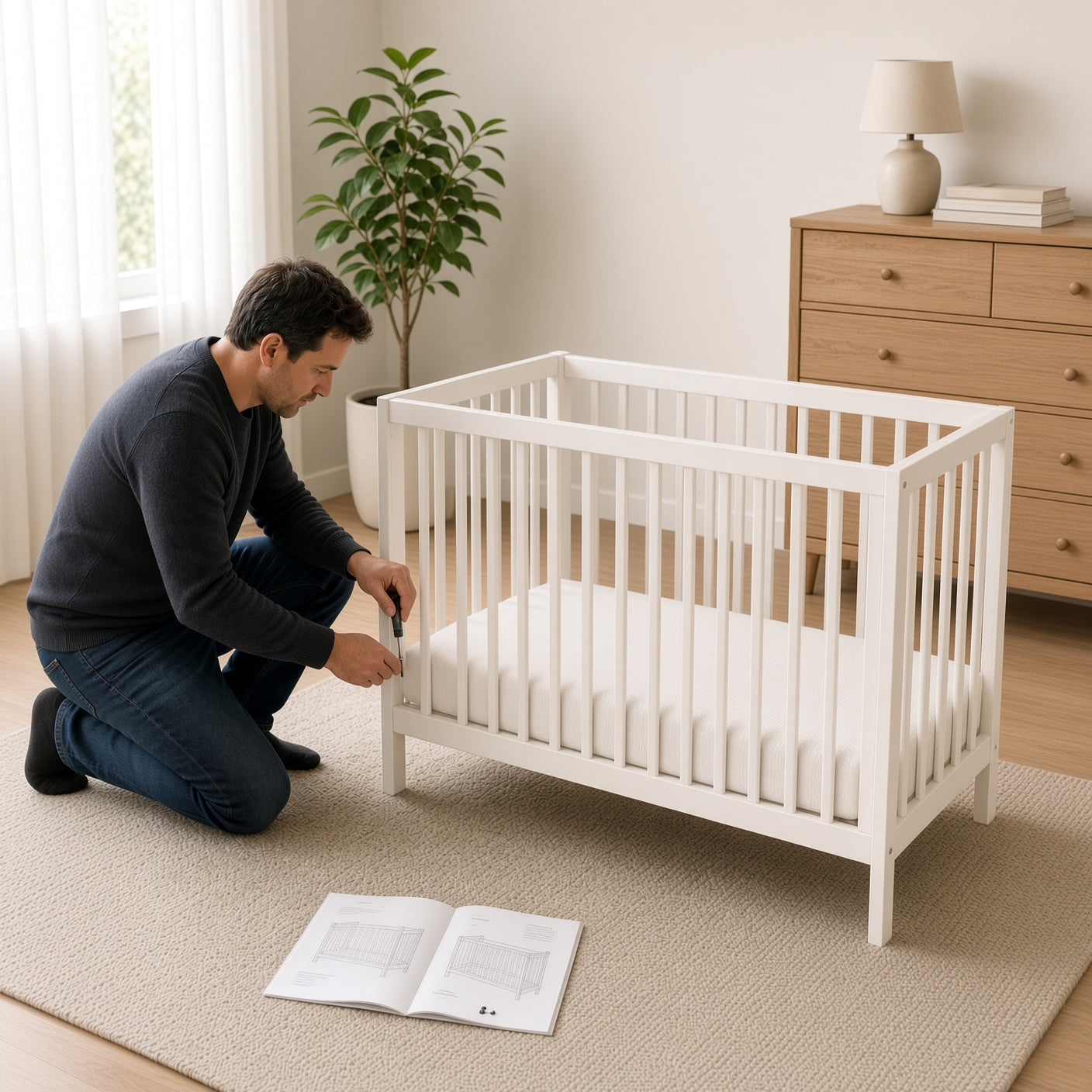
The first step is assembly exactly as the manufacturer directs, because missing hardware or swapped parts can make a safe crib unsafe. Keep the manual, use the supplied fasteners, and stop if any part is loose, cracked, or does not line up.
The right mattress is the one designed for that crib model or that exact size category, and it needs to sit flat with no bunching or curling. A mattress that bows, shifts, or leaves visible side gaps is not a safe fit for infant bed safety.
The only bedding you need on the mattress is one tight fitted sheet made for that mattress. Extra layers, waterproof pads not approved by the manufacturer, pillows, and folded blankets can change the surface and raise suffocation or overheating concerns.
The baby should go down on their back for every sleep, even if they fall asleep in your arms or after a feed. Once a baby is able to roll on their own, current advice should be confirmed with your healthcare provider and the latest Canadian guidance, but the starting position is still on the back.
The sleep area should stay completely clear, not just mostly clear. That means no bumper pads, no stuffed toys, no sleep positioners, no wedges, no nests, and no extra blankets tucked around the body.
The crib location matters as much as the crib itself, because cords and heat sources create avoidable hazards. Keep the sleep space away from windows, blind cords, curtain ties, wall décor that could fall, and heaters or direct sun exposure.
The first-night setup is simple and should look almost bare. Your checklist is a stable assembled crib, flat mattress, fitted sheet, baby dressed for room conditions, clear space around the crib, and the manual stored nearby for future adjustments.
What should be in the crib and what should stay out
The crib should contain only the baby, a firm mattress, and a fitted sheet unless your clinician has given a specific medical exception. That plain setup is what sids cot safety looks like in real life.
Loose blankets, pillows, duvets, toys, and bumper pads should stay out because they can cover the face, trap heat, or create entrapment points. These are comfort items for awake time, not for unsupervised newborn sleep.
Nests, pods, loungers, wedges, and sleep positioners should stay out because they add soft sides or angled surfaces around the baby. That can increase risks linked to suffocation, rebreathing exhaled air, and unsafe rolling positions.
Sleep clothing is usually safer than loose bedding for warmth, but the product still has to match the baby's age, size, and stage. Follow the garment label and current safe sleep guidelines Canada sources rather than adding layers just because the room feels cool to an adult.
| Item | Safe for sleep? | Why | Safer alternative |
|---|---|---|---|
| Firm crib mattress | Yes | Flat support surface | Use the correct mattress for the crib |
| Fitted sheet | Yes | Stays tight to the mattress | Use one made for that mattress |
| Loose blanket | No | Can cover face and add heat | Use appropriate sleep clothing |
| Pillow | No | Soft surface hazard | Keep crib empty |
| Stuffed toy | No | Obstructs breathing space | Remove from crib during sleep |
| Bumper pad | No | Can trap, cover, or entangle | Keep slats clear |
| Nest or pod | No | Soft sides and rebreathing risk | Move baby to a flat approved sleep space |
| Wedge or positioner | No | Changes position and can trap baby | Use a flat mattress only |
Unsafe sleep products and surfaces: what to avoid and why

Couches, sofas, recliners, and armchairs are among the riskiest places for a sleeping baby because soft cushions and gaps can block breathing fast. If you think you may fall asleep while feeding, moving to the baby's approved sleep space before you get drowsy is safer than staying on a couch or chair.
Adult beds are not designed for newborn sleep because they usually include soft mattresses, pillows, blankets, and spaces where a baby can roll or become trapped. Bed sharing is especially unsafe with smoking or vaping exposure, alcohol, cannabis, sedating medication, extreme fatigue, prematurity, low birth weight, or more than one bed sharer.
Car seats, strollers, swings, bouncers, and inclined sleepers may be useful for transport or soothing, but they are not the default place for routine unsupervised sleep. If a baby falls asleep there, the safer plan is usually to move them to a flat approved sleep surface as soon as it is feasible and safe to do so.
Portable gear with covers can also create airflow and heat concerns. Heavy pram covers, thick drapes over strollers, and over-bundling can reduce ventilation and make safe sleep for babies room temperature harder to judge.
| Surface or product | Safe for routine unsupervised sleep? | Main concern |
|---|---|---|
| Crib | Yes, if safety-compliant and set up correctly | Unsafe only if used with extra items or wrong mattress |
| Bassinet | Yes, if approved for infant sleep | Outgrow limits can arrive quickly |
| Approved play yard | Yes, if manufacturer says so | Add-ons and inserts may not be approved |
| Couch or sofa | No | Suffocation and entrapment |
| Recliner or chair | No | Slumping and wedging |
| Adult bed | No general recommendation for newborn routine sleep | Soft bedding, gaps, overlay risk |
| Car seat outside travel use | No for routine sleep | Positioning and airway concerns |
| Swing or bouncer | No | Inclined surface |
| Nest or pod | No | Soft side and rebreathing risk |
| Unscreened used crib | No until checked | Missing parts, recalls, poor fit |
Crib safety standards in Canada: what to look for when buying

A safe crib in Canada starts with current compliance, clear instructions, and a retailer that can explain what mattress and parts belong with it. Crib safety standards Canada rules are not always the same as advice you read on U.S. or Australian sites, so Canadian labeling and documentation matter.
The frame should feel sturdy, level, and complete, with no loose joints, no broken slats, and no improvised repairs. If screws are missing, holes are stripped, or parts have been replaced with hardware-store substitutes, the crib should not be used.
The finish should be intact and the materials should be transparent, but a non-toxic finish alone does not make a crib sleep-safe. Safe sleep depends first on structure, fit, and correct use, then on material quality and general durability.
The mattress fit should be exact for that crib, and the warning labels and manual should still be available. Families should also check for recalls through the manufacturer and Canadian consumer safety sources before first use.
How to choose a safe second-hand crib or cot

A second-hand crib can make sense for budget reasons, but it needs a harder inspection than a new one because missing history is part of the risk. The safest used option is one with a model label, original manual, complete hardware, and no modifications.
You should walk away if the crib has cracks, warping, peeling finish, missing parts, loose sides, homemade repairs, or no way to confirm what mattress belongs in it. A bargain stops being a bargain if the frame or fit is uncertain.
The mattress deserves its own review because used mattresses can be the wrong size, too soft, damaged, or hard to clean fully. Even when the frame looks solid, an incompatible used mattress can undermine sids cot safety.
A practical inspection checklist includes the product label, recall check, manual, hardware count, frame stability, mattress fit, surface condition, and proof that no aftermarket accessories were added. If any of those pieces are missing, a new entry-level crib may be the safer value choice.
Room sharing vs bed sharing: what lowers risk and what raises it

Room sharing means the baby sleeps on a separate surface in the same room, while bed sharing means the baby sleeps in the same adult bed. Mainstream guidance supports room sharing as the lower-risk arrangement and warns that bed sharing adds risk, especially in specific circumstances.
The first 6 months are the period most often highlighted for room sharing, and some guidance extends that conversation up to 12 months . Your healthcare provider and current Canadian sources should be the final check for your file, because public guidance language can be updated.
Risk rises sharply on a sofa or armchair and rises further with smoking or vaping exposure, alcohol, cannabis, sedating medication, severe sleep deprivation, soft bedding, prematurity, or low birth weight. This is not about blame. It is about choosing the setup with the fewest known hazards.
SIDS basics: what it is, why risk peaks at 2 to 4 months, and what safe sleep can do
SIDS refers to the sudden death of an infant that remains unexplained after a full investigation, and it is discussed alongside other sleep-related infant deaths because the prevention steps overlap. Safe sleep practices reduce risk factors linked to these events, but they do not eliminate risk completely.
The 2 to 4 months period is often highlighted because babies are still early in neurological and sleep-arousal development during that window. In plain terms, their bodies are still maturing the systems that help them wake or respond to breathing challenges.
No crib, mattress, monitor, or product can truthfully claim to prevent SIDS on its own. A sids safe cot is really a shorthand way parents use to mean a sleep space that follows current safe sleep guidance, not a guarantee.
Current Canadian incidence figures should be checked against the latest federal or provincial public health reporting before quoting a number. If you want the most current local data, use a government or hospital source rather than a retailer or a social post.
Breastfeeding, pacifiers, swaddling, and overheating: common newborn sleep questions

Breastfeeding is associated in some evidence with a lower risk of SIDS, but it is not a guarantee and should not be treated as one. It belongs beside, not instead of, back sleeping and a clear flat sleep space.
Offering a pacifier at sleep times is also associated in some guidance with lower risk, but babies should not be forced to take one. Feeding goals come first, and parents should check current newborn guidance, especially in the early breastfeeding period.
Swaddling should only be used if it is done correctly and stopped once the baby shows signs of rolling. A baby who can roll while swaddled has less ability to reposition, which changes the risk picture.
Overheating matters because too many layers, hats indoors, heavy bedding, and blocked airflow can make sleep less safe. Safe sleep for babies room temperature is best managed by dressing the baby for the room and checking current health guidance, not by piling blankets into the crib.
What if my baby only sleeps while being held, fed, or in a car seat?
This is common, exhausting, and one of the biggest reasons safe sleep plans break down in real homes. The safer goal is still to transfer the baby to a flat approved sleep surface once they are asleep or drowsy enough, even if that takes practice.
If a baby falls asleep in a car seat or carrier, move them to the crib, bassinet, or other approved flat sleep space as soon as it is safe and practical. Transport devices are for travel, not for routine overnight or unsupervised sleep.
Gentle settling helps more than adding sleep gadgets. A dark room, steady routine, feed-then-place pattern, hands-on soothing in the crib, and white noise used according to product safety instructions can support the transition without changing the sleep surface itself.
Breathing concerns, unusual limpness, repeated vomiting, persistent distress, or sleep that only seems possible in one position should be reviewed with a healthcare provider. This guide is general information, not medical advice for your baby's specific symptoms.
Safe sleep quick-start checklist for newborns
The best quick check is a nearly empty sleep space every single time. Screenshot this and use it before naps, bedtime, and travel.
- Baby sleeps on their back.
- Sleep surface is flat and firm.
- Crib, bassinet, or play yard is approved for infant sleep.
- Mattress fits properly and lies flat.
- Only a fitted sheet is on the mattress.
- No pillows, blankets, toys, bumpers, nests, pods, wedges, or positioners.
- Baby is dressed for the room, not covered with loose bedding.
- Sleep space is away from cords, curtains, heaters, and falling décor.
- Manual, labels, and parts are intact.
- Used items have been screened for recalls and missing hardware.
FAQ: baby nests, monitors, twins, pram covers, and other edge cases
Baby nests and pods are not approved replacements for a crib, bassinet, or other flat compliant infant sleep surface. If a product has padded sides, a cushioned base, or a lounging design, treat it as awake-time gear unless official product labeling and current guidance say otherwise.
DockATot-style loungers should not be treated as unsupervised sleep products. Specific recall or regulatory wording can change by market and date, so parents should verify current notices directly with regulators and the manufacturer instead of relying on reposted summaries.
Baby monitors can help you observe a child, but they are not proven to reduce SIDS risk. A monitor is a convenience and supervision tool, not a substitute for a safe sleep setup.
Twins should have sleep arrangements reviewed against current guidance and, when needed, medical advice tied to their birth history. Separate sleep surfaces are the cautious default unless a clinician has given specific direction otherwise.
Pram covers should be used carefully because airflow and heat can become issues fast. If a cover traps warmth or blocks ventilation, remove it and move the baby to a more suitable sleep setting when possible.
A practical last step before you buy
The safest crib setup is usually the simplest one, and checking fit in person can prevent expensive mistakes later. If you are comparing safe cribs for babies, bassinets, or nursery furniture in Toronto, it helps to see mattress fit, room scale, and assembly details up close, or use a virtual consultation if you are shopping from elsewhere in Canada. Baby Warehouse has served Toronto families since 1995 and offers showroom and online help for safety-conscious nursery planning.


