

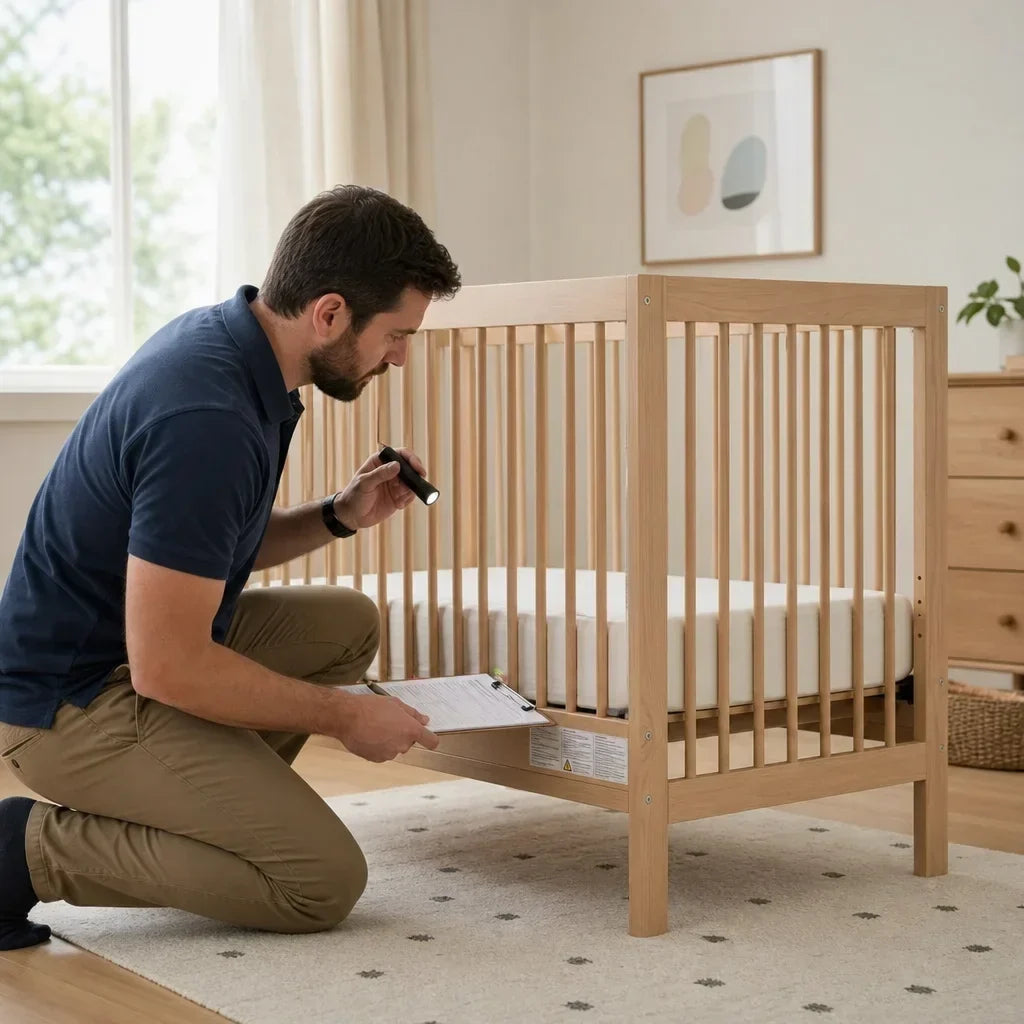
Crib safety for newborns starts with a simple rule: a newborn can sleep in a crib from day 1 if the crib is a current, verifiable product and the sleep space is set up properly. A sturdy-looking hand-me-down is not automatically a safe crib, and that is where many families get tripped up.
A practical check works in three parts. Verify the crib itself. Verify the mattress fit. Verify the bare sleep setup. If any one of those fails, stop before a baby sleeps there.
Quick answer: Is this crib safe for a newborn today?
A crib is safe for infants when it is intact, assembled exactly as designed, free of recalls, and used with a firm, snug-fitting mattress plus only a fitted sheet. That means no guessing on missing parts, no DIY fixes, and no soft extras in the sleep space.
A newborn can use a crib from birth, including at 4 weeks old, if the product is meant for infant sleep and still meets current Canadian requirements. Temporary sleep at a grandparent's house, cottage, or travel stop does not lower the standard.
An old, secondhand, inherited, antique, unlabeled, or modified crib should be treated as unverified until it passes a full safety check. If you cannot confirm the brand, model, instructions, hardware, and recall status, the safer answer is usually not to use it for sleep.
Canada crib safety basics: what Health Canada expects
Health Canada crib safety guidance starts with the federal Cribs, Cradles and Bassinets Regulations, which set requirements for these infant sleep products in Canada. The key takeaway is plain: use products sold for the Canadian market when possible, and keep the label, instructions, and model details.
A crib, cradle, and bassinet are not interchangeable labels under Canadian rules because each product type is regulated for a different intended sleep use. A play yard or bedside sleeper may also be used for sleep only if the manufacturer says it is intended for infant sleep and you follow that product's own limits and instructions.
Marketplace finds, imported products, and unlabeled sleep products are harder to verify because you may not be able to confirm compliance, recalls, or approved replacement parts. That is why visual inspection alone is not enough for health canada crib safety.
Old crib safety in Canada: when age alone is a red flag
Age alone does not prove a crib is unsafe, but age increases the odds that standards changed, hardware wore out, or labels and instructions were lost. That is the real old crib safety problem.
Questions like "is a crib from 1992 still safe," "is a 25 year old crib safe," or "is it okay to use a 30 year old crib" all lead to the same answer: if the crib is from an earlier standard era, or you cannot verify its exact model and condition today, do not assume it is safe for a newborn. A 10-year-old crib may still be usable if it is complete, traceable, and recall-free. A 30- or 40-year-old crib usually raises too many verification problems.
An inherited crib at a grandparent's home is not safer just because it will be used for naps or only on weekends. The same rule applies to an old safe cot, cottage crib, or daycare hand-me-down.
Canada does not use a simple expiry sticker for cribs, so "how old can a crib be and still be safe" is really a verification question, not an age-only question. If the crib is very old, missing a label, modified, or impossible to trace to a manufacturer, I would not use it for infant sleep.
Keep, repair, or discard? A decision tree for an old or secondhand crib
Keep and use the crib only if the frame is solid, all hardware is present, the model can be identified, instructions are available or obtainable, the mattress fits correctly, and the crib clears a recall search. That is the pass side of an old crib safety checklist.
Stop and verify further if the crib has labels but no instructions, if spare parts were used, if assembly history is unknown, or if the mattress is not the one intended for that model. In that middle zone, do not use it for sleep until the manufacturer or another authoritative source confirms what belongs with that exact crib.
Do not use the crib for sleep if it has a drop-side, missing hardware, cracked wood, loose joints, broken or missing slats, a damaged mattress support, obvious warping, homemade repairs, decorative cutouts, or a missing label plus unknown model. Some defects are not repair projects. They are end-of-use signals.
What can never be made safe: drop-side cribs, missing parts, and structural hazards
Drop-side cribs are not a safe option today and should not be used. In plain English, the moving side can fail, detach, or create a gap that can trap a baby.
A seller saying a drop side crib canada model "still works fine" does not change the risk. If you are asking whether drop side cribs banned in canada should still be used because they look sturdy, the answer is no.
You should not try to make a drop-side crib safe by locking it, wedging it, tightening it, or adding aftermarket hardware. Unless the manufacturer provides an approved fix for that exact model and you can prove current compliance, do not use it for infant sleep.
Other non-negotiable hazards include missing or non-original hardware, broken slats, cracked rails, protruding parts, unstable framing, large gaps, and damaged mattress supports. These are structural hazards, not cosmetic ones.
Can sanding, repainting, new hardware, or a new mattress make an antique crib safe?
Cosmetic restoration does not make an antique crib compliant for infant sleep. Sanding and repainting can improve appearance, but they do not fix unsafe design, entrapment hazards, missing testing history, or worn structure.
DIY hardware swaps are risky because crib parts are not generic in the way many people assume. If a bolt, bracket, support, or mattress platform part is missing, only the exact approved part for that exact model should be used, if the manufacturer still offers it.
A new mattress does not rescue an unsafe frame. It only helps when the crib itself is sound and the mattress is the correct type, size, and firmness for that model.
If the crib has sentimental value, repurpose it instead of using it for sleep. Decor, supervised photo use, or toy storage can preserve the piece without turning an antique into a newborn bed.
Crib safety checklist: what to inspect before any baby sleeps in it
Use a crib safety for newborns checklist that starts with identification: brand label, model number, and manufacturer details should be present and readable. Without that, recall checks and replacement-part checks get much harder.
The frame should pass a hands-on inspection with no wobble, no cracked wood, no missing slats, no loose fasteners, no damaged rails, no cutouts, and no drop-side mechanism. Those are pass-fail items, not style preferences.
The mattress support should sit securely with all original support parts in place and no sagging or bent hardware. If the platform feels uneven or unstable, stop there.
Aftermarket add-ons should not be attached to the crib. That includes liners, bumpers, wedges, straps, and sleep-positioning accessories.
A store display crib can still be set up wrong once it gets home, which is why every family should recheck assembly after delivery. For grandparents buying secondhand, this crib safety for infants checklist is even more important because the product history is often incomplete.
Mattress fit and firmness: one of the biggest crib safety mistakes

A crib mattress should fit snugly and lie flat so it does not leave dangerous side gaps. Mattress mismatch is one of the easiest ways to turn a decent crib into an unsafe one.
Use the mattress type and size recommended for that exact crib model whenever possible. Borrowing a random mattress, using a thicker one, or dropping in a softer mattress can create gaps or an unsafe sleep surface.
Firmness matters because newborn sleep should happen on a firm, flat surface, not a plush or cushioned one. If the frame is old, a brand-new mattress still does not solve structural problems.
What should be in a newborn’s crib? The bare crib setup

The safest setup is simple: a firm mattress, a fitted sheet, baby on their back, and nothing else in the sleep space. That is the core of crib safety for newborns.
The four things that should not be in a crib include pillows, loose blankets, stuffed toys, and crib bumpers. You should also keep out quilts, positioners, loungers, nests, pods, wedges, and other soft accessories not meant for safe sleep.
Crib bumpers are not a safe solution, and there is no real need for them in a properly designed crib. If a baby brushes the side of the crib, that minor contact is less dangerous than adding a soft product around the perimeter.
A supervised soothing item is not automatically a sleep-safe item. If it is not intended by the manufacturer for unsupervised infant sleep, it should not be left in the crib.
Safe sleep around the crib: room sharing, cords, anchors, and nursery hazards

A safe crib can still sit in an unsafe room, so placement matters. Keep the crib away from windows, blind cords, curtain ties, monitor cords, lamps, shelves, heaters, and wall decor that could fall or dangle.
Nearby furniture should be anchored because dressers and bookcases can tip as children start to pull, climb, and reach. Window screens are not fall-prevention devices, so keep climbable furniture away from windows as your child grows.
Room sharing is commonly recommended in infant safe-sleep guidance, but bed sharing is a separate issue and should not be confused with placing a baby in their own crib nearby. For your own setup, use current guidance from Health Canada and your care team.
How to check crib recalls in Canada

Start with the label. You need the brand, model name or number, and any manufacturing details you can find before running a proper recall search.
Search the Government of Canada's recalls and safety alerts database first for Canada-specific results. Then check the manufacturer's website and product support pages for the same model.
If the crib came from a cross-border brand, a U.S. recall database may add context, but Canadian recall information should take priority for Canadian families. Do not treat an American product listing as proof that a crib sold here met Canadian requirements.
If you cannot find a label or cannot confirm the manufacturer, treat the crib as unverified and unsafe for newborn sleep until proven otherwise. Keep photos of labels, hardware, and the full crib when asking a retailer or manufacturer for help.
What if the crib has no label, no instructions, or missing parts?
No label means no reliable way to confirm the crib's model, age, recall status, or approved replacement parts. That alone is enough to stop and reassess before any baby sleeps there.
Missing instructions matter because assembly details are part of safety, not just convenience. If the exact manual cannot be obtained from the manufacturer for that exact model, I would not use the crib for a newborn.
Missing or damaged parts should not be solved with a generic hardware kit from a hardware store or online marketplace. Exact approved parts matter because crib loads, spacing, and support points are product-specific.
This is where many secondhand deals fall apart. A family sees a solid frame, but a safe crib is a complete, verifiable system, not just four wooden sides.
Crib vs cradle vs bassinet vs play yard: what is safe for a newborn?

A crib is the standard long-term infant sleep space, while a cradle or bassinet is usually meant for the earlier stage and has its own manufacturer limits. Each product type exists under a different rule set or intended-use category, which is why labels matter.
A play yard may be safe for sleep only if the manufacturer says it is approved for infant sleep and you use it exactly as instructed. The same goes for bedside sleepers.
The right question is not which product sounds coziest. The right question is whether that exact product is designed, labeled, and set up for unsupervised infant sleep in Canada.
| Sleep space | Typical use | Main safety check |
|---|---|---|
| Crib | Standard everyday infant sleep | Verify model, assembly, mattress fit, recalls |
| Bassinet | Early-stage infant sleep | Follow size and mobility limits exactly |
| Cradle | Early-stage infant sleep | Stop use when baby reaches product limits |
| Play yard | Only if approved for sleep by maker | Use only the included sleep surface and setup |
| Bedside sleeper | Product-specific use | Confirm Canadian instructions and limits |
When to lower the mattress and when to move out of the crib
Lower the mattress as soon as your baby reaches the developmental stage listed in the crib instructions, such as pushing up, sitting, or pulling to stand. This is milestone-based guidance, not a race against a birthday.
Move out of the crib when the manufacturer says the crib's height, mobility, or use limit has been reached. Do not try to extend crib use with add-on rails, bumpers, or sleep accessories.
If a toddler is climbing out, the next step should follow the product instructions and the child's readiness, not a shortcut fix inside the crib. Safety changes as the child's movement changes.
SIDS and crib safety: what matters most for newborn sleep
Crib setup does not guarantee any one outcome, but it does reduce known sleep-environment risks like suffocation, entrapment, and overlay from extra bedding or accessories. That is why safe-sleep guidance stays so consistent on firm, flat, bare sleep spaces.
SIDS risk is discussed most often in early infancy, and many sources identify the peak period around 2 to 4 months. The exact medical reasons are broader than crib design, so this article should stay focused on the sleep environment you can control.
Risk drops as babies get older, but safe-sleep habits still matter through infancy. A pacifier may appear in some safe-sleep guidance, but it does not replace the basics of a bare crib and correct product setup.
If you cannot afford a new crib
Budget pressure is real, and families should not be shamed for looking at secondhand options. The goal is to find a compliant sleep space, not a perfect-looking one.
A lower-cost current-model crib from a trusted Canadian retailer is usually a better route than trying to rescue an unverified antique or marketplace find. Simpler designs can still meet the same safety purpose.
Borrowing a crib can make sense only if it can be fully verified, assembled with the correct parts, checked for recalls, and set up with the right mattress. Cheap DIY repairs are not a safe money-saving strategy.
If you want help comparing current compliant cribs, nursery sets, or crib mattresses, Baby Warehouse has served Toronto families since 1995 from a 10,000 sq ft showroom and offers Canada-wide delivery plus virtual consultations. That can be useful if you want a second set of eyes on fit, setup, or nursery planning.
FAQ
Can a newborn sleep in a crib from day 1?
Yes, if the crib is meant for infant sleep, meets current Canadian requirements, is assembled correctly, and has a firm mattress with only a fitted sheet.
Are older cribs safe to use?
Some are, but only if they are complete, traceable, structurally sound, recall-free, and still compliant in practice. Many older cribs fail on missing labels, missing parts, or outdated design.
Is a 30 year old crib safe to use?
Usually that age raises too many verification and wear issues to assume safety. If you cannot prove the exact model, approved parts, and recall status, do not use it for infant sleep.
Do cribs expire in Canada?
There is no simple blanket expiry date stamped onto all cribs under one rule. Safety depends on condition, traceability, instructions, approved parts, and current compliance.
Are drop-side cribs illegal in Canada?
Current guidance is to avoid them and not use them for infant sleep. If you are evaluating one, the practical answer is the same: do not use it.
Can you make a drop-side crib safe?
No practical DIY fix makes it a recommended sleep space. Do not lock it, wedge it, or retrofit it unless the manufacturer has an approved documented fix for that exact model.
How do I know if a crib mattress fits properly?
It should fit snugly, lie flat, and match the crib model it was intended for. Do not substitute a random mattress just because the dimensions look close.
Are crib bumpers safe in Canada?
They should not be used in a baby's sleep space. A bare crib is the safer setup.
What should not be in a baby's crib?
Keep out bumpers, pillows, blankets, stuffed toys, wedges, positioners, loungers, nests, and pods. For sleep, less is safer.
What if my crib has no label or missing parts?
Treat it as unverified and stop use until the exact model and exact approved parts can be confirmed. If that cannot be done, do not use it for newborn sleep.
How do I check whether a crib has been recalled?
Use the model information from the label and search the Government of Canada recalls database first, then the manufacturer. If you cannot identify the crib, you cannot properly clear it.
When should I move my baby out of the crib?
Follow the crib's instructions and move when the product's height, mobility, or use limits are reached. Milestones matter more than age alone.
If your crib does not clearly pass the verify-the-crib, verify-the-mattress, verify-the-setup test, stop there and recheck before tonight. That one pause is usually the difference between a sleep space that only looks fine and one that is actually safe to use.


