

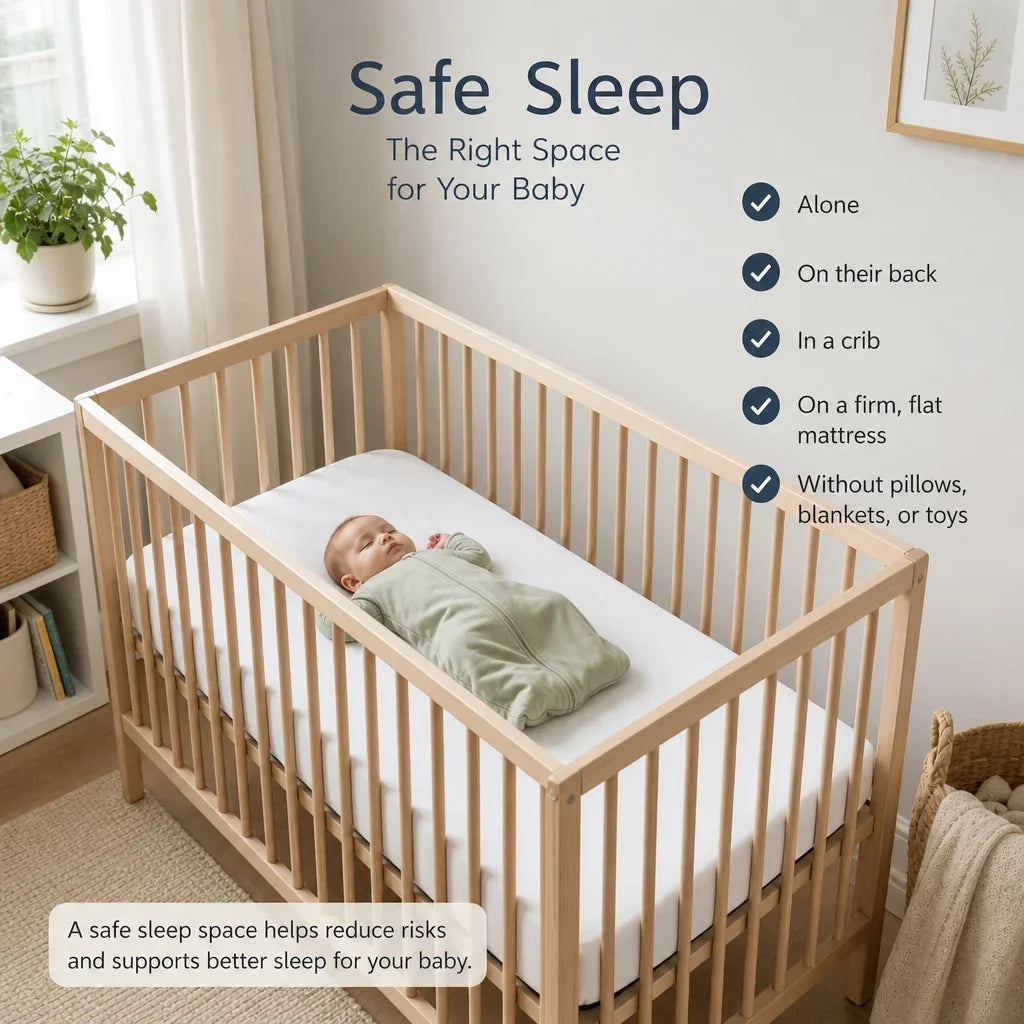
A safe crib is simpler than social media makes it sound. The core crib safety rules are consistent: use a properly assembled crib, a firm tight-fitting mattress, a fitted sheet only, and place baby on their back with nothing loose in the sleep space. This guide covers crib safety rules in Canada, with Canada-first references and a few clearly labeled U.S. comparisons where they help.
Crib Safety Rules at a Glance
The safest setup is a crib assembled exactly to the manufacturer's instructions, with a firm flat mattress made for that crib and only a fitted sheet on top. Health Canada regulates cribs, cradles, and bassinets in Canada under the Cribs, Cradles and Bassinets Regulations, SOR/2016-152.
Safe sleep and crib safety overlap because the crib is the sleep environment, not just the furniture. Baby crib safety rules for routine sleep start with back sleeping, a flat sleep surface, and no soft or loose items that can raise suffocation or entrapment risk.
The short do-and-don't list is not complicated. Do use a compliant crib, lock in all hardware, re-check assembly after moving it, and keep cords and furniture hazards away; do not add pillows, loose blankets, bumper pads, toys, wedges, or tents inside the crib.
What Makes a Crib Safe or Unsafe?

A safe crib is structurally sound, compliant with current standards, correctly assembled, and used with the right mattress. An unsafe crib usually shows one or more red flags: broken slats, loose rails, missing hardware, damaged mattress support, peeling finish, decorative cutouts, or an unknown history after years in storage or multiple owners.
The risk changes with the defect, which is why a quick visual check is not enough. Broken or widely spaced parts can create entrapment hazards, loose joints can lead to collapse, high snag points can create strangulation risks, and a warped frame can leave dangerous mattress gaps.
| Hazard | Why it matters |
|---|---|
| Missing bolts or brackets | Can weaken the frame and lead to collapse |
| Loose slats or rails | Can trap a limb or create a fall risk |
| Damaged mattress support | Can drop or tilt under weight |
| Decorative cutouts | Can create head or limb entrapment points |
| Peeling paint or finish | Can expose the surface to wear and mouthing concerns |
| Unknown replacement parts | May not fit or perform like original parts |
Crib Safety Standards in Canada: What Parents Should Know
Canadian shoppers should start with Canadian rules, not mixed advice pulled from different countries. The main legal reference is Health Canada's Cribs, Cradles and Bassinets Regulations, SOR/2016-152.
Those rules matter because labels, warnings, and design requirements can differ between Canada and the U.S. U.S. advice may cite the CPSC or ASTM standards, which can be useful as background, but parents should treat them as supplementary unless the product is actually sold and labelled for that market.
A compliant crib should have a permanent label with identifying information and safe-use instructions. If you cannot find a model number, manufacturer name, or assembly information, that alone is a serious reason to pause before using or buying it.
Step-by-Step Crib Inspection Checklist Before First Use
The right way to inspect a crib is to check identity first, structure second, and recall status last. Start by finding the product label, model number, manufacturer, and any date or batch information, then match that to the manual if you have it.
The next pass is hardware and assembly. Confirm every bolt, bracket, and support piece is present and installed where the manual shows it; if parts are missing, stop there and do not improvise with look-alike screws or third-party hardware.
Then inspect the frame for physical damage. Look closely at slats, rails, corner areas, mattress supports, and attachment points for cracks, looseness, warping, or poorly seated components.
Mattress fit comes after the frame passes. Place the mattress flat on the support and check that it sits evenly, with no obvious side gap, bunching, or corner lift; the safest route is always the mattress size or model the crib maker recommends.
The final step is a crib recall check in Canada. Search Health Canada's recalls database and the manufacturer's own recall or safety notice page before first use, especially with a secondhand crib or marketplace purchase.
Use this pass/fail decision tree to keep the choice simple:
- Safe to use now: label present, hardware complete, frame solid, mattress fits, no recall found.
- Safe only after original parts arrive: model verified, issue is limited to missing manufacturer hardware or instructions.
- Replace or retire immediately: cracks, broken slats, unknown parts, missing label, failed fit, or unresolved recall.
How a Crib Mattress Should Fit

A crib mattress should be firm, flat, and intended for infant sleep in that crib or crib-size category. Soft, pillow-top, thick add-on layers, or memory-foam-like surfaces are not the goal here because a crib mattress fit issue is both a comfort problem and a safety problem.
The mattress should sit snugly against the inside of the crib without obvious open space around the sides or corners. If the mattress shifts easily, leaves visible gaps, or does not lie flat on the support, treat that as a fail and check the crib manual or mattress sizing before using it.
The safest buying habit is to match crib and mattress specifications before setup, not after delivery. That is one reason parents comparing cribs in person often bring the mattress question up at the same time, especially when choosing convertible models or shopping baby furniture in Toronto for a smaller nursery.
What Should and Should Not Be in a Crib
The safest crib contains baby, a firm mattress, and a fitted sheet only. That answers both what should not be in a crib and what are four things that should not be in a crib: pillows, loose blankets, stuffed toys, and bumper pads should stay out.
Other items to keep out include sleep positioners, wedges, crib tents, extra padding, and decorative accessories. If a product changes the flat sleep surface, adds softness, or can shift near baby's face, it does not belong in the crib.
Crib bumpers are not a safe fix for a proper crib. If you are asking are crib bumpers safe in Canada, the practical answer for parents is to avoid them and rely on a crib that already meets current safety expectations instead of adding padding inside it.
The safer alternative to bumpers is not another accessory. Use a compliant crib, a proper mattress fit, and a wearable sleep sack if appropriate for your baby's stage and the product instructions, rather than trying to pad the crib walls.
Quick do and don't list
Do:
- Use a fitted sheet made for the mattress.
- Dress baby for room temperature instead of adding loose bedding.
- Re-check the crib after moving, disassembling, or reassembling it.
Don't:
- Add bumpers, pillows, quilts, or stuffed animals.
- Use wedges, positioners, or aftermarket padding.
- Hang cords, bibs, or necklaces on or near the crib.
Where to Put the Crib in the Room

The best crib location is a clear area away from cords, windows, shelves, heaters, lamps, and climbable furniture. Placement matters because strangulation and entrapment hazards often come from the room around the crib, not the crib alone.
A crib should not sit where blind cords, curtain cords, monitor cables, or charger wires can reach the sleep space. Babies grow fast, and a setup that seems out of reach for a newborn may not be safe once they can roll, sit, or pull up.
The warning about putting a crib against a wall is really about trapping hazards and creating unsafe access. If wall placement creates a gap, presses cords into the crib zone, or places the crib beside shelves, art, or furniture a child can push against, it is the wrong spot; if the manufacturer gives specific clearance instructions, follow those first.
Use this nursery layout checklist before first sleep:
- Anchor dressers and shelving to the wall.
- Keep the crib away from windows and window coverings.
- Remove reachable cords, strings, and hanging decor.
- Keep lamps, humidifiers, and heaters outside the reach zone.
- Do not place the crib beside a bed, sofa, or climbable chair.
New, Old, and Secondhand Cribs: Keep, Repair, Replace, or Retire?

A secondhand crib can be usable only if you can verify its identity, condition, and history. Secondhand crib safety is less about price and more about whether you can confirm the model, the original hardware, the instructions, and the recall status.
Old cribs carry extra risk because design rules change and wear is not always visible. Repeated assembly can strip fasteners, mattress supports can weaken over time, and replacement parts from another model can make a crib unsafe even when it looks complete.
Drop-side crib safety deserves a clear answer: avoid them. If a crib side moves, drops, or has an older sliding-hardware design, treat it as a do-not-use item unless the manufacturer and Health Canada guidance for that exact model say otherwise.
Use this keep-repair-replace-retire decision tree:
- Keep and use: the label is intact, original parts are present, assembly is solid, and recall checks are clear.
- Repair only with original manufacturer parts: the model is verified and the maker still supplies the exact hardware.
- Replace: the crib has hidden wear, poor mattress fit, or uncertain part compatibility.
- Retire: it has a moving side, broken slats, cracks, missing labels, or an unresolved recall.
How to Check Labels, Model Numbers, and Recalls Before You Buy

The label is the first thing to check because it tells you whether the crib can be traced. Look for the brand name, model number, manufacturing details, and any compliance or warning information attached permanently to the crib.
For a crib recall check in Canada, search the Government of Canada's recalls and safety alerts pages and then check the manufacturer's website. If you are buying used, ask the seller for clear photos of the label, all four sides, the mattress support, and the hardware before you agree to pick it up.
A marketplace crib without a manual is not automatically unsafe, but it raises the work you need to do before use. Ask for the model number, assembly instructions, confirmation that all original hardware is included, and close-ups of any worn areas.
Buying from an established retailer can make this part easier because the product information, support, and matching mattress guidance are easier to verify. That matters for parents comparing crib styles online and in store, especially when they want value without guessing about compliance.
Crib vs Bassinet vs Portable Crib vs Play Yard

These products are not interchangeable just because they all hold a baby. A full-size crib, bassinet, portable crib, and play yard each have different intended uses, labels, and setup instructions.
A bassinet is usually for an earlier stage and a smaller body size, while a full-size crib is the longer-term sleep space. Portable crib safety depends heavily on proper setup and locking mechanisms, and play yard vs crib safety is not a tie by default because each model is designed and tested for its own use case.
The safe choice is the product that matches your baby's stage and is used exactly as directed by its manufacturer. If a play yard is approved by its maker for infant sleep and set up correctly, it may work for travel or short-term use, but that does not make every play yard or every insert safe for routine overnight sleep.
| Product | Main use | What to check |
|---|---|---|
| Full-size crib | Long-term infant sleep space | Assembly, mattress fit, label, recall status |
| Bassinet | Earlier-stage sleep | Weight/stage limits, flat surface, stability |
| Portable crib | Travel or compact use | Locking points, fabric tension, mattress pad fit |
| Play yard | Contained rest/play, model-specific sleep use | Manual, approved sleep setup, no add-on inserts |
Safe Setup and Everyday Use as Your Baby Grows

Crib safety changes with development, not just age. The mattress support should be lowered as your baby becomes more mobile, because rolling, sitting, and pulling up all change fall risk.
Mobiles and hanging toys should come down once baby can push up, reach, or grab them. If an item can be pulled into the crib or wrapped around baby, it has stayed up too long.
Routine re-checks should happen after any move, storage period, or reassembly. They also make sense after visible growth milestones, because a crib that was set up correctly for a newborn may need a lower mattress position and a cleaner reach zone for an active older baby.
Good maintenance is simple and repeatable. Tighten hardware if the manual allows it, inspect the mattress support, check that the fitted sheet still fits properly, and look for new hazards introduced by nursery changes like moved cords or nearby furniture.
When to Move a Child Out of the Crib
The move out of a crib should be based on the manufacturer's limits and your child's climbing behaviour, not a random birthday. The manual is the authority because height limits and rail design can differ by model.
Practical signs that the crib phase is ending include repeated climbing attempts, reaching high enough to tip over the rail, or treating the side as a ladder. Once that starts, the safety issue is no longer sleep setup alone; it becomes fall prevention.
A convertible crib or toddler bed can make that transition simpler because the room setup changes less at once. Parents planning a full nursery often think about that early when comparing cribs, mattresses, and kids' furniture as one long-term purchase.
Can Babies Sleep in Car Seats, Swings, or Other Products Instead of a Crib?
A crib or other approved flat infant sleep space is the right place for routine sleep unless your medical team gives different instructions. Car seats, swings, loungers, strollers, and similar seated products are not substitutes for a crib just because a baby falls asleep in them.
That matters because product purpose is part of safety, not a marketing detail. If the item is designed for transport, soothing, or supervised awake time, parents should not treat it as an overnight sleep surface unless the manufacturer clearly states otherwise.
This is one of the most common money-saving mistakes families make. Buying fewer products is fine, but replacing a crib with a seat, swing, or improvised nest is not the safe place to cut cost.
Special Considerations for Premature Infants or Babies With Medical Needs
Some babies need instructions that differ from general guidance, especially after a NICU stay or when a specialist is involved. In that case, follow the discharge plan and your pediatrician's or specialist's directions for sleep positioning and equipment use.
General crib safety still matters even when medical guidance changes the details. The crib should still be structurally sound, correctly assembled, and free of unapproved accessories unless a clinician has directed otherwise for that baby.
FAQ: Common Crib Safety Questions Parents Ask
The rules for cribs in Canada are not hidden, but they do get blurred online. The reliable baseline is a compliant crib, proper assembly, a firm tight-fitting mattress, back sleeping, and an empty crib except for a fitted sheet.
Crib slat spacing is a common question because older advice still circulates online. Parents should rely on current Canadian-compliant products and manufacturer specifications rather than trying to pass an old crib with a tape measure when the model history is uncertain.
At what age is SIDS no longer a risk does not have a neat all-clear date for everyday parenting decisions. Risk changes with age, but safe sleep habits should continue throughout infancy rather than stopping because of a viral chart or family advice.
Terms like the 5 8 5 rule, the 10-10-10 rule, the 90 minute crib rule, or generic lists of 7 safety precautions are not standard crib safety standards in Canada unless a credible medical or government source defines them clearly. If a rule has no source attached, parents should treat it as internet shorthand, not a regulation.
Crib Safety Checklist for Shopping and Setup
Use this printable-style crib safety checklist before you buy, when you assemble, and again before first sleep.
Buying checklist
- Confirm the crib is sold for the Canadian market.
- Check for a permanent brand and model label.
- Read the manual before purchase if possible.
- Verify which mattress size or model fits that crib.
- Search for recalls before buying new or used.
- Skip any crib with a moving side, missing parts, or unknown history.
Setup checklist
- Assemble exactly to the manual.
- Use only original hardware and parts.
- Install a firm, flat, tight-fitting mattress.
- Use one fitted sheet only.
- Keep the crib empty of soft items and accessories.
- Place the crib away from cords, windows, heaters, and furniture hazards.
Ongoing use checklist
- Re-check hardware after moving or reassembling.
- Lower the mattress as baby becomes more mobile.
- Remove mobiles and hanging toys once reachable.
- Watch for climbing attempts and manufacturer use limits.
- Re-check recalls if the crib has been stored or passed on.
If you are shopping cribs, crib mattresses, or nursery sets and want to compare them in person, it helps to see the fit, finish, and room scale at the same time. Families across Toronto and the GTA often do that before finalizing a nursery layout, and virtual consultations can help with matching a crib, mattress, and furniture plan if you are buying from home.


