

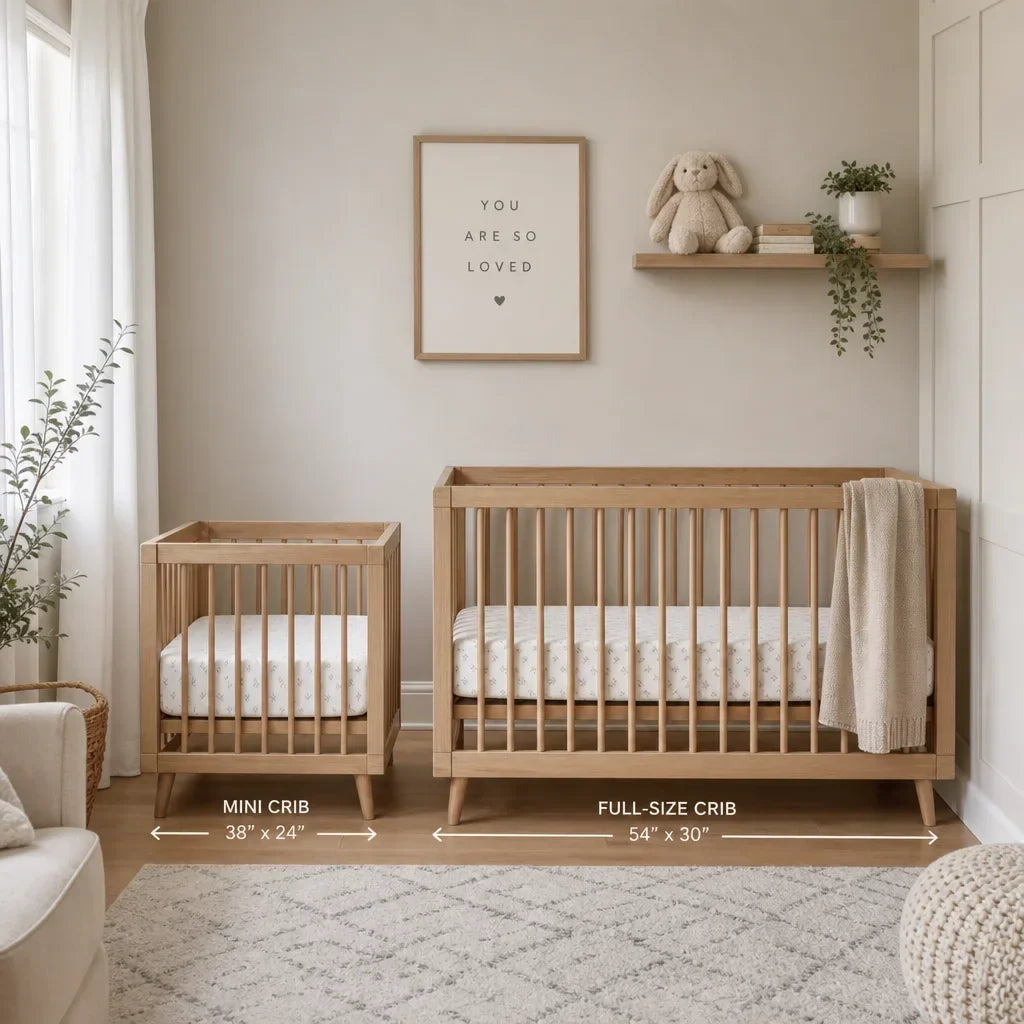
A smaller crib is not automatically the better buy. In the mini crib versus regular crib decision, the right choice usually comes down to four things: your floor space, how long you want the crib to last, how easy you want mattress and sheet shopping to be, and whether this is your main sleep space or a second one.
Mini crib versus regular crib: the quick answer
A mini crib works best when space is tight and every inch matters. It is usually the better fit for a small nursery, a condo bedroom, room sharing, a crib for apartment living, or a second sleep space at grandparents' house.
A regular crib works best when you want one crib to do the main job for longer. A standard crib usually gives you more room to grow, easier shopping for a standard crib mattress and crib sheets, and more convertible crib options.
Both types can be safe sleep spaces if the crib is intended for infant sleep in Canada, assembled correctly, used with the correct mattress, and set up with a firm surface and fitted sheet only. Safe sleep guidance from public health authorities recommends placing baby on their back, on a firm flat sleep surface, with no pillows, quilts, bumpers, or loose soft items in the crib .
Mini crib vs regular crib at a glance
A mini crib is smaller and often easier to place, while a regular crib is larger and usually lasts longer. Typical mini crib mattress sizing is often around 24 x 38 inches, while a standard crib mattress is commonly around 28 x 52 inches, but model-specific sizing still needs to be checked before you buy bedding .
| Feature | Mini crib | Regular crib |
|---|---|---|
| Typical sleep surface | About 24 x 38 in | About 28 x 52 in |
| Best fit | Small nursery, room sharing, secondary room | Primary nursery, long-term use |
| Portability | Some models are lighter, fold, or have wheels | Usually heavier and less mobile |
| Longevity | Often outgrown sooner | Usually lasts longer into toddler years |
| Mattress shopping | More model-specific | Easier to find standard sizes |
| Sheet shopping | Can take more checking | Standard crib sheets are easier to find |
| Convertibility | Some convert, some do not | More models convert to later bed stages |
| Upfront spend | Often lower | Often higher |
| Best use case | Compact condo, portable mini crib, mini crib for grandparents house | Main everyday crib for one child or more |
| Watch-outs | Earlier outgrowing, bedding fit issues | Larger footprint, heavier presence in room |
What is the difference between a mini crib and a regular crib?

The biggest difference is footprint. A mini crib is built to take up less floor space than a mini crib vs full size crib comparison shows right away, while a regular crib is designed as the main crib size most families picture for a primary nursery.
The second big difference is bedding compatibility. A standard crib size usually makes it easier to buy a standard crib mattress, fitted sheets, mattress protectors, and replacement bedding without checking each product label twice.
The third difference is how long the crib may work for your family. Mini cribs are often chosen for the newborn stage, room sharing, and compact layouts, while regular cribs are chosen when parents want more years from one purchase and fewer transitions.
The last practical difference is mobility. Some compact models are sold as a portable mini crib with locking wheels or foldable frames, but that is a model feature, not a rule for the whole category.
Is a mini crib okay for a newborn?
Yes, a mini crib can be okay for a newborn if that specific crib is intended for infant sleep and you use the matching properly fitted mattress. The safe setup is the same as with any crib: firm mattress, fitted sheet, no loose bedding, and baby placed on their back to sleep .
What matters most is the product itself, not just the category name. Parents should check the manufacturer's assembly instructions, age and stage guidance, and any height or weight limits before using a mini crib for newborn sleep.
A mini crib is often a practical choice for room sharing. Health authorities commonly recommend room sharing for at least the first 6 months, and many families use a compact crib to make that possible in a smaller bedroom .
A mini crib is a good idea when you know the smaller size matches your space and your timeline. It is less ideal if you are trying hard to avoid buying another sleep setup sooner.
How long can a baby stay in a mini crib vs a regular crib?

A baby can usually stay in a mini crib for less time than in a standard crib because the sleep surface is smaller. Many families use a mini crib for roughly 12 to 24 months, and some models may last longer, but the real limit is the manufacturer's instructions plus your child's size and mobility .
A standard crib usually lasts longer into toddlerhood. Many children use a full-size crib for roughly 2 to 4 years, especially when the crib later converts or when the child is not climbing early .
The right time to transition out is not based on birthday alone. The main triggers are reaching the model's height or weight limit, starting to climb, or looking cramped enough that safe sleep becomes harder to maintain.
The manufacturer limit always wins over a general age range. If one crib says to stop sooner, stop sooner, even if another family used theirs longer.
What are the pros and cons of a mini crib?
Mini crib pros and cons are pretty straightforward. The main advantage is space saving, and the main drawback is shorter useful life.
Mini crib pros
- Fits better in condos, apartments, and shared bedrooms
- Works well as the best crib for small nursery layouts
- Can be easier to move if the model has wheels or a lighter frame
- Useful as a second crib in a cottage, guest room, or grandparents' home
- Can replace a bassinet for some families if the crib is approved for newborn sleep and fits the room
Mini crib cons
- Often outgrown sooner than a regular crib
- Mini crib mattress options can be less straightforward
- Crib sheets may be harder to match across brands and models
- Not every compact crib converts later
- Some parents end up paying more overall when they upgrade early
The main drawbacks of using a small crib are earlier transition timing and less standardization in bedding. That is why we tell parents to compare the whole setup cost, not just the crib frame.
What are the pros and cons of a regular crib?
Regular crib pros and cons are the opposite in the places that matter most. A standard crib takes more room, but it usually gives you more runway.
Regular crib pros
- More room for baby to grow
- Standard crib mattress shopping is simpler
- Standard crib sheets are easier to find in stores and online
- Better long-term value when used as the main crib
- More models offer toddler bed, daybed, or full-size conversion paths
Regular crib cons
- Larger footprint in the nursery
- Harder to fit for room sharing in smaller homes
- Usually heavier and less portable
- Can cost more up front
A regular crib is usually the better pick for a larger primary nursery. It is also the easier answer if you want the crib to last longer or you plan to reuse it for another child later.
Mini crib vs bassinet vs pack and play: which one makes sense?

These products solve different problems. A bassinet is built for the earliest stage and usually takes the least room, a mini crib gives you a compact crib-style sleep space that may last longer than a bassinet, and a pack and play is often chosen for travel, temporary setups, or flexible multi-use spaces.
A mini crib vs bassinet comparison usually comes down to longevity and footprint. Many babies outgrow a bassinet by around 3 to 4 months or earlier if they roll, push up, or hit the product limit, while a mini crib can often stay useful much longer if the model is suitable from birth .
A mini crib vs pack and play comparison usually comes down to everyday sleep versus convenience. Some families use a playard for regular sleep if the product instructions allow it, but you should never assume every pack and play is the same or interchangeable with a crib for every use in Canada.
A mini crib is often the better middle ground for room sharing. It gives a more crib-like setup than a bassinet and may feel more stable as a daily sleep space than a travel-focused option, while still fitting where a standard crib may not.
A bassinet may still be the easier first choice after a C-section or for parents who want baby very close to the bed. A pack and play may still be the better choice for overnight visits, travel, or a highly temporary setup.
Safety: what to check before you buy either type of crib
Safety depends more on the exact crib and how you use it than on mini versus standard sizing. The crib should be intended for infant sleep in Canada, assembled exactly as directed, and used without aftermarket changes or makeshift mattress fixes.
The mattress fit matters every night. The correct mattress is the one designed for that crib or one the manufacturer clearly says fits that model, because gaps and poor fit can create unsafe sleep conditions.
The hardware should stay tight and complete. Loose screws, missing parts, cracked slats, damaged corners, and warped mattress supports are reasons to stop using a crib until the issue is fixed or the crib is replaced.
Secondhand buying needs extra caution. Avoid damaged cribs, modified cribs, and older drop-side designs, and check recall information through Canadian consumer product safety resources before use.
The safe sleep setup itself should stay simple. Public health guidance supports a firm flat mattress, fitted sheet only, baby on their back, and an empty crib with no pillows, blankets, bumpers, positioners, or stuffed toys .
Mattress and sheet shopping: where mini cribs get trickier

Standard bedding is usually easier to buy because standard dimensions are more consistent across the category. That makes a standard crib mattress and standard fitted crib sheets simpler for many families to replace and compare.
Mini crib mattress shopping takes more checking because mini crib size is not as universal in day-to-day retail language. Two products may both be called mini, but the mattress thickness, interior dimensions, and recommended fit can still differ by model.
The safest buying method is to match the crib first, then the mattress, then the sheets. If the crib maker sells a matching mattress for that frame, that is usually the easiest place to start.
Improvised fixes are never the answer. Do not wedge in an oversized mattress, pad gaps with blankets, add a topper to change the fit, or use loose sheets that can bunch.
What to measure before ordering bedding online
- The crib's interior mattress area
- The exact model name and number
- The mattress length, width, and thickness listed for that crib
- Whether the sheet is labelled for mini crib mattress or standard crib mattress use
- Whether the protector is sized for the same mattress dimensions
Price vs long-term value: which crib costs less overall?
A mini crib is often cheaper up front, but not always cheaper over the full buying cycle. The lower initial price can disappear if you need a second crib or toddler bed much sooner.
A regular crib usually costs more at the start, but it can give better long-term value when it serves as the main crib for years, uses easier-to-find bedding, and converts to the next stage instead of being replaced outright.
The real cost-of-ownership check includes more than the frame. Compare the crib, mattress, two or three fitted sheets, a mattress protector, any conversion kit, and the chance that you will need another bed earlier.
The best value is the crib that matches your stage and your space. A family in a one-bedroom condo may get excellent value from a compact crib, while a family furnishing a dedicated nursery may spend less overall by buying full size once.
Best choice by scenario
The best crib for small nursery layouts is usually a mini crib. It preserves floor space for a dresser, glider, closet access, and a safe walking path.
A crib for room sharing is also often mini first. In many parents' bedrooms, a regular crib takes up too much width near the bed, while a compact crib makes the first months easier without forcing furniture into unsafe placements.
A crib for apartment living usually leans mini as well, especially in condos with smaller bedrooms and tighter door swings. That is one reason mini cribs are a good idea for urban homes where the nursery and the parents' room may need to do double duty.
A primary nursery with enough room usually leans regular crib. If you want one crib to last longer and you have the floor space, the standard option is usually the less complicated path.
A mini crib for grandparents house makes sense when the sleep space is occasional and square footage is limited. A smaller frame is easier to place in a guest room and may be easier to move when the room needs to serve other uses.
Families planning more children often lean toward a standard crib if storage space and room size allow. Longer useful life and easier replacement bedding usually make it easier to reuse from one child to the next.
Twins need a more careful layout plan than a crib category guess. Two mini cribs may fit where two standard cribs do not, but measuring the room and checking walking clearance matters more than labels.
How to measure your nursery before choosing a crib
The best measuring method is to plan the whole room, not just the mattress area. Crib placement affects dresser clearance, traffic flow, blackout curtain access, and how comfortable overnight care will feel.
Start with the wall length where the crib may go. Then measure door swing, closet access, window area, baseboard heaters, and the path you need to walk while holding baby at night.
Measure the assembled crib footprint, not only the mattress size. The outer frame is what determines whether the crib fits beside your bed, clears a dresser, or blocks a glider.
Taping the crib footprint on the floor helps more than people expect. Painter's tape lets you see the actual shape in the room before you order anything.
Keep the crib away from cords, window coverings, shelves, and heaters. Safe placement matters just as much as choosing between mini crib vs standard crib sizes.
How to choose: a simple decision tree
If your nursery is tight, or you plan to room-share for the early months, start by looking at a mini crib. That is usually the cleanest answer for compact layouts and second sleep spaces.
If you want maximum longevity and easier bedding shopping, lean toward a regular crib. The larger size usually makes the long game simpler.
If your main goal is lower upfront spend, compare the full setup and likely transition timing before deciding. A cheaper frame is not automatically the cheaper plan.
If this crib is mainly for grandparents, a cottage, or occasional overnights, a mini crib or portable mini crib often makes more sense than buying a full-size model for limited use.
If you are still split, compare both sizes in person before you buy. Seeing the footprint beside a dresser or bed usually makes the answer obvious. If you are shopping in Toronto or the GTA, you can compare compact and full-size crib options in our showroom or book a virtual consultation to match the crib, mattress, and nursery layout with Canada-wide delivery available.
FAQ
How long can a baby stay in a mini crib?
Many families use a mini crib for about 12 to 24 months, though some models last longer. The correct limit is always the manufacturer's instructions plus your baby's size, mobility, and climbing stage .
Is a mini crib okay for a newborn?
Yes, if the product is intended for newborn sleep, assembled properly, and paired with the correct firm mattress. The sleep setup should follow safe sleep guidance with a fitted sheet only and no loose bedding .
Are mini cribs a good idea?
They are a good idea for small nurseries, room sharing, apartments, and second sleep spaces. They are less ideal if you want one crib to last as long as possible without upgrading.
What are the drawbacks of using a small crib?
The main drawbacks are shorter lifespan, less standardized mini crib mattress fit, and fewer easy bedding grab-and-go options. Some families also end up buying a second bed sooner.
Can a mini crib replace a bassinet?
Sometimes, yes. A mini crib can replace a bassinet if the crib is suitable for newborn sleep and fits your room, but a bassinet may still be more convenient right beside the bed in the earliest months.
Are mini crib mattresses the same size?
No, you should not assume they are all identical. Mini crib mattresses can vary by model, so always check the crib maker's dimensions and fit guidance before buying.
Is a mini crib cheaper than a regular crib?
It is often cheaper up front, but not always cheaper overall. If you need to replace it earlier, the long-term spend can end up closer than expected.
When should a baby move out of a mini crib?
Move out when your child reaches the manufacturer's limit, starts climbing, or no longer fits comfortably and safely. The same rule applies to a regular crib.
What is the 90 minute crib rule?
That phrase is not a standard crib-shopping rule or a recognized Canadian crib safety standard. If you saw it online, treat it carefully and check the original source before relying on it.
Why is SIDS highest at 2-4 months?
Public health guidance recognizes that SIDS risk is higher in early infancy, which is one reason safe sleep habits matter from day one. For medical questions about SIDS risk by age, speak with your baby's healthcare provider and rely on recognized public health sources rather than social posts.
At what age is SIDS no longer a risk?
SIDS risk drops as babies get older, but safe sleep practices should continue for the full infant period recommended by health authorities. For age-specific guidance, use Canadian public health advice or your child's healthcare provider.
If you are narrowing down crib options now, compare the footprint, mattress fit, and long-term plan before you compare colours. That usually leads to the better buy.


