

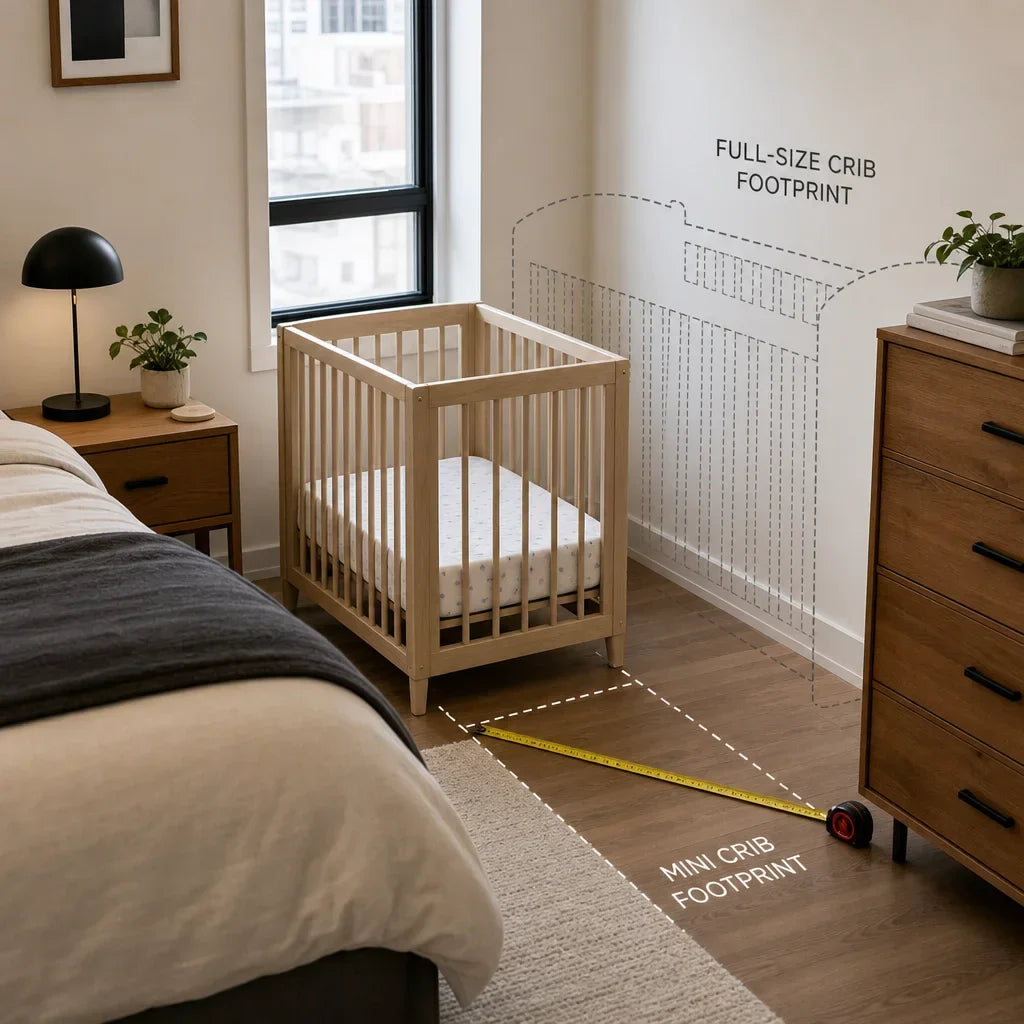
The best cribs for small spaces are usually not the biggest bargain or the trendiest style. The right pick is the crib that fits your room safely, leaves you enough space to move, and still works for how long you plan to use it.
Best cribs for small spaces: quick answer by room type
A mini crib is usually the best choice when every inch counts, because its footprint is roughly 24 x 38 inches, while a standard full-size crib is roughly 28 x 52 inches. That smaller size makes a real difference in a condo bedroom, a nursery nook, or a crib in small bedroom layouts where walking space matters as much as sleeping space.
A full-size crib for small spaces still makes sense when the crib can stay in one place and you want longer use before a bed transition. A standard crib takes more floor area, but it avoids the shorter usable lifespan that comes with many best small cribs and mini options.
A portable crib for small spaces works best when you need to move the sleep space between rooms, store it part of the time, or keep a second setup for grandparents. That category only works as an everyday sleep solution if the manufacturer says it is approved for overnight sleep.
A convertible crib is the better value when your room can handle the footprint and you want one piece to last beyond infancy. Some small-space shoppers focus only on the initial size, but the smarter comparison is footprint plus how many years the crib may serve your family.
| Crib type | Typical footprint | Best for | Longevity | Mattress needs | Mobility | Main trade-off |
|---|---|---|---|---|---|---|
| Mini crib | About 24 x 38 in | Apartments, shared rooms, tiny nurseries | Shorter than full-size | Mini crib mattress | Moderate on some models | Earlier transition likely |
| Full-size crib | About 28 x 52 in | Long-term nursery setup | Longer use | Standard crib mattress | Lower | Takes more space |
| Portable mini crib | Varies by model | Room-to-room use, flexible setups | Model-specific | Often mini-sized or model-specific | Higher | Check overnight sleep approval |
| Travel crib / playard | Varies by model | Temporary or travel use | Model-specific | Model-specific | Highest | Not every model is for regular overnight use |
Mini crib vs full-size crib vs portable crib vs travel crib

A mini crib is the most practical apartment sized crib when your goal is a permanent sleep setup in the smallest possible footprint. It feels lighter in the room, usually fits better beside an adult bed, and often suits parents who are room-sharing in the first year.
A full size crib for small spaces is the better fit when you can dedicate one wall or corner to it and do not want to buy twice. The extra sleeping surface gives you more runway before your child outgrows it, which is why many parents still choose it even in smaller homes.
A compact crib for small spaces sits between those two ideas only if the model is truly trimmed on outer dimensions, not just marketed that way. The number to compare is the outer footprint, because bulky end panels and drawer bases can make a crib feel much larger than the mattress size suggests.
A portable crib for small spaces is about flexibility, not just size. Wheels, foldability, and lighter construction help in shared homes, but those convenience features do not replace the need for sturdy construction and clear manufacturer sleep guidance.
A travel crib or playard belongs in a different category from a nursery crib. Some models are excellent for temporary use, but parents should check the manual and product listing before using one as a primary sleep space.
What size crib is best for small spaces?
A mini crib for small spaces is usually the best answer when the room is tight enough that a few extra inches affect door swing, dresser access, or the path around the bed. The practical gain is not just floor space. It is also easier caregiver access in a compact room.
A best full size crib for small spaces is the better answer when you have a clear spot for it and want to avoid an earlier transition. That is common in small nurseries where the crib can sit against one wall and the rest of the room uses slim furniture.
The smallest crib size you should shop for is not the one with the shortest label. It is the smallest crib that still meets current safety standards, uses the correct mattress, and leaves you enough room to stand beside it comfortably.
A mini baby crib is simply a crib with a smaller sleep area and smaller outer frame than a standard crib. There are mini cribs, and they make sense when your main problem is square footage, not when you just want a crib that looks smaller online.
Can a full-size crib fit in a small room?

Yes, a full-size crib can fit in a small room if it does not block the door, closet, dresser drawers, or the path you use at night. The footprint is roughly 28 x 52 inches, which is manageable in many bedrooms if the rest of the furniture is slim and intentional.
The best full size crib for small spaces usually has a clean, straight profile with no oversized headboard, thick posts, or attached changer. Those design choices do not just affect style. They affect how much visual and physical space the crib takes up.
A crib with drawers can reduce the need for a second storage piece, but it can also increase bulk and side clearance needs. That trade-off matters in a small bedroom with crib ideas where every drawer opening competes with bed space or a closet door.
Small-room fit guide: 3 common layout scenarios

A 5 x 7 foot nursery nook usually works better with a mini crib or another compact crib for small spaces than with a full-size model. A footprint of roughly 24 x 38 inches leaves more room for a narrow dresser, vertical storage, and a safe standing spot beside the crib.
A crib beside a full-size or queen bed in the parents' room usually favours an apartment size crib or portable mini crib. That setup needs enough space to get in and out of bed, reach the baby quickly, and keep exits clear during the night.
A one-bedroom apartment nursery corner usually works best when you keep the crib, one storage piece, and one feeding spot only. In that layout, the most useful furniture to skip is often a bulky changer or wide dresser that steals the walking path.
Where to put a crib in a small room — and where not to put it

The safest place to put a crib in a small room is away from windows, blind cords, curtain pulls, heaters, vents, and wall items that could fall. Those are placement basics because cords, heat sources, and unsecured decor create avoidable hazards.
A crib in parents' bedroom should sit where you can reach the baby easily without blocking the doorway or forcing a tight squeeze between furniture. A good layout is one that still lets the room function at 2 a.m., not just during a showroom walkthrough.
A crib should not be placed tight against furniture that creates entrapment risk or makes access awkward. Parents also should not place a crib beside climbable furniture, because toddlers who can pull up may use nearby pieces as a step.
The simplest placement checklist is this: the door opens fully, you can stand beside the crib, drawers can open, and cords stay out of reach. That is how to put crib in small bedroom setups without turning the room into an obstacle course.
Are mini cribs a good idea? Pros, cons, and how long they last
Mini cribs are a good idea when your room is the limiting factor and you need a safe sleep space with a smaller footprint. They are especially practical for condos, room-sharing, and families who want the nursery to feel open rather than crowded.
The main drawbacks of using a small crib are shorter usable lifespan, model-specific mattress and sheet sizing, and fewer bedding choices. Those are manageable trade-offs, but they are real costs in convenience and long-term value.
A mini crib is worth getting when you know the room cannot comfortably handle a standard crib or when you expect the setup to be temporary. Many families use a mini crib as phase one, then move to a larger crib or bed later.
How long a baby can stay in a mini crib depends on the manufacturer limits and the child's height, weight, and climbing behaviour. There is no safe blanket age because limits vary by model, so the product manual is the rule that counts.
A 2 year old may fit in some mini cribs and outgrow others, which is why the manual matters more than general internet advice. The real transition triggers are reaching the stated limit, climbing attempts, and reduced comfort in the smaller sleep space.
Whether a 2.5 year old should still be in a crib is a separate decision from whether a mini crib still fits. Some toddlers still sleep in cribs safely, but parents should follow the product limits and speak with their pediatrician on sleep-transition questions specific to their child.
What features matter most in a crib for a small space?

The most important feature in an apartment size crib is compact outer dimensions, not just a compact mattress. Outer size tells you whether the crib will fit past the bed, beside the dresser, and through a narrow condo layout.
An adjustable mattress height matters because it changes both safety and daily use. A higher setting can be easier for newborn access, and lower settings become important as babies grow and pull up.
Lockable wheels are useful on compact cribs for small spaces when you need occasional movement for cleaning or room reconfiguration. Wheels are a convenience feature, though, not a reason to compromise on stability or sleep approval.
A foldable frame can help in a temporary setup, but foldability only adds value if you truly plan to store or move the crib. In a permanent nursery, a sturdy fixed frame is often the simpler choice.
Easy assembly matters more in small homes than people expect because condos, hallways, and elevators can limit how you bring furniture in. Assembly time varies widely by model, and the more complex the frame, the more that matters in a tight space.
Mattress, sheets, and low-tox materials for small cribs

Mini cribs usually need special mattresses and sheets sized for that crib type or that exact model. Parents should never improvise sizing, because mattress fit is a safety issue, not a styling choice.
A small crib Canada shopper should check the product page and manual for mattress compatibility before ordering. The right question is whether the mattress is approved for that crib, not whether it looks close enough in size.
Low-tox materials matter in a nursery because babies spend long stretches close to the sleep surface and finish. Many parents prefer non-toxic finishes, solid wood where possible, and low-emission materials for peace of mind and indoor air quality.
A crib mattress can be a concern for sensitive families if materials trap odours, use heavy chemical treatments, or have hard-to-clean covers. That is not a reason to make medical claims. It is a reason to read material details and choose washable, well-documented products.
What certifications should you look for?

The certifications and testing language to look for are the ones clearly listed by the manufacturer or retailer for the exact crib you are buying. In Canada, parents should check current product listings rather than assume US terms always translate directly.
GREENGUARD Gold is a common label parents recognize for lower chemical emissions, while JPMA, ASTM, and CPSC are terms often seen on US-market crib information. Those labels can be useful context, but Canadian shoppers should confirm exactly what standard or compliance statement applies to the item sold here.
The safest way to shop certifications is to read the current product page, the manual, and any brand documentation attached to that crib. If a certification matters to your purchase decision, verify it before checkout rather than relying on a general category page.
Best crib type for shared bedrooms, twins, and multi-child rooms
Mini cribs or compact cribs for small spaces are often the most practical option for shared bedrooms because two full-size cribs can overwhelm the room quickly. The tighter the layout, the more floor path and caregiver access become the deciding factors.
Twin cribs for small spaces require even more planning around the feeding chair, dresser, and doorway than a single-crib room. In most multi-child setups, the first priority is keeping enough open floor area to move safely between both sleep spaces.
Room-sharing with parents has different priorities from siblings sharing a room. In a parents' bedroom, the key issue is bed access and night-time reach. In a sibling room, the key issue is traffic flow, storage, and keeping climbable furniture away from the crib area.
What to buy with a crib for a small space
The best companion pieces for a small bedroom with crib ideas are a narrow dresser, vertical shelving, and only the storage you will truly use daily. In compact rooms, fewer pieces usually work better than multi-piece sets with oversized proportions.
Under-crib bins can help only if the crib's base design leaves usable clearance and the manufacturer does not restrict storage there. That makes this a model-by-model decision, not a universal small-space trick.
A small crib with storage or an apartment sized crib with drawers can save you from buying another piece, but added storage often means a larger visual footprint. Parents should compare the total room plan, not just the promise of extra drawers.
A convertible crib can offer better long-term value if the room can support it, but conversion features are not automatically the best choice in the tightest spaces. The right buy is the one that fits the room now and still makes sense for your next stage.
Small-space crib buying checklist: what to measure before you order
Measure the room first, because the best apartment size crib on paper still fails if the door, bed, or dresser cannot work around it. Start with wall-to-wall room dimensions, then measure the exact area where the crib would sit.
Measure door swing, closet access, and dresser drawer clearance next. A crib that fits the floor plan but blocks storage or entry will make the room frustrating every single day.
Measure the path to the crib, not just the crib spot. That includes the space you need to walk, bend, lift the baby, and move around during night feeds.
Measure nearby obstacles such as baseboards, radiators, vents, windows, and bed frames. Small obstructions can matter in a compact room because they reduce the usable rectangle more than parents expect.
Measure the crib's outer dimensions, not just the mattress dimensions or sleeping surface. This is the mistake we see most with compact crib for small spaces shopping, especially online.
Measure delivery and assembly access too, including condo elevators, stair turns, and narrow hallways. A crib can fit the room perfectly and still become a headache if the box or assembled parts are hard to maneuver.
If you want a second opinion before ordering, comparing crib sizes in person or through a virtual consultation can help you avoid a measurement mistake. Stores with showroom and Canada-wide delivery options can be useful for that kind of planning.
FAQ
What size crib is best for small spaces?
A mini crib is usually best when every inch matters, while a full-size crib is better when you have a dedicated spot and want longer use. Typical footprints are about 24 x 38 inches for mini cribs and about 28 x 52 inches for full-size cribs.
Are mini cribs good for small spaces?
Yes, mini cribs are good for small spaces because they reduce footprint and visual bulk. Their trade-off is that many babies outgrow them sooner than standard cribs.
What is the smallest crib you can buy?
The smallest crib you should consider is a properly certified mini crib that uses the correct mattress and follows the manufacturer's limits. Smaller is only better if it still works as a safe everyday sleep space.
How long can a baby stay in a mini crib?
A baby can stay in a mini crib until the model's height, weight, or developmental limits are reached. There is no universal age cutoff, so parents should check the manual for that exact crib.
Does a baby need a full-size crib?
No, a baby does not automatically need a full-size crib. A mini crib can work well if it meets safety standards, fits the baby appropriately, and suits your room and timeline.
Can a full-size crib fit in a small bedroom?
Yes, if the layout stays functional after it goes in. The crib should not block the door, closet, bed access, or the place where you need to stand beside it.
Where should you put a crib in a small room?
Put the crib where you can reach it easily and where it stays away from windows, cords, heaters, vents, and falling decor. In shared bedrooms, keep exits and night-time paths clear.
Where should you not place a baby crib?
Do not place a crib beside window cords, curtain pulls, heaters, vents, or climbable furniture. Avoid squeezing it tight against pieces that make access awkward or create gaps.
Do mini cribs need special mattresses and sheets?
Yes, mini cribs usually need mini crib mattresses and fitted sheets made for that size or model. Parents should follow the crib manufacturer's compatibility guidance exactly.
Is there such a thing as a portable crib?
Yes, there are portable cribs, including wheeled mini cribs and travel-style options. Parents should still confirm whether the exact model is approved for overnight sleep.
What are the drawbacks of a small crib?
The main drawbacks are a shorter usable lifespan, fewer bedding options, and model-specific mattress sizing. That trade-off is often worth it in small apartments or shared rooms.
What should I measure before buying an apartment size crib?
Measure room dimensions, crib location, door swing, closet access, drawer clearance, walking path, nearby obstacles, and delivery access. Always compare the crib's outer dimensions, not just the mattress size.
If you are choosing between a mini crib, a full-size model, or a portable option, start with your tape measure before you start with colour or style. That one step usually answers more than product rankings do.


