

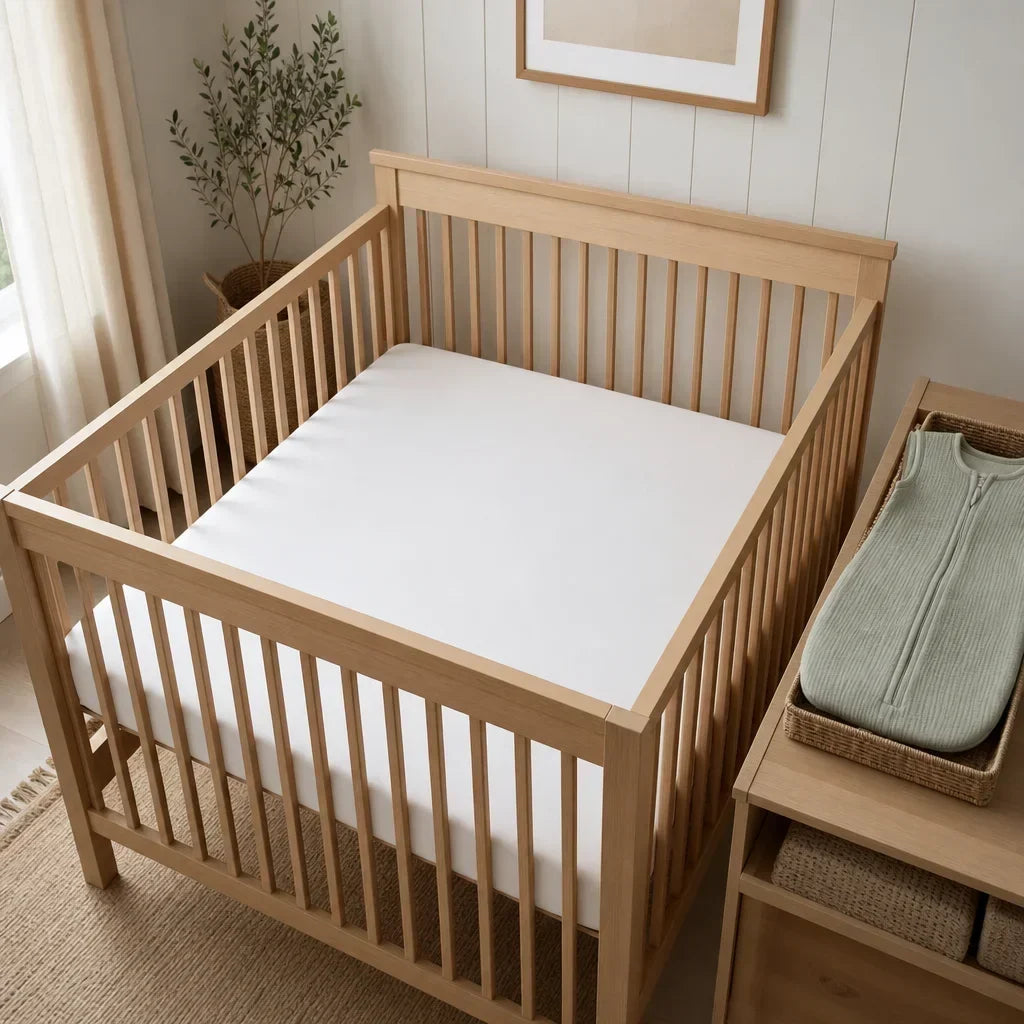
Crib bumper safety has a short answer. Padded, braided, and decorative crib bumpers are not recommended for infant sleep, and the safest setup is a bare crib with a firm, flat mattress and one fitted sheet.
Quick answer: Are crib or cot bumpers safe?
Crib and cot bumpers are not considered a safe choice for infant sleep because they add soft material, attachment points, and potential entanglement hazards to the sleep space. That applies to newborns, older babies, and most products sold as padded bumpers, braided bumpers, cot padding, or decorative crib sides.
A bare sleep space is the safer standard: a firm, flat mattress and a fitted sheet only. Parents worry about head bumps and limbs slipping through slats, and that concern is real, but current safe-sleep guidance still prioritizes an empty crib over added cushioning.
Products marketed as breathable or mesh liners need a separate discussion because they are built differently from thick padded bumpers. That said, breathable wording is marketing language, not proof that a product is the safest choice for routine infant sleep.
What counts as a bumper, liner, or sleep-space padding?
A crib bumper is any pad, pillow-like panel, braid, or cushioned strip attached to the inside of a crib or cot. A cot liner is usually a thinner panel, and a mesh liner is usually a fabric wall with more airflow than padded bumpers, but both still add material inside the sleep space.
The same issue applies across product names. Crib is the common North American term, while cot is more common in the UK and Australia, but crib bumper danger and cot bumper risks come from the same basic setup: added fabric and attachments around a baby's face and body.
Bassinet bumper pads, cradle bumpers, and Moses basket bumpers fit the same category because they add soft sides or padding where a baby sleeps. Smaller sleep spaces can increase surface contact, which is one reason bassinet bumper safety is not treated as a separate safe exception.
Rail guards and teething guards are a different product category because they are meant to cover the top rail, not line the full sleep space. Even then, they should only be used exactly as directed by the crib maker and should never create loose fabric or padding near a sleeping infant.
Why crib bumpers are considered unsafe
Crib bumpers unsafe is the right shorthand because the risk is not just one thing. Soft padding can create suffocation risk, support rebreathing near the sleep surface, and introduce strangulation or entrapment hazards through ties, loose sections, or shifting fabric.
Babies do not need much extra material to get into trouble during sleep. If a baby's face presses into padding, airflow can be reduced, and if a product loosens or shifts, it can bunch, twist, or create gaps.
Older babies are not automatically protected by being more mobile. Once a baby can roll, sit, stand, or pull up, a bumper can become something to push against, climb on, or get tangled with. That is one reason cot bumpers unsafe remains a concern even after the newborn stage.
The soft look is what misleads people. Bumpers can look protective, but safe sleep works by removing hazards, not adding cushioning around them.
Padded vs braided vs mesh vs no bumper: risk comparison table

The safest baseline is no bumper at all. The table below shows why no bumper remains the standard comparison point.
| Product type | Suffocation risk | Strangulation or tie risk | Entrapment risk | Airflow or rebreathing concern | Climb-out risk | Recommended for infant sleep? | Notes |
|---|---|---|---|---|---|---|---|
| Padded bumper | Higher | Present if attached with ties or if material loosens | Present if gaps form or baby presses into it | Present | Can increase once baby stands | No | This is the classic crib bumper danger most guidance warns about. |
| Braided bumper | Present | Present if it shifts or wraps loosely | Present between braid sections and mattress edge | Present | Can increase once baby stands | No | Braided crib bumper safety concerns are not solved by the shape. |
| Mesh liner | Lower padding bulk than thick bumpers, but not risk-free | Present because it still attaches to the crib | Present if fit is poor or liner loosens | Marketed as breathable, but not the same as necessary or safest | Can contribute once baby uses crib sides for leverage | Not the default recommended setup | Mesh crib bumper safety is not the same as a clear endorsement. |
| No bumper / bare crib | Lowest baseline in this comparison | None from bumper material | No bumper-related gap or tie issue | No added airflow barrier | No added foothold | Yes | Firm mattress and fitted sheet only. |
Are breathable or mesh crib liners safe?
Breathable does not mean proven safe for every sleep setup. Breathable crib liner safety claims usually describe the fabric's airflow, but they do not erase fit problems, attachment hazards, loose sections, or the fact that the product is still an added layer inside the crib.
Mesh can reduce some of the bulk seen with thick padded bumpers. It does not solve the full safety problem because a breathable mesh crib liner safe claim still depends on secure fit, correct installation, product design, crib compatibility, and the baby's stage of development.
Parents also ask whether babies can breathe through mesh. Some mesh fabrics allow more airflow than padded fabric, but that point alone does not make all mesh liners safe or necessary. Are mesh crib liners safe is still not a yes-by-default question.
If you are evaluating a liner sold in Canada, check the manufacturer's instructions, warnings, age limits, and crib-fit requirements. We would treat any claim like breathable bumpers safe or breathable cot bumper safety with caution unless it is backed by current authority guidance and a product that matches your exact crib.
Are bassinet, cradle, and Moses basket bumpers safe?
The same safe-sleep rule applies in bassinets, cradles, and Moses baskets: do not add soft bumpers, side pads, or loose sleep-space padding. Bassinet bumper pads safety is not different in principle from crib bumper safety.
These sleep spaces are smaller, so extra padding can leave less room and create more contact between the baby and the side surface. That is why cradle bumpers safe and bassinet bumper safety searches should lead to the same plain answer: avoid them for infant sleep.
Manufacturer instructions matter because each sleep product has its own design limits. If a bassinet, cradle, or basket manual does not call for an accessory, adding one can change how the sleep space performs.
At what age, if ever, are bumpers safe?
There is no simple age where crib bumpers safe at what age becomes an automatic yes. Risk changes as babies roll, sit, stand, and pull up, but mobility does not make padded, braided, or tied products harmless.
For newborns, the answer is the clearest: no bumpers. The same caution still applies at 6 months, 10 months, and around 1 year because the product can shift from a soft-surface risk to a climbing or entanglement risk.
For toddlers, the real question may be whether the child is still in an infant crib setup at all. Standard crib use ends when a child reaches 35 inches tall or begins climbing out, whichever comes first. At that point, parents should follow the crib manufacturer's limits and review whether a toddler bed or other age-appropriate setup is safer.
Mesh products do not create a universal age exception either. If a family is using a liner despite the caution around them, removal timing should come from the product instructions, crib compatibility, and the child's developmental milestones, not a guessed age.
My baby keeps bumping their head or getting limbs through slats. What should I do instead?
A brief bump on the crib side is usually less dangerous than adding soft padding around the sleep space. That feels unsatisfying when you hear a knock or see an arm through the slats, but it is why safe-sleep advice still favours a bare crib.
Modern crib slats are meant to be spaced no more than 6 centimetres, or 2 3/8 inches, apart. That spacing is designed to reduce the risk of a baby's body slipping through while still allowing an open crib structure.
The safer fixes are practical. Use a properly assembled crib, a well-fitting mattress, and a fitted sheet only. If warmth is the issue, use a sleep sack or wearable blanket instead of loose bedding.
The setup should also change as your baby develops. Lower the mattress once your baby can sit or pull up, and move to the next sleep stage when the crib maker's height or climbing limit is reached. If you see repeated hard impacts, unusual bruising, frequent climbing, or anything that concerns you developmentally, bring it up with your pediatrician.
Myth vs fact
- Myth: Bumpers are needed to stop serious head injuries. Fact: brief contact with crib slats is usually a smaller risk than adding padded sides.
- Myth: Bumpers are the best way to stop arms and legs slipping through. Fact: a bare crib is still the safer standard, and sleep sacks can help with general sleep comfort without padding the crib walls.
- Myth: If a product says breathable, the safety issue is solved. Fact: breathable marketing does not remove fit, attachment, or climb-related concerns.
What to use instead of crib or cot bumpers
A safe crib bumper alternative is not another padded product. What to use instead of crib bumpers is a simple infant sleep setup: a firm, flat mattress, one fitted sheet, and baby placed on their back.
If your concern is warmth, use a wearable blanket or sleep sack instead of blankets or cot padding. If your concern is looks, keep decor on the walls, dresser, or chair rather than inside the crib.
If your concern is teething on the rail, look at the crib maker's instructions before adding any rail cover. A rail guard solves a different problem from a bumper, and it should never create loose fabric, ties, or soft padding in the sleep area.
There is no soft padded equivalent that gives the same bumper look and still matches safer infant sleep best practice. That is the honest answer to what to use instead of cot bumpers and what should I use instead of a crib bumper.
Safe crib setup checklist
A safe sleep space is simple and easy to check. Use this list whenever you set up a new nursery or re-check hand-me-down items.
- Firm, flat crib mattress
- Tight fitted sheet only
- Baby placed on their back for sleep
- No pillows
- No quilts, duvets, or loose blankets
- No bumper pads or liners
- No stuffed toys
- No sleep positioners or nests
- No loose straps, cords, or tied-on accessories
- Re-check the crib after gifts, nursery styling changes, or secondhand additions
If you are building a nursery from scratch, focus on the crib, mattress fit, and room layout first. Decorative extras should stay outside the crib so the sleep space stays clear every night and every nap.
Are crib bumpers illegal in Canada? Canada vs. U.S. rules explained
Legal status and safety are not the same thing. A product can be sold in a market and still not be the safest choice for infant sleep.
In Canada, parents should start with current Health Canada and Canadian safe-sleep guidance rather than assume retail availability equals approval. Because rules and enforcement can change, we would not treat any single article as the final word on whether crib bumpers are illegal in Canada or how a specific liner is classified.
In the United States, the Safe Sleep for Babies Act became law in 2022 and addressed padded crib bumpers as part of a wider federal safe-sleep push. Readers should still verify the current scope, definitions, and retailer policies, especially when asking whether mesh crib liners are treated differently from padded bumpers.
The practical takeaway is simple. Do not use legality as a shortcut for safety, and do not use a marketing label as proof that a product belongs in a baby's sleep space.
If you already own bumpers or mesh liners, what should you do?
If a product is not recommended for infant sleep, the safest next step is to remove it from the crib, cot, bassinet, or cradle and reset the space to a bare setup. That applies whether the product is padded, braided, decorative, or sold as a liner.
Secondhand products deserve extra caution. Used bumpers and liners can have stretched ties, missing warnings, unknown age, wear that affects fit, or older designs that do not match current guidance.
If you are unsure what a product is or whether it belongs in the crib, check the original manual, product label, and current government or pediatric guidance. If there is no clear instruction, do not guess inside a baby's sleep space.
If you are setting up a nursery and want to keep things simple, shop for a safe crib and well-fitting mattress rather than sleep accessories. Families in Toronto often find it easier to compare crib designs in person, and Baby Warehouse also offers virtual consultations across Canada if you want help choosing nursery furniture that supports a straightforward safe-sleep setup.
FAQ
Are crib bumpers safe for babies?
No. Crib bumpers are not recommended for infant sleep because they add soft material and attachment-related hazards to the crib.
Are breathable mesh crib liners safe?
Not by default. Mesh may be less bulky than padded bumpers, but breathable mesh crib liner safe claims do not remove fit, attachment, and developmental concerns.
Are crib bumpers illegal in Canada?
Do not assume a simple yes or no without checking current Canadian guidance and enforcement updates. The safer point is that availability does not equal safety.
What can I use instead of a crib bumper?
Use nothing on the crib sides. The safer alternative is a firm mattress, fitted sheet, and a sleep sack if warmth is the concern.
How do I prevent my baby from hitting their head on the crib?
Keep the crib bare, make sure it is assembled correctly, and use the correct mattress fit. Brief bumps are usually less risky than adding padding.
At what age are crib bumpers safe?
There is no universal age when bumpers become automatically safe. Follow the crib maker's limits and keep infant sleep spaces free of added padding.
Are bassinet bumper pads safe?
No. The same safer-sleep principle applies to bassinets, cradles, and Moses baskets.
Are cot bumpers safe for a 1 year old?
Not as a general recommendation. By that age, climbing and entanglement concerns can matter as much as soft-surface concerns.
Should I remove crib bumpers if I already have them?
Yes, if the product is in your baby's sleep space and is not part of current safer-sleep guidance. Reset the crib to a bare setup.
What are four things that should not be in a crib?
No pillows, no loose blankets, no bumper pads or liners, and no stuffed toys.
Are crib bite guards safe?
They are a separate product from bumpers. Only use one if the crib manufacturer allows it and it does not create loose fabric or padding near the baby.
What is the 90 minute crib rule?
This is not a standard crib bumper safety term in mainstream safe-sleep guidance. If someone uses it online, ask them for the original pediatric or government source before relying on it.
The short version is still the right one to remember. Keep the crib bare, compare products by the hazards they add, and if something is sold to pad the inside of a baby's sleep space, treat it with caution and check current Canadian guidance before using it.


