

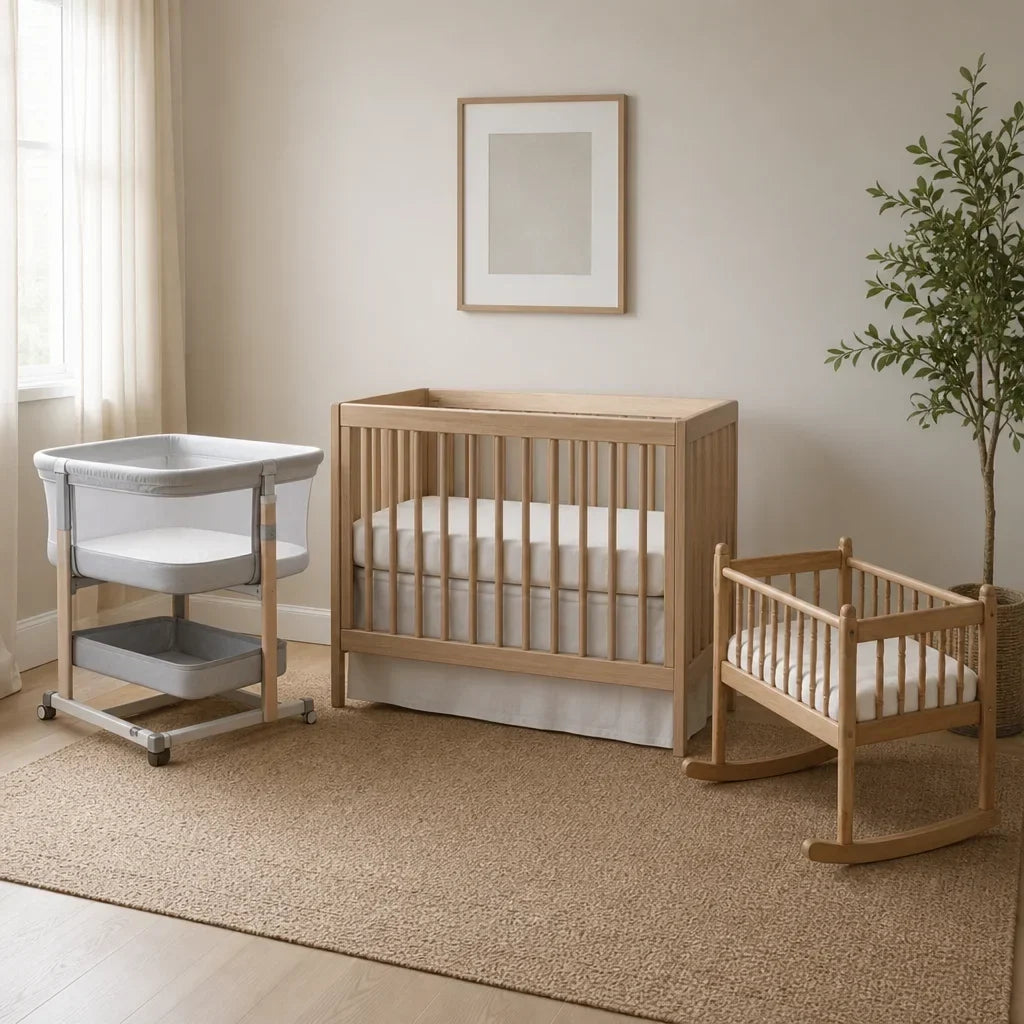
The safest sleep space is not the fanciest one. In the bassinet vs crib vs cradle decision, the right pick usually comes down to room setup, how long you want it to last, and whether the specific product is approved for unsupervised infant sleep.
Bassinet vs crib vs cradle: the quick answer
A bassinet is usually the easiest choice for early room sharing because it is compact, easier to move, and built for the newborn stage. Many bassinets are used only for the first few months, and manufacturer limits often end use around about 4 to 6 months or earlier if baby rolls or pushes up.
A crib is usually the best long-term value because it can work from birth if the manufacturer allows it and can often stay in use into the toddler years. Many standard cribs are used much longer than bassinets or cradles, often roughly 2 to 3 years depending on the model, height limits, and when the child climbs out.
A cradle is a more specialized option that appeals to families who want gentle rocking motion in a compact infant bed. It can be safe only if that specific cradle is designed for unsupervised infant sleep, assembled exactly as instructed, and used only within its stated limits.
Many families buy a bassinet first and a crib next because that setup balances bedside convenience with long-term nursery use. Other families skip the bassinet and start with a crib from day one to avoid buying twice.
- Best for bedside newborn setup: bassinet
- Best for nursery-first setup: crib
- Best for longest use: crib
- Best for a small bedroom with more longevity: mini crib
- Best for soothing motion: cradle, if the model is approved for overnight sleep
- Best for strict budget over time: usually crib or mini crib
What is the difference between a bassinet, cradle, and crib?

A bassinet is a small infant sleep space designed for the earliest stage, usually with a lighter frame and a smaller footprint than a crib. The key point in any bassinet vs crib comparison is that a bassinet is built for short-term newborn use, not the full baby-to-toddler period.
A cradle is also a small infant bed, but it usually adds a rocking or gliding motion as its defining feature. In cradle vs bassinet comparisons, that motion is the main difference, not just the shape or the name parents use.
A crib is a larger enclosed baby bed with fixed sides, and it is designed to last much longer than a bassinet or cradle. In crib vs cradle decisions, the crib usually wins on lifespan and nursery value, while the cradle wins only if you specifically want motion in a compact newborn sleep space.
A mini crib is not the same as a bassinet, because it functions more like a smaller crib than a newborn-only sleep product. That matters in mini crib vs bassinet decisions, since a mini crib often lasts longer and can reduce the need for an early transition.
A playard or pack and play belongs in the wider conversation, but it is a separate category with its own instructions and sleep approvals. In a bassinet vs crib vs pack n play comparison, the deciding factor is not the label but whether the exact product and sleep surface are approved for unsupervised sleep.
Head-to-head comparison table: size, portability, lifespan, cost, and room-sharing fit

The most practical way to compare bassinet vs cradle vs crib is to look at how each one works in real life. This table keeps the focus on everyday use, not marketing features.
| Factor | Bassinet | Cradle | Crib | Mini crib |
|---|---|---|---|---|
| Best stage | Newborn to early infancy | Newborn to early infancy | Birth onward if manufacturer allows | Birth onward if manufacturer allows |
| Typical use window | Often about 4 to 6 months or less depending on milestones and limits | Often about 4 to 6 months or less depending on milestones and limits | Often into toddler years depending on model and child size | Longer than bassinet, shorter or similar to some full cribs depending on model |
| Footprint | Small | Small | Largest | Smaller than standard crib |
| Portability | Best | Good to limited | Limited | Limited |
| Room-sharing fit | Best | Good | Depends on bedroom size | Very good |
| Motion | Sometimes | Usually the main feature | None | None |
| Long-term value | Limited | Limited | Best | Very good |
| Second purchase likely needed | Yes | Yes | No for early stages | Less urgent than bassinet |
| Assembly effort | Usually lighter | Usually moderate | Usually highest | Moderate |
| Small condo fit | Good | Good | Depends | Best balance |
| Best after C-section or frequent feeds | Often best beside the bed | Sometimes helpful | Less convenient bedside | Good if room allows |
Which one is best for a newborn?

A bassinet is often the easiest newborn choice when parents want baby close by at night without fitting a full crib into their room. That is why bassinets remain popular in Canada, especially in condos, apartments, and shared bedrooms.
A crib can also be a very good newborn choice if you already have the nursery ready or want one sleep space from day one. In bassinet vs crib debates, the crib is not less safe because it is bigger; it is safe when it meets current standards, uses the correct mattress, and follows the manufacturer instructions.
A cradle can work for a newborn, but it suits a narrower set of families because the use period is short and the rocking feature is not essential for safe sleep. In is a cradle or bassinet better questions, the bassinet is usually the more practical answer unless you specifically want that motion and accept the earlier transition.
The simplest ranking by use case is this: bassinet for bedside convenience, crib for longest use, cradle for families who want compact rocking and understand the tradeoff. If your bedroom is tight but you want more longevity, a mini crib can be the better compromise than either a bassinet or cradle.
Which one should you buy if your family setup is specific?

A bassinet is usually the best fit for room sharing in the first weeks because it takes less space beside the bed and is easier to access overnight. That makes it a practical choice for frequent feeds, recovery after a C-section, and smaller bedrooms where a full crib feels bulky.
A crib is usually the best fit for parents who want one main purchase with the strongest long-term value. In crib vs bassinet vs cradle decisions for budget-minded families, buying the longer-use sleep space first often avoids the cost and disruption of an early switch.
A mini crib is often the best fit for a small condo or apartment when parents want more lifespan than a bassinet without the footprint of a standard crib. In mini crib vs bassinet comparisons, the mini crib usually gives up some portability but reduces transition urgency.
A cradle makes the most sense for parents who strongly want soothing motion and are comfortable with a shorter use window. In cradle vs bassinet for newborn setups, the cradle is worth considering only if the exact model is approved for overnight sleep and the rocking system is used exactly as instructed.
A second sleep space for grandparents is usually easiest as a crib or a bassinet, depending on how often it will be used and how much room is available. A short-term occasional setup may suit a bassinet, while a more regular sleep space usually makes a crib or mini crib more practical.
A multi-floor home usually benefits more from portability than from motion, so a bassinet often works better than a cradle. If you are carrying the sleep space or moving it room to room, lighter weight and smaller size matter more than decorative style.
Pros and cons of a bassinet

A bassinet's biggest advantage is convenience in the newborn stage because it is compact, visually lighter, and easier to place near the parents' bed. That is the main reason people get bassinets instead of cribs, especially when nighttime access matters more than long-term use.
A bassinet's biggest drawback is how quickly some babies outgrow it. Many models are used only for a few months, and stopping points are often tied to milestones like rolling, pushing up, or reaching the manufacturer's weight limit, not age alone.
A bassinet does not prevent SIDS by itself, because no sleep product does that. Safer sleep depends on using an approved sleep space with a firm flat surface, a properly fitting mattress, and no pillows, bumpers, nests, or loose blankets.
Some babies seem to dislike a bassinet, but the sleep space is not always the real problem. Fussiness can come from routine changes, reflux, temperature, overtiredness, or simply preferring contact, so it is too simplistic to say newborns hate bassinets.
Pros and cons of a cradle

A cradle's main appeal is gentle motion in a compact infant bed, and that can be very attractive to parents who like a classic nursery look. In baby cradle vs bassinet comparisons, the cradle stands out more for feel and function than for longer use.
A cradle's main downside is that it usually has one of the shortest practical lifespans of the three options. That makes it harder to justify if your top priorities are long-term value, minimal transitions, or buying once.
A cradle is safe for overnight sleep only when that exact product is designed for unsupervised infant sleep and all instructions are followed. In are cradles safe for babies to sleep in questions, the honest answer is yes for some models and no assumption for the category as a whole.
A rocking feature needs to be used exactly as the manufacturer describes, including any lock or fixed-position instructions. Parents should never improvise wedges, added padding, or homemade parts on a cradle or any other infant sleep product.
Pros and cons of a crib

A crib offers the strongest long-term value because it is the sleep space most families can keep using the longest. In bassinet vs crib and crib vs cradle decisions, this is the crib's clearest advantage.
A crib can be used from birth when the product instructions allow it and the sleep setup is done correctly. That means a crib is not just for older babies, and many families skip the bassinet stage entirely without giving up a safe newborn sleep option.
A crib takes more room and usually costs more upfront than a bassinet or cradle. The tradeoff is that it often avoids a second purchase in the first few months, which can make it the most cost-effective path over time.
A standard crib, mini crib, and convertible crib solve slightly different problems. Standard cribs maximize sleeping space, mini cribs help smaller rooms, and convertible cribs may extend furniture use further depending on the design.
Bassinet vs mini crib vs standard crib

A mini crib is often a better choice than a bassinet for a small bedroom when parents want a compact footprint without a very short use window. That is why mini crib vs bassinet is one of the most useful comparisons for condo living.
A bassinet is usually easier to move and often better for close bedside placement in the earliest weeks. A mini crib gives up some of that portability, but it usually lasts much longer and can simplify the transition plan.
A standard crib gives the most room and the longest traditional nursery setup, but it may not fit every bedroom comfortably. In bassinet vs crib vs cradle size comparisons, the standard crib is usually the least flexible option for very tight spaces.
A playard may help for travel or temporary use, but it should not replace a crib or bassinet unless the exact sleep configuration is approved for unsupervised infant sleep. In bassinet vs crib vs pack n play decisions, the product manual matters more than the broad category.
Safe sleep basics for bassinets, cradles, and cribs

The safest choice is a product made for infant sleep, assembled correctly, and used with the mattress and parts intended for that model. In Canada, parents should look for current product compliance information and follow the manufacturer's instructions exactly, especially for products covered by the Cribs, Cradles and Bassinets Regulations.
The sleep surface should be firm, flat, and free of added soft items. That means no pillows, sleep positioners, loose blankets, bumper pads, or aftermarket inserts unless the manufacturer specifically approves that exact use.
A bassinet does not reduce SIDS risk just because it is smaller. Room sharing and a safe setup may support safer sleep practices, but no bassinet, cradle, or crib should be marketed as preventing SIDS.
A used sleep product deserves extra caution because missing hardware, damaged parts, worn supports, or old designs can change safety. Parents should check for recalls, confirm that all original parts are present, and avoid using any item that has been modified or repaired with non-original hardware.
Safe sleep checklist
- Use only a sleep product intended for infant sleep.
- Follow the product manual and assembly steps exactly.
- Use the mattress made for that model, with a tight fit.
- Keep the sleep space bare.
- Stop using it at the first listed milestone or limit.
- Do not add wedges, positioners, extra padding, or homemade fixes.
- Check recalls before using a second-hand item.
When to stop using a bassinet or cradle and move to a crib

You should stop using a bassinet or cradle when your baby reaches the product's stated milestone or size limit, even if they still seem to fit. Many models are discontinued around about 4 to 6 months, but rolling, pushing up, sitting, or hands-and-knees movement can end use earlier.
Age alone is not the safest guide because babies develop at different speeds. In when should I stop using a bassinet and when should I stop using a cradle questions, the manual matters more than a general timeline.
If your baby outgrows the bassinet earlier than expected, the next step is simple: move to a crib or mini crib approved for that age and stage. Outgrowing a newborn sleep space early is normal and does not mean anything is wrong with your routine.
A crib transition is less stressful when the new sleep space is ready before you need it. That is one reason we tell parents shopping nursery furniture in Toronto to choose the crib early, even if they plan to use a bassinet first.
How to plan the crib transition without rushing it

The easiest transition plan is to buy or set up the crib before the bassinet stage ends. That avoids assembling furniture under pressure after your baby has already reached a limit.
A familiar routine usually matters more than the room itself during the switch. If appropriate for your baby, some daytime naps in the crib can help the space feel normal before it becomes the main sleep spot.
A nursery can be fully furnished before the crib becomes the nightly sleep space. Many families buy the crib, dresser, and storage pieces early, then use a bassinet beside the bed for the first stretch.
Transition checklist
- Check the bassinet or cradle manual now, not later.
- Assemble the crib before the limit is reached.
- Keep the new sleep space bare and simple.
- Move before baby exceeds a rolling or push-up milestone listed by the manufacturer.
- Keep the bedtime routine consistent during the switch.
What features matter most and which ones are optional?
The essential features are simple: approved sleep design, proper mattress fit, stable construction, and instructions you can follow correctly. Those basics matter more than app controls, vibration settings, storage baskets, or decorative extras.
Rocking, wheels, under-basket storage, canopies, and electronic features are convenience choices, not safety upgrades. In bassinet Canada and crib safety standards Canada searches, parents are usually better served by focusing on compliance and setup before features.
Convertible design can be a meaningful value feature on some cribs because it may extend furniture use beyond the infant stage. It is still optional, though, and it only adds value if the room plan and budget make sense for your family.
Cost and value: which option saves money in the long run?
A crib usually saves more money over time because it lasts longer and is less likely to require a second purchase in the first few months. That is the clearest answer to which option is most cost-effective long term.
A bassinet can still be worth the money when bedside convenience solves a real problem in the newborn stage. For parents recovering physically, feeding often at night, or fitting baby into a small bedroom, that short-term convenience may justify a shorter lifespan.
A cradle is usually the hardest option to justify on value alone because it combines a short use window with a more niche feature set. Parents generally choose it for preference, style, or motion, not because it offers the best budget math.
A mini crib often lands in the middle on value because it can cost more upfront than a bassinet but may reduce the need to buy twice. For many small-space families, that makes it a smarter compromise than the basic bassinet vs crib debate suggests.
Canadian rules and common safety questions parents ask
A crib is not mandatory in Canada for a newborn, but a safe approved sleep space is. That sleep space may be a crib, bassinet, or cradle if the exact product is designed for infant sleep and used according to its instructions.
Canadian safety rules do matter, but parents should check the current official guidance rather than rely on old advice from listings or family hand-me-downs. The governing federal framework commonly referenced for these products is the Cribs, Cradles and Bassinets Regulations.
Crib bumpers should not be treated as a normal nursery add-on because soft padded items do not belong in an infant sleep space. If you are checking current legality or enforcement details, confirm them through the Government of Canada source rather than a retailer blog or marketplace seller.
Used drop-side or older sleep products deserve especially careful review because outdated designs and missing hardware can create risk. If a second-hand item cannot be clearly identified, fully assembled with original parts, and checked against recalls, it is better skipped.
Final recommendation: how to choose the right sleep space for your family
Choose a bassinet if your top priority is easy bedside access in the first months. Choose a crib if your top priority is long-term value and one main sleep space. Choose a cradle only if you specifically want its motion or style and accept that the use period is usually shorter.
Choose a mini crib if your room is tight but you still want something closer to a crib than a bassinet. That is often the most practical answer for GTA families furnishing smaller bedrooms or condo nurseries.
Measure the room, think through your nighttime routine, and buy the safest setup you can use consistently. If you want to compare crib sizes, mini cribs, and durable nursery furniture in person, Baby Warehouse has served Toronto families since 1995 from a 10,000 sq ft showroom and also offers virtual consultations across Canada.
FAQ
Is a cradle the same as a bassinet?
No. A cradle usually includes a rocking or gliding function, while a bassinet is the broader compact newborn sleep-space category.
Are bassinets or cribs better for newborns?
Neither is automatically better. A bassinet is often more convenient for room sharing, while a crib usually offers better long-term value and can be suitable from birth if the manufacturer allows it.
Can a baby sleep in a cradle all night?
Only if that exact cradle is approved for unsupervised infant sleep and is used exactly as instructed. You should never assume every cradle is meant for overnight sleep.
Do bassinets prevent SIDS?
No. A bassinet does not prevent SIDS on its own, and no sleep product should be presented that way. Safe sleep practices matter more than the label on the product.
At what age should a baby go from bassinet to crib?
Many babies move around about 4 to 6 months, but the real trigger is the model's stated limit plus milestones like rolling or pushing up. Check the manual for your exact product.
Do I need both a crib and a bassinet?
No. Many families use both, but plenty start with only a crib or only a mini crib if it suits the room and routine.
Is a mini crib better than a bassinet for a small space?
Often yes, if you want more longevity. A bassinet usually wins on bedside convenience, but a mini crib usually lasts longer.
Are cradles safe for babies to sleep in?
Some are, some are not. Safety depends on whether the specific product is approved for infant sleep, assembled correctly, and used within its limits.
Why do people get bassinets instead of cribs?
They usually want a smaller footprint, easier bedside access, and a sleep space that feels more manageable in the newborn stage.
Is a crib mandatory in Canada for a newborn?
No. What is required is a safe infant sleep space, which may be a crib, bassinet, or cradle depending on the exact product and its instructions.
Are crib bumpers illegal in Canada?
Do not rely on social posts or old product listings for that answer. Check current Government of Canada guidance, and in practice keep all bumper pads and soft items out of the sleep space.
What should I check before using a second-hand crib or bassinet?
Check for recalls, original hardware, no missing parts, no cracks or loose joints, no modifications, and a manual that matches the exact model. If any of those are missing, pass on it.
If you are weighing one more option before you buy, compare the room measurements against a standard crib and a mini crib first. That single step clears up a lot of the bassinet vs cradle vs crib confusion.


