

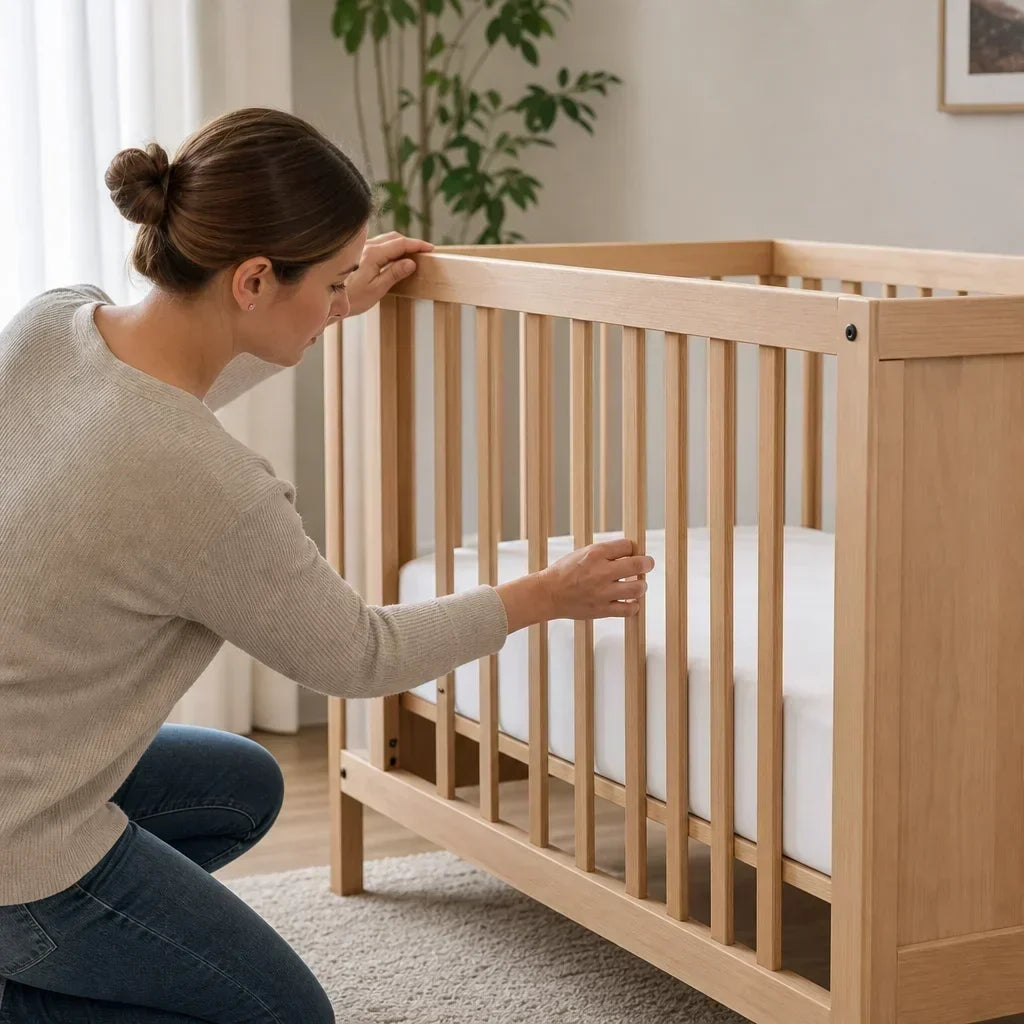
Canada crib regulations are simpler than most product pages make them sound. In Canada, cribs, cradles, and bassinets sold for infant sleep must meet federal safety rules under the Cribs, Cradles and Bassinets Regulations and the practical checks parents care about are structure, mattress fit, labels, materials, and safe sleep setup. This guide explains the current Canada crib safety standards in plain English, including used cribs, drop-side models, mattress fit, and how Canadian rules compare with U.S. references. Regulations can change, so for legal or commercial compliance questions, check the current Health Canada source as well.
What Canada crib regulations actually mean for parents
Canadian crib regulations are federal product-safety rules for sleep products sold for babies, not just general advice from retailers. The main point is straightforward: a crib, cradle, or bassinet should be built to reduce entrapment, falls, suffocation hazards, sharp or protruding parts, and failures in normal use.
Parents do not need to read legislation to shop well. The useful checks are whether the sleep product is meant for infant sleep, whether the mattress fits as designed, whether the hardware and instructions are complete, whether the finish is intact, and whether the setup follows safe-sleep guidance with no loose items inside.
The same questions matter whether you are buying new, reusing a family crib, or looking at a marketplace listing. Cross-border products can add another layer because a U.S. listing that mentions CPSC crib safety standards does not automatically confirm that the product was intended for the Canadian market or comes with the right instructions for use here.
Quick answer: Is this crib safe in Canada?
A crib is only a reasonable option if you can confirm what it is, who made it, how it is assembled, and whether it is complete and unmodified. If the model information, instructions, original hardware, or mattress compatibility are missing or unknown, stop there and do not use it for infant sleep until it is verified.
A used or older crib becomes a no for safe sleep the moment you find cracks, loose slats, wobble, peeling finish, missing screws, substitute parts, homemade repairs, added hooks or cords, or any drop-side hardware you cannot verify. One unsafe detail is enough to walk away, because improvised fixes create risk that the product was never tested with.
A marketplace or cross-border crib needs extra scrutiny because compliance is harder to confirm after the packaging, labels, and support documents are gone. If the seller cannot provide the model name, manufacturer, instructions, mattress information, and recall history, replacement is usually the safer path than guessing.
Crib vs cradle vs bassinet: what counts under Canadian rules
The legal difference is that Canadian rules group cribs, cradles, and bassinets as distinct infant sleep products under the same federal regulation, but they are built for different stages and sizes. A crib is the larger long-term sleep space, a cradle is a smaller infant sleep product that may rock or swing within regulated limits, and a bassinet is also for smaller, younger babies with earlier use limits set by the manufacturer.
For shoppers, the practical difference is use stage rather than jargon. A bassinet is not meant to do the same job as a full crib for years, and a decorative sleep product such as a lounger or nest is not a safe crib substitute just because it looks cozy.
The word cot adds confusion because it is common in the U.K. and in search queries like cot safety standards or cot safety regulations. In Canada, most parents who say cot really mean crib, or sometimes a portable sleep product, so the safer approach is to ignore the label and confirm the product's intended sleep use and instructions.
| Product | Plain-English use | Shopper takeaway |
|---|---|---|
| Crib | Main baby sleep space for a longer stage | Check full assembly, mattress fit, and future conversion parts |
| Cradle | Smaller infant sleep product, sometimes with movement | Follow the maker's use limit and movement design exactly |
| Bassinet | Smaller early-stage sleep space for younger babies | Stop use once baby reaches the stated limit or can roll/push up |
Current Canadian crib safety standards in plain English
A compliant crib should have a stable frame, secure sides, a properly supported mattress, no dangerous openings, and no parts that can snag clothing or trap a baby. That is the core of crib safety standards Canada, even when product pages use different wording.
Slat spacing is one of the checks parents search for most because wide gaps create entrapment risk. The commonly cited maximum for crib safety standards slat spacing is about 6 cm, or 2 3/8 inches, in Canadian and North American guidance, but parents should still confirm current manufacturer compliance and Health Canada requirements rather than measure alone and assume the crib passes.
Mattress support matters because a sleep surface that tilts, sags, or leaves side gaps can create a hazard even when the frame looks solid. The mattress must fit the specific crib as intended, and older hand-me-down mattresses are a frequent problem because they may not match the crib's original dimensions or support design.
Corner posts, decorative cutouts, exposed hardware, and protruding parts matter because they can catch clothing, create openings, or weaken the structure over time. This is why I tell parents to be careful with ornate older cribs, even when they look sturdier than modern ones. Appearance is not the same thing as compliant design.
Warnings and instructions are part of the safety standard, not packaging filler. A new crib should come with product identification, assembly directions, use warnings, and compatibility information for the mattress or conversion parts if the model is convertible.
| What to check | Why it matters |
|---|---|
| Tight, stable frame | Reduces collapse, wobble, and loose-part risk |
| Slats and side construction | Helps prevent head or limb entrapment |
| Mattress support | Keeps the sleep surface flat and secure |
| No protrusions or sharp edges | Reduces snagging and injury hazards |
| Complete labels and instructions | Confirms proper assembly and intended use |
| Intact finish and materials | Reduces exposure to peeling coatings or damaged surfaces |
Materials, finishes, and labels parents should look for
Safe crib compliance is not only about wood, metal, or style. Coatings, stickers, accessible surface materials, and the way parts are finished also matter because babies mouth rails and touch surfaces constantly.
The safest shopping signal is clear documentation. Look for a model name, manufacturer details, assembly instructions, warning labels, and retailer or manufacturer support you can actually reach after purchase. A vague listing with no documents is a bigger red flag than a simple design.
Words such as non-toxic, low-emission, or certified-safe materials are only useful when the seller can tie them to product documentation or recognized testing details. Not every compliant crib in Canada has to show the same badge, so treat logos as supporting information, not the only proof that a crib is suitable.
How to make sure a crib mattress fits safely
A safe crib mattress fits snugly with no significant gap between the mattress edge and the crib sides. The commonly cited gap limit in guidance is about 3 cm , but the safest rule for parents is even simpler: use only the mattress size and type the crib maker specifies for that exact model.
Firmness and flatness matter as much as fit. A baby should sleep on a firm, flat crib mattress with a fitted sheet only, not on pillow-top padding, memory foam add-ons, sleep positioners, wedges, or extra cushioning meant to make the crib feel softer.
Used mattresses deserve the same caution as used cribs because shape changes over time. If the mattress bows, leaves side gaps, has torn covers, or no longer matches the crib model, replace it rather than trying to fill the space with rolled blankets or padding.
Portable, mini, or convertible sleep products need their own matching mattress, not a close-enough substitute. That single mismatch is one of the easiest ways to turn a compliant crib into an unsafe setup.
Are old, used, antique, or drop-side cribs safe?

Age alone does not decide whether a crib is safe, but older cribs are much harder to verify for current compliance and much more likely to have wear, missing parts, unsafe design features, or recall issues. That is the real answer behind searches like whether a 10-year-old, 25-year-old, 30-year-old, or 40-year-old crib is still safe.
A crib from 2017 may still be serviceable if it is complete, unmodified, properly assembled, supported by current instructions, and paired with the correct mattress. A crib from 2002 or 1992 is more likely to raise problems with outdated design, absent labels, worn hardware, or unknown repair history, even if it looks fine at first glance.
Antique or heirloom cribs should be treated as sentimental furniture first, not automatically as safe sleep equipment. If you cannot verify the original design, parts, and current suitability, keep it for display or storage rather than overnight sleep.
Drop-side cribs are a major caution category in Canada and the U.S. because side hardware and moving-side designs have long been associated with serious safety concerns. If you are asking whether drop-side cribs are banned in Canada, the safe parent answer is to avoid them and choose a current fixed-side crib with clear documentation instead.
Cribs do not come with a universal legal expiry date stamped on them, so the useful question is not whether cribs expire in Canada. The useful question is whether this exact crib can still be verified as complete, unmodified, structurally sound, and appropriate under current guidance.
Used crib checklist: what to inspect before you say yes
A used crib is only worth considering when the seller can prove what it is and that nothing critical is missing. Start with the model number, manufacturer name, date information if available, original hardware, and assembly instructions. If any of that is absent, the inspection is already on shaky ground.
The frame should be tight, level, and free from cracks, splits, wobble, rust, bent metal, missing slats, stripped screw holes, peeling finish, and homemade repairs. A crib that has been drilled, repainted, glued, or fixed with substitute fasteners should not be trusted for infant sleep.
Accessories and add-ons are another reason to walk away. Reject any setup with aftermarket bumpers, extra boards, replacement slats from another model, added hooks, hanging cords, or a non-matching mattress the seller included as a bonus.
A recall check is part of the checklist, not an optional extra. If the crib cannot be identified well enough to search for recalls or manufacturer support, that alone is a practical reason to pass.
Antique cribs can still have value as decor, toy storage, or a memory piece. They are just not the place to cut corners on overnight sleep for a newborn.
Safe sleep basics in and around the crib

The safe-sleep setup is simple: place baby on their back, on a firm flat mattress, in a crib, cradle, or bassinet that is free of loose items. That means no pillows, stuffed toys, loose blankets, sleep positioners, or padding inside the sleep space.
A separate nursery is not required for safe sleep in Canada. Room sharing is commonly recommended in early infancy by public-health guidance, while bed sharing is treated differently because it introduces separate risks that are outside what a compliant crib can solve.
Crib placement matters because the danger is often around the crib, not just in it. Keep the sleep space away from blind cords, curtain cords, monitor cords, heaters, shelves, lamps, and furniture that could create gaps or falling-object hazards.
A crib should not be pushed into a risky wall or furniture setup that creates a trap space or lets cords and objects fall into the sleep area. The problem is not the wall by itself. The problem is the gap, pinch point, or surrounding hazard you create when the crib is placed carelessly.
SIDS risk is highest in early infancy, with the peak often described around 2 to 4 months in public-health education, but no crib or accessory can promise prevention. The right takeaway is to follow safe-sleep guidance consistently rather than rely on products marketed as extra protection.
Safe sleep checklist
- Place baby on their back for sleep.
- Use a firm, flat mattress with a fitted sheet only.
- Keep the crib empty except for the baby.
- Stop using bassinets or cradles when the manufacturer says to stop.
- Keep cords, heaters, shelves, and gaps away from the sleep space.
Crib bumpers, liners, and accessories: what is safe and what to avoid
Crib bumpers are not a safe answer for babies who brush the rails or bump their head lightly in sleep. They add material to the sleep space, and that runs against the empty-crib principle behind safe bassinet Canada and crib guidance.
The safer alternative to crib bumpers is not another padded accessory. It is a properly sized, compliant crib with the correct mattress, plus the understanding that small contact with crib rails is normal and not a reason to pad the sleep area.
Avoid bumpers, mesh liners unless explicitly supported by current guidance for that model, nests, loungers, wedges, sleep positioners, pillows, stuffed toys, loose blankets, extra mattresses, and most aftermarket attachments. A fitted sheet and manufacturer-approved components are different because they are part of the intended setup.
If a baby is very active, focus on supervised floor time and normal motor development outside sleep rather than trying to engineer a softer crib. Padding the sleep space usually solves the wrong problem and creates a new one.
Canada vs U.S. CPSC crib safety standards: what shoppers should know

Canadian and U.S. crib rules target similar hazards, but they are not interchangeable shorthand for compliance. A crib that mentions CPSC crib safety standards or ASTM testing may still need separate confirmation that it was sold with the right information and suitability for the Canadian market.
The U.S. comparison is still useful because many online listings are written for American buyers. If you see references to CPSC crib safety standards PDF documents, ASTM numbers, or U.S.-only warnings, treat that as a prompt to confirm the exact model, market, and mattress compatibility before buying in Canada.
| Topic | Canada | U.S. |
|---|---|---|
| Governing reference | Cribs, Cradles and Bassinets Regulations | CPSC rules, often alongside ASTM references |
| Main hazard focus | Entrapment, falls, structural failure, unsafe openings, labels | Similar hazard themes |
| Shopper takeaway | Confirm Canadian-market suitability and instructions | Do not assume U.S. compliance language alone covers Canada |
Do cribs need certifications? What labels and claims actually matter
There is no one simple badge parents can use as a shortcut for every crib sold in Canada. Shoppers often see terms such as ASTM tested, JPMA, GREENGUARD, or certified materials, but those labels do not replace checking the actual product details, instructions, compatibility, and seller support.
The most useful labels are the plain ones: model identification, assembly instructions, warnings, and compatibility notes for mattresses or conversion parts. Those details tell you whether the crib can be assembled and used as intended.
I would not buy a crib based on badge collecting alone. A reputable seller with clear documentation, current product support, and answers about mattress fit is more helpful than a product page full of logos but thin on specifics.
When should a child move out of a crib?
The move out of a crib depends more on climbing, height, and the manufacturer's use instructions than on a birthday. A 2.5-year-old may still be in a crib safely if the child remains within the model's limits, while another child may need to transition earlier because climbing starts first.
A 3-year-old can still sleep in a crib in some cases, but parents should check the manual before assuming that is fine. Once a child can climb out, exceeds the stated limit, or no longer fits the intended stage, it is time to stop using that crib as a crib.
Convertible models can make the transition easier, but only when you use the correct manufacturer-approved conversion kit and hardware. Mixing parts from another brand or improvising a toddler rail changes the setup the crib was designed for.
What to do if a crib fails a safety check
Stop using the crib for sleep the moment a key safety check fails. If the mattress does not fit, the finish is peeling, the slats are damaged, the hardware is missing, or the crib has been modified, do not try to work around it overnight.
Do not repair an infant crib with substitute screws, hardware-store brackets, plywood inserts, pool noodles, rolled blankets, bumper pads, foam wedges, or furniture hacks. A crib may look fixed after a DIY repair, but it has not been tested in that altered state.
If documentation is the only thing missing, contact the manufacturer first. If the maker cannot confirm the correct assembly, parts, or mattress, replacement is usually the safer answer than guessing.
How to shop for a compliant crib in Canada
The best buying checklist is short: confirm the intended market, read the product details, verify the matching mattress, check assembly support, and avoid vague marketplace listings that cannot answer basic questions. That is how you shop for a safe crib, not by chasing style photos alone.
Value matters, but low price is not the same thing as good value if the listing leaves out compatibility, support, or safety information. A crib that lasts, comes with clear instructions, and fits the right mattress is usually the cheaper decision than replacing a questionable one later.
For GTA families who want to compare options in person, it helps to test mattress fit, room layout, and nursery planning with a retailer that sells current nursery furniture and can answer product questions clearly. Baby Warehouse has served Toronto since 1995 and offers a 10,000 sq ft showroom, virtual consultations, and Canada-wide delivery. That can make the crib, mattress, and nursery-set decision easier when you want to compare models side by side.
FAQ
What are the current safety standards for cribs in Canada?
Current Canadian crib regulations require infant sleep products sold as cribs, cradles, or bassinets to meet federal safety requirements for structure, openings, mattress support, materials, labels, and safe use information under the Cribs, Cradles and Bassinets Regulations.
Are old cribs still safe in Canada?
Some may be, but older cribs are harder to verify and more likely to have outdated design, wear, missing hardware, recalls, or modifications. Safety depends on the exact crib, not age alone.
Are cribs from 1992 still safe?
A crib from 1992 should be treated with caution because it is much less likely to come with current instructions, original parts, and easy verification of present-day suitability. Use only if it can be fully verified, and many parents choose replacement instead.
Is it safe to use a 25 year old crib?
A 25-year-old crib is difficult to recommend for infant sleep unless it is complete, unmodified, structurally sound, and fully documented. Missing records and hidden wear are the main problems.
Do cribs expire in Canada?
There is no universal expiry date that applies to every crib. What matters is current condition, completeness, instructions, compatibility, and whether the crib can still be verified as suitable for safe sleep.
Are crib bumpers safe in Canada?
Crib bumpers are not considered a safe sleep solution. The safer setup is an empty crib with a firm mattress and fitted sheet only.
What is a safe alternative to crib bumpers?
Use a compliant crib with the correct mattress and keep the sleep space empty. Minor contact with rails is normal and safer than adding padding.
Is a crib mandatory in Canada for newborns?
No single product is mandatory, but newborns need a safe sleep surface intended for infant sleep, such as a compliant crib, cradle, or bassinet used according to the manufacturer's instructions.
Is a separate room required for a baby in Canada?
No. A separate room is not required for safe sleep. Room sharing is commonly recommended in early infancy, while the key rule is that the baby's own sleep surface should remain safe and uncluttered.
How do I know if a crib mattress fits safely?
Use the exact mattress type and size specified for that crib model, and do not use it if it leaves visible side gaps, shifts easily, or does not sit flat and firm in the frame.
Are drop-side cribs banned in Canada?
The parent-safe answer is to avoid drop-side cribs. Their moving-side design has long raised serious safety concerns, and a current fixed-side crib is the better choice.
Can I use a crib from the U.S. in Canada?
Possibly, but do not assume U.S. CPSC references alone prove Canadian suitability. Confirm the model details, instructions, mattress compatibility, and intended market before using it here.
Should a 2.5 year old still be in a crib?
Possibly. Check the manual and your child's climbing behaviour, height, and use stage rather than age alone.
Can a 3 year old still sleep in a crib?
Sometimes, if the child is still within the manufacturer's limits and not climbing out. The manual matters more than the birthday.
What certifications do cribs need?
There is no single universal badge parents must find on every crib in Canada. Clear product identification, instructions, compatibility details, and reputable seller support matter more than any one logo.
Compare the mattress fit, not just the crib style. That one step prevents a lot of bad nursery decisions.


