

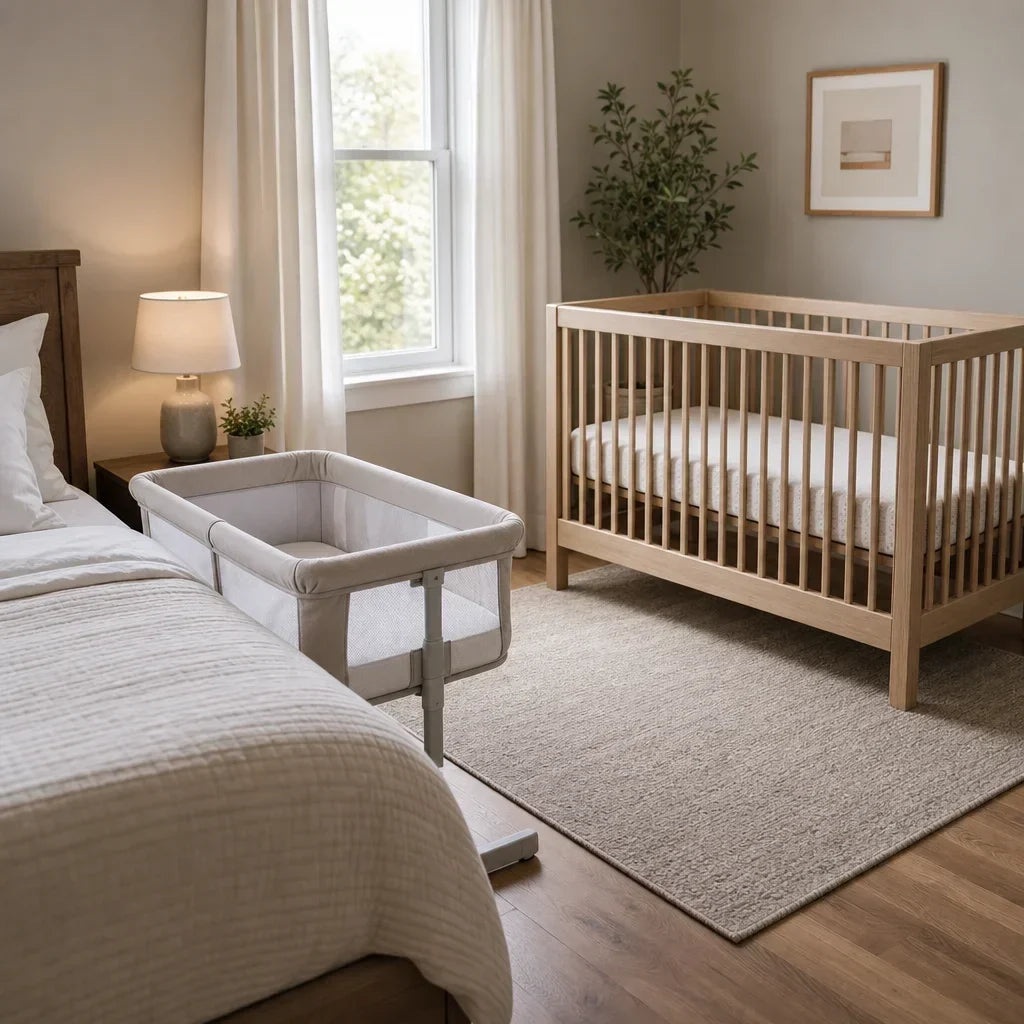
A bassinet vs crib newborn decision is simpler than the internet makes it sound. For most families, either can work safely from birth if the product is designed for infant sleep, assembled correctly, and used with a firm, flat mattress and no loose items inside.
Bassinet vs crib for newborns: the short answer
A bassinet is usually the better short-term choice if you want a smaller sleep space beside your bed, easier room-sharing, and something lighter to move around the home. A crib is usually the better long-term choice if you want one main sleep space from day one and better value over years instead of months.
The better pick depends on four practical things: room size, budget, how mobile the sleep space needs to be, and whether you want one purchase or two stages. A bassinet often fits early newborn life better. A crib often fits the family budget better over time because it lasts much longer.
- Choose a bassinet if you want bedside convenience, a compact footprint, and early-month portability.
- Choose a crib if you want a safe sleep space from birth through the toddler years in one setup.
- Choose both only if the extra convenience is worth a second purchase, a shorter use window, and later storage.
Bassinet, crib, and cot: what each term means in Canada
A bassinet is a smaller newborn sleep space made for the early months, while a crib is a larger infant bed designed to last much longer. In Canada, most retailers use the word crib, while cot is used less consistently and may mean different things in different countries.
A crib vs cot comparison in Canada is mostly a terminology issue, not a major safety or function difference. When shoppers search bassinet vs cot or crib vs cot, the smarter move is to check the actual product size, age stage, mattress fit, and safety labelling instead of relying on the word alone.
A mini crib sits between a bassinet and a full-size crib. It takes less floor space than a standard crib but usually lasts longer than a bassinet, which is why it can be a strong middle option for condo living or one-room setups.
A cradle, bedside sleeper, Moses basket, and play yard are separate categories. Some are sleep products, some are occasional-use products, and some depend entirely on the exact model and setup instructions, so they should never be treated as interchangeable by default.
Side-by-side comparison: bassinet vs crib vs cot vs mini crib

A side-by-side view makes the choice easier because these products solve different problems. A bassinet is best for the newborn stage and room-sharing. A full crib is best for longevity. A mini crib is often the compromise for small bedrooms.
| Option | Best stage | Portability | Room-sharing fit | Longevity | Best for |
|---|---|---|---|---|---|
| Bassinet | Birth to about 4–6 months, depending on the model limits | Usually easiest to move | Usually best beside the parents' bed | Shortest use window | Newborn months, night feeds, smaller rooms |
| Mini crib | Newborn stage into later infancy or beyond, depending on the model | Moderate | Better than a full crib in tighter rooms | Longer than a bassinet, shorter than some full cribs | Condos, one-purchase families, shared rooms |
| Full-size crib or cot | Newborn through about 2–4 years, depending on the design and the child | Lowest | Needs more space | Longest use window | Best long-term value |
A bassinet versus crib decision is really a trade-off between closeness now and longevity later. The option between bassinet and crib that saves the most stress is the one that fits your bedroom, your recovery, and how many setup changes you want in the first year.
A play yard or pack n play belongs in a different category. Some models allow sleep when used exactly as directed, but parents should only use it for routine sleep if that specific model says it is approved for that purpose and the setup follows the manual.
Is a bassinet safer than a crib?
A bassinet is not automatically safer than a crib, and a crib is not automatically safer than a bassinet. Safety depends more on whether the product is meant for infant sleep, meets current requirements, has the correct mattress for that model, and is used with a bare sleep surface.
A newborn can sleep safely in either a compliant bassinet or a compliant crib from birth. The bigger risks usually come from misuse: soft bedding, added positioners, incline, aftermarket inserts, damaged second-hand products, missing hardware, or using a product for overnight sleep when it was not designed for that use.
No bassinet vs crib safety article should promise that either product prevents SIDS. The safer message is simpler: follow current safe-sleep guidance, use the product exactly as directed, and ask your pediatric care team about health concerns that affect your baby’s sleep. This is general information, not a product recommendation for your situation.
Baby nests should not be treated as approved substitutes for a crib or bassinet unless current guidance from the product maker and Canadian authorities clearly says the product is intended for that sleep use. If you cannot verify that, do not assume it is safe for overnight sleep.
Safe sleep checklist for any newborn sleep space

A safe newborn sleep setup starts with a firm, flat surface and a mattress made for that exact product model. The mattress should sit snugly with no visible gaps, and the sleep space should be empty except for the fitted sheet.
Loose blankets, pillows, bumpers, stuffed toys, sleep positioners, and extra padding do not make a newborn safer or more comfortable in a crib or bassinet. They add risk, which is why the safest setup looks plain.
The product limits matter as much as the product category. Parents should follow the maker’s age, weight, and developmental limits exactly, especially once a baby starts rolling, pushing up, or trying to sit.
Room-sharing is different from bed-sharing. Health authorities commonly recommend room-sharing for at least the first 6 months , but that still means the baby has a separate sleep surface, not the adult bed.
Wheels, if the product has them, should lock securely. Hardware should be tight, the frame should feel stable, and mesh or side panels should not sag or create unsafe gaps.
Mattress materials are worth checking, but the practical goal is simple: choose a mattress made for that model and look for clear safety and materials information from the manufacturer. We would avoid dramatic claims about mattress toxicity unless they are backed by a reliable authority, because parents need clear product facts, not fear.
Can a newborn sleep in a crib from day one?
Yes, a newborn can sleep in a crib from day one if the crib is assembled correctly, the mattress fits properly, and the setup follows safe-sleep guidance. A crib may look large for a tiny baby, but size alone does not make it unsafe.
A 4 week old can also sleep in a crib, and so can a newborn in what some families call a cot, as long as the product is a proper infant sleep space and not just any small bed or basket. What matters is correct setup, not making the sleep space feel smaller with padding or rolled blankets.
Some parents feel their baby settles more easily in a smaller bassinet. That can happen, but it is not universal. Some babies sleep well in a full crib right away, which is one reason a bassinet is helpful for some families but not necessary for all.
Do you need both a bassinet and a crib?
No, many families do not need both a bassinet and a crib. A crib from day one or a mini crib in the parents’ room can cover the same core need without a second early-stage purchase.
A bassinet is optional if you have a tight budget, a one-room setup, limited storage, or a clear goal to buy one main sleep space and keep things simple. That is the strongest argument for going straight to a crib instead of buying a bassinet first.
A bassinet can still be worth it if room-sharing matters, nighttime feeds are frequent, recovery makes bending harder, or you want to move the baby from room to room in the first weeks. This is why people get bassinets instead of cribs even when they already plan to own a crib later.
The hidden cost of buying both is not just money. It is also a shorter bassinet lifespan, another item to store, and one more transition your baby may need to make a few months later.
How long can a baby sleep in a bassinet?

Most bassinets are used for about 4–6 months, but there is no single universal age because each model has its own limits. The right stop point is the first limit reached: age, weight, or developmental milestone.
Many bassinets also have weight limits in roughly the 15–20 lb range, though some models differ. Parents should always use the exact limit printed in the manual, because the label on that product overrides any general article online.
A 4 month old may be too big for a bassinet if the baby is rolling, pushing up on hands, trying to sit, looks crowded, or is close to the stated weight limit. Development matters just as much as age.
The signs a bassinet is no longer safe are practical and visible: the frame feels less stable, the baby can move enough to create unsafe positioning, or the baby has reached a stage the product was not built to handle. At that point, move to a crib before the limit becomes urgent.
When to move from bassinet to crib

The most common bassinet-to-crib transition happens around 3–6 months, but the real trigger is usually the product limit or the baby’s development, not the calendar alone.
The easiest move is usually gradual. Start with one nap a day in the crib, keep the sleep routine the same, and avoid changing too many variables at once, such as room, swaddle plan, white noise, and bedtime timing.
Moving before the limit is smarter than waiting until the bassinet is clearly outgrown. I would rather see parents transition a little early than squeeze out another week from a setup that no longer fits safely.
Some babies protest the change at first. That does not mean the crib is wrong. It usually means the routine changed, and routine often matters more than the shape of the sleep space.
Why parents choose a bassinet over a crib
Parents usually choose a bassinet for convenience, not because it is automatically better or safer. A smaller footprint, easier room-sharing, and simpler nighttime care are the main reasons bassinets stay popular.
The early weeks after birth can make a compact sleep space feel more manageable. That is especially true in smaller bedrooms, after a C-section, or when a parent wants the baby close without setting up a full-size crib beside the bed.
Babies do not universally prefer one option. When parents ask, “crib or bassinet which one is better,” the honest answer is that settling depends on the baby’s temperament, routine, and the exact sleep environment more than the category name.
Some babies seem to hate the bassinet because they wake more easily, dislike the change in motion, or simply settle better in a different space. If reflux or breathing concerns are part of the picture, those need a pediatric conversation, not a DIY sleep-positioning fix.
Small spaces, condos, twins, and one-purchase families: what to choose

A mini crib is often the best compromise for small bedrooms, condos, and families trying to decide between bassinet and crib without buying both. It saves floor space while giving you a longer use window than a bassinet.
A bassinet is often the easiest fit right beside the parents’ bed, but that does not automatically make it the smartest one-purchase option. If your room can handle a mini crib, it may solve the newborn stage and the next stage with fewer changes.
A full crib makes the most sense for families focused on long-term value, a dedicated nursery, or passing the furniture down to a younger sibling later. That is usually the most practical route when budget matters more than portability.
For twins, parents need to check each product’s instructions carefully because not every sleep product is designed for more than one baby. No family should assume two babies can share one sleep surface unless the product specifically says that setup is intended and safe.
For grandparents’ homes, ease of setup, storage, and how often the baby will actually sleep there matter more than having every category. A simple, properly rated sleep space is better than a crowded room full of gear.
Quick scenario guide
| If this sounds like you | Usually the strongest option |
|---|---|
| Small condo bedroom | Bassinet or mini crib |
| One purchase only | Mini crib or full crib |
| Night feeds and bedside convenience matter most | Bassinet |
| Long-term value matters most | Full-size crib |
| You want a middle option | Mini crib |
| Twins | Verify model-by-model instructions before buying |
Cost and long-term value: which is more worth buying?
A bassinet is often cheaper upfront, while a crib is often the better long-term value because it can last years instead of months. The real comparison is total sleep setup cost, not just the first product in the cart.
If you buy a bassinet first and a crib later, you are paying for two stages, two setups, and possibly two mattresses. That can still be worth it for convenience, but parents should price the whole plan, not one item at a time.
Convertible cribs can improve long-term value because they may cover more than one age stage. That matters most for families who want fewer future purchases and a room that grows with the child.
The best answer to “are bassinets better than cribs” on value is usually no. They are often better for short-term convenience, while cribs are usually better for durability and years of use.
Pros and cons of a bassinet and a crib
A bassinet’s main strengths are closeness, portability, and a smaller footprint. Its main weaknesses are a short use window, another likely purchase later, and less long-term value.
Bassinet pros
- Compact for room-sharing
- Easier to move in many homes
- Convenient for frequent night wakes
Bassinet cons
- Usually outgrown in about 4–6 months
- Often needs a crib purchase later
- Can create one more sleep transition
A crib’s main strengths are longevity, stability, and better value over time. Its main weaknesses are space, lower portability, and a bigger footprint in the parents’ room.
Crib pros
- Safe from birth when set up properly
- Longer use period, often into the toddler years
- Better one-purchase value
Crib cons
- Takes more room
- Harder to move
- Less bedside-friendly in tight spaces
What to check before you buy
Measure the room before you shop. The key checks are wall-to-wall space, clearance around the bed, doorway width, and whether the sleep space fits where you actually want to use it.
Check the mattress compatibility and included parts before you buy. A crib or bassinet should use the mattress made for that model or one the manufacturer specifically approves, because fit is a safety issue, not a styling choice.
Look at how the sleep space fits the whole nursery flow. A well-planned room leaves enough space for diaper changes, dresser access, and a future transition to a longer-term setup instead of forcing you to redo the room too soon.
Seeing furniture in person can help when you are torn between a bassinet vs mini crib or a crib vs cot style option. If you are in the GTA, visiting a showroom to compare real sizes and finishes can save a return. If not, a virtual consultation can still help you plan around your room and budget.
Frequently asked questions about bassinets, cribs, and newborn sleep
A bassinet does not prevent SIDS, and neither does a crib. The goal is risk reduction through safer sleep practices and using a proper infant sleep space exactly as directed.
A baby nest should not be assumed safe for overnight sleep unless current guidance and the product maker clearly say it is intended for that use. If that proof is missing, it should not replace a crib or bassinet.
A stroller bassinet should only be used for overnight sleep if the manufacturer explicitly states that the model is approved for that purpose. Parents should not treat all stroller bassinets as interchangeable with bedside bassinets or cribs.
A mini crib is a good compromise for many families because it sits between bassinet and crib on size and longevity. It is often the most practical middle ground for condo living or parents trying to skip the bassinet stage.
A Moses basket is not exactly the same as a bassinet, even though parents sometimes group them together. Construction, support, handles, and intended use can differ, so the label and manual matter more than the casual name.
A crib mattress can have smell or materials concerns for some families, but the practical buying standard is still to choose a well-made mattress that fits the crib properly and comes with clear product information. We would keep health claims conservative and look for transparent materials and safety details instead of dramatic promises.
If you are still stuck between a bassinet, mini crib, or full-size crib, the next step is simple: measure your room, decide whether you want one purchase or two, and compare the real products side by side. That is where an in-store visit or a virtual consult can genuinely help, especially when you want safe, durable nursery furniture that fits your space and budget.


