

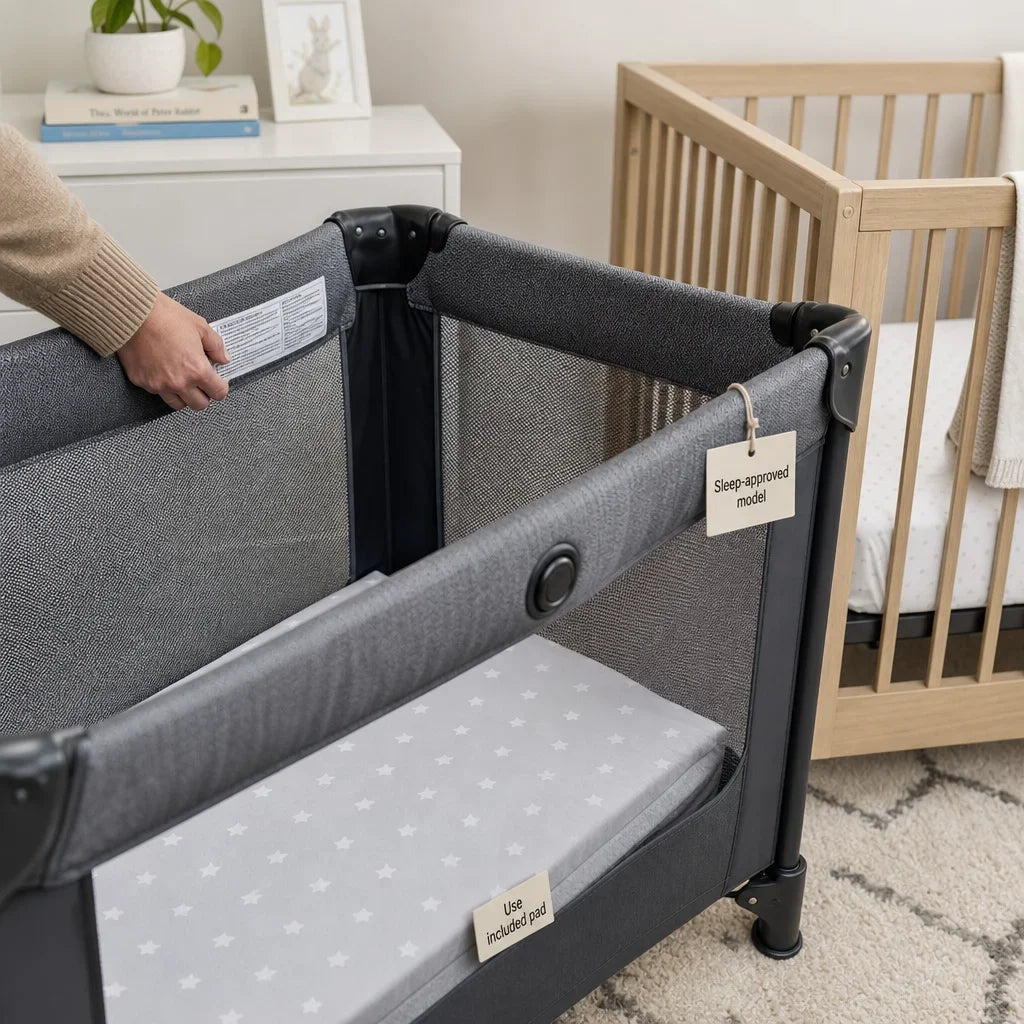
A pack and play is not automatically a crib substitute. In this crib vs pack and play guide, the right choice comes down to sleep approval, size, portability, and how long you want it to last.
Crib vs pack and play vs mini crib: the short answer
A standard crib is usually the best fit for a primary nursery and the longest use window. A mini crib is often the best middle ground for small bedrooms and daily home use. A pack and play can work as a sleep space only when that specific model is approved by its manufacturer for infant sleep and used exactly as directed. That approval, not the product category alone, is what matters.
A crib versus pack and play decision usually comes down to four things: whether this is for every night or occasional sleep, whether the sleep space stays in one room or moves, how much floor space you have, and whether you want one purchase to last into the toddler stage. Those are the factors that change the answer.
A condo bedroom usually points parents toward a mini crib or an approved compact sleep setup. A grandparents' home often points toward a pack and play instead of crib furniture if visits are occasional. Travel and cottage use usually favour a foldable travel crib or playard. A full nursery usually points toward a standard crib.
Quick verdict box
- Best for a dedicated nursery: standard crib - Best for a small room that stays set up: mini crib - Best for travel or a second sleep space: pack and play or travel crib, if approved for sleep by the manufacturer - Best long-term value: standard crib, especially a convertible model - Best for occasional grandparent visits: pack and play can make sense if it is sleep-approved and used as directed
Can a baby sleep in a pack and play instead of a crib?
A baby can sleep in a pack and play instead of a crib only if that exact product is approved by its manufacturer for infant sleep or overnight sleep and you follow its instructions exactly. A playard is not interchangeable with a crib just because both are used with babies. The safe answer depends on the model, the stage, the included sleep surface, and the stated limits.
A pack and play safe for overnight sleep must be used with the mattress pad or surface it came with, plus only accessories the manufacturer allows for that model. That means no extra mattress, no foam topper, and no improvised padding unless the maker specifically approves it. Mattress fit matters because gaps around the edge can create a hazard.
Families do use a pack and play as a main sleep space in the early months, especially for room sharing, travel, and small-space living. Many later move to a crib because a crib gives more room, feels more permanent in a nursery, and usually lasts longer. The transition point is not one set age. It is when the product limits are reached, the baby looks cramped, the baby starts pulling up or climbing, or the manufacturer no longer recommends that stage.
A pack and play does not count as a crib in the practical shopping sense. The difference between crib and pack and play use is that a crib is designed as a stationary nursery sleep space, while a playard is built around portability and multi-use convenience. Some models overlap on overnight sleep. Not all do.
Safety basics: what makes each option safe or unsafe

The safest setup is the one used exactly as the manufacturer intended, with the included sleep surface and a properly fitted sheet only if the manufacturer permits one. That rule applies whether you choose a crib, a mini crib, a portable crib, or a pack and play. Safe sleep guidance also calls for a bare sleep surface with no loose blankets, pillows, bumpers, or toys.
A crib mattress vs pack n play pad is not a swap. Standard crib mattresses, mini crib mattresses, and pack and play pads are different product categories with different dimensions and fit tolerances. A mattress that is too small can leave dangerous gaps. A mattress that is too thick can change the way the product performs.
Bassinet inserts, newborn inserts, and changing attachments are stage-specific accessories, not universal sleep surfaces. If a product includes a raised bassinet or newborn insert, that stage has its own limit and its own instructions. Once the manufacturer says to stop using that stage, you stop using it, even if the baby still seems comfortable.
Safe vs unsafe accessories
| Setup | Usually safe when approved | Unsafe unless manufacturer specifically approves it |
|---|---|---|
| Standard crib | Crib mattress made for that crib size, fitted crib sheet | Sleep positioners, loose bedding, extra padding |
| Mini crib | Mini crib mattress made for that model or size, fitted mini crib sheet | Standard crib mattress forced to fit, loose inserts |
| Pack and play | Included pad or mattress surface, fitted sheet if allowed for that model | Aftermarket mattress, foam topper, folded blankets under baby |
| Travel crib | Included sleep surface, approved sheet if allowed | Swapping in a different mattress or adding cushioning |
Crib vs pack and play vs mini crib: side-by-side comparison table

A standard crib wins for space and longevity. A mini crib wins for compact daily use. A pack and play wins for portability. A travel crib usually wins when folding speed and carrying matter most.
| Feature | Standard crib | Mini crib | Pack and play / playard | Travel crib |
|---|---|---|---|---|
| Primary use | Full nursery sleep space | Small-room daily sleep space | Portable sleep and play space | Lightweight travel sleep space |
| Overnight sleep suitability | Yes, when assembled and used as directed | Yes, when assembled and used as directed | Only on sleep-approved models and stages | Only on sleep-approved models |
| Footprint | Largest | Smaller than standard crib | Varies by model | Usually compact and foldable |
| Mattress feel | Usually the most substantial nursery setup | More nursery-like than a playard | Thinner, firmer pad by design | Varies by model |
| Portability | Low | Low to moderate on foldable models | High | High |
| Folding / storage | Limited | Some models fold | Strong advantage | Strong advantage |
| Room sharing | Can be bulky | Often a good fit | Often a good fit | Good for temporary setups |
| Travel friendliness | Low | Moderate on foldable models | High | Highest on lightweight models |
| Longevity | Longest | Shorter than standard crib | Depends on model limits | Depends on model limits |
| Best for | Dedicated nursery | Condo, small bedroom, shared room | Grandparents, travel, backup sleep | Frequent travel |
Crib vs pack and play pros and cons
Standard crib
- Pros: roomiest sleep space, longest use, strongest nursery feel
- Cons: largest footprint, not travel-friendly, higher upfront spend in many cases
Mini crib
- Pros: smaller footprint, often easier in condos, better for daily use than a playard for many families
- Cons: outgrown sooner than a standard crib, less flexible for travel than a pack and play
Pack and play
- Pros: folds, travels, easy second sleep space, useful for visits and cottages
- Cons: only some models are approved for overnight sleep, thinner pad, often shorter practical use for primary sleep
Size comparison: is a crib bigger than a pack and play? What about a mini crib?

A standard crib is generally bigger than a pack and play in usable sleep area. A standard crib mattress is about 28 x 52 inches , while a mini crib mattress is about 24 x 38 inches . Pack and play dimensions vary by model, so you need the exact product listing before you compare footprint or sleep area.
Outer footprint and interior sleep area are not the same thing. A product can take up a fair bit of floor space while still giving your baby a smaller sleeping surface than a crib. That is why pack and play dimensions vs mini crib comparisons should look at both the outside measurements and the actual mattress or pad size.
A mini crib vs pack and play size comparison is closer than a standard crib comparison, but they are not automatically the same size. Some mini cribs have a more crib-like rectangular sleep surface, while some playards use different corner shapes or frame designs. That affects both the feel of the sleep space and what sheets fit properly.
Typical size guide
| Product type | Typical sleep surface or mattress size | What that means in real rooms |
|---|---|---|
| Standard crib | About 28 x 52 in | Best for a full nursery or larger bedroom |
| Mini crib | About 24 x 38 in | Better for small rooms and room sharing |
| Pack and play | Varies by model | Check the exact product before buying sheets or planning layout |
| Travel crib | Varies by model | Best if folded size matters as much as open size |
A measuring checklist matters as much as the product dimensions. Measure wall-to-wall space, doorway width, elevator width if you live in a condo, dresser clearance, and your walking path around the bed. Painter's tape on the floor is one of the simplest ways to see whether a mini crib or pack and play will actually fit where you want it.
Do babies sleep better in a crib or pack and play?
Babies do not universally sleep better in one or the other. Sleep quality depends on temperament, routine, familiarity, stage, and whether the setup fits the baby safely and comfortably. There is no reliable rule that says every baby sleeps better in a crib than pack and play.
Parents often feel that a crib mattress seems more substantial and the crib itself feels roomier. A pack and play surface often feels firmer and thinner by design. That difference can affect parent perception, but it does not create a universal outcome for infant sleep.
Daily ergonomics can be a deciding factor for parents even when the baby sleeps fine in both. Some cribs and mini cribs offer mattress height settings that are easier on the back in the early months. Some playards sit lower once infant inserts are no longer used, which can make frequent lifting harder during nightly care.
How long can a baby use each option?

Use length depends on the manufacturer's height and weight limits, the child's mobility, and whether the child is trying to climb, not age alone. That is the practical answer for how long can I use a pack and play as a crib and how long can a baby stay in a mini crib.
A standard crib usually gives the longest use window because it has the largest sleep surface and is built as a primary nursery product. Many children stay in a standard crib into the toddler stage before moving to a toddler bed, depending on the crib design and the child's size and climbing behaviour.
A mini crib is usually outgrown sooner than a standard crib because the sleep surface is smaller. That does not make it a poor choice. It just means a mini crib is often a space-saving solution first and a long-term solution second.
A pack and play can also be outgrown quickly for primary sleep if the baby becomes tall, active, or visibly cramped. The exact limit varies by model, and that is why the product manual matters more than general online advice. Once the baby reaches the stated limit, pushes up, pulls to stand, or starts climbing, you re-check the manufacturer's instructions before continuing.
Transition checklist
- Baby's head or limbs regularly press the sides
- Baby is rolling and moving enough that the stage insert no longer applies
- Baby is pushing up, pulling to stand, or trying to climb
- Baby has reached the stated height or weight limit for that model
- The sleep setup no longer fits your routine or room layout safely
Mini crib vs pack and play: which is better for a small space?
A mini crib is usually better for a small space that stays set up every day. A pack and play is usually better if you need the sleep space to fold, move, store, or travel. That is the core mini crib or pack n play trade-off.
A mini crib often feels more like scaled-down nursery furniture. It can be a better visual and practical fit for condo bedrooms, shared rooms, or a small nursery where the sleep space stays in one place. If you want a compact room to still feel like a real nursery, mini crib vs pack and play usually leans mini crib.
A pack and play usually wins when your small space has to do double duty. If the sleep setup needs to move from bedroom to living room, go to a grandparent's home, fit in the car, or store away between uses, a playard offers flexibility that most mini cribs do not.
A foldable mini crib sits in the middle, but it is still not the same as a playard. Foldable crib frames can help with storage, yet they are still crib products first. A pack and play is built around portability first.
Crib vs pack and play for newborns, room sharing, and recovery after birth
For newborn months, families often choose the option that fits beside the parents' bed and reduces night-time strain. That is why crib vs pack and play for newborn searches are so common. The best answer is the one that fits your room, your recovery, and the product's approved use.
Room sharing is easier with a smaller footprint. A mini crib or a sleep-approved playard can be easier to fit in a bedroom than a full crib. If you expect to move the setup later into a nursery, a mini crib or approved pack and play may make the first phase simpler.
Recovery after birth can change the practical choice. Bending height, wheel mobility, where the sleep space sits relative to your bed, and how often you need to move it can matter as much as the product category. For some families, a compact setup works better in the first months and a full crib makes more sense later.
Travel crib vs pack and play vs portable crib: what is the difference?
These terms overlap, but they are not identical. A standard crib is fixed nursery furniture. A mini crib is a smaller crib for tighter rooms. A portable crib usually means a crib-style product that may fold. A playard or pack and play is a portable framed enclosure that may include a sleep-approved setup on some models. A travel crib is usually a lighter product designed specifically for transport.
Pack 'n Play is also a brand-associated term that many parents use generically for all playards. That helps explain why searches for travel crib vs pack and play often mix different products together. The right comparison is not name against name. It is sleep approval, folded size, open size, and how often you will move it.
Not every playpen is meant for overnight sleep. Not every travel item replaces a nursery crib. That distinction matters more than the label on the box.
Sheets and mattresses: what fits, what does not, and what not to buy

Standard crib mattresses, mini crib mattresses, and pack and play pads are not interchangeable by default. That is the short answer to crib mattress vs pack n play and mini crib mattress fit questions. Buy the size intended for the exact product.
A standard crib sheet usually does not fit a mini crib or pack and play properly. Mini crib sheets are not automatically the same as pack and play sheets either. Even when the sizes look close on paper, corner shape, pad thickness, and manufacturer tolerances can differ enough to make the fit unsafe or unreliable.
You should not put a crib mattress in a pack and play unless the manufacturer of that exact playard explicitly says you can. The same caution applies to using a mini crib mattress in a pack and play or using an aftermarket mattress for a playard. If the brand does not approve it, do not improvise.
Fit matrix for sheets and mattresses
| Item you have | Standard crib | Mini crib | Pack and play |
|---|---|---|---|
| Standard crib mattress | Yes, if made for that crib | No | No |
| Mini crib mattress | No | Yes, if made for that mini crib or size | Not by default |
| Pack and play pad/mattress | No | Not by default | Yes, use the included or approved surface |
| Standard crib sheet | Yes, if fitted properly | Usually no | No |
| Mini crib sheet | No | Yes, if fitted properly | Not always |
| Pack and play sheet | No | Not always | Only if made for that exact or approved size/model |
Decision guide: which one should you buy for your situation?
The best choice depends on how your home works day to day. If you want one long-term nursery setup, a standard crib is usually the strongest answer. If you need a compact daily sleep space, a mini crib often makes more sense. If you need a second sleep space, portability usually pushes the choice toward a pack and play.
Quick decision tree
| Your situation | Usually the better fit | Why |
|---|---|---|
| Small condo or apartment | Mini crib | Compact footprint with a more crib-like daily setup |
| Dedicated nursery | Standard crib | Most room, longest use, strongest long-term value |
| Frequent travel | Travel crib or pack and play | Foldability and transport matter most |
| Grandparents' home | Pack and play for occasional visits, mini crib for regular care | Choose based on frequency of overnight use |
| Cottage or second home | Pack and play or travel crib | Easier to store and move |
| Tight budget and short-term flexibility | Pack and play | Lower barrier to adding a second sleep space in many cases |
| Want one purchase to last longer | Standard crib or convertible crib | Best long-term nursery solution |
| Shared room beside parents | Mini crib or sleep-approved playard | Smaller footprint near the bed |
Parents of twins or families planning multiple sleep zones should think in terms of layout before product type. Measure first, then compare the real footprint of two units, your walking path, and where changing and feeding will happen.
Buying checklist before you choose
The smartest buy starts with measurements and usage, not marketing labels. Write down where the sleep space will live, whether it needs to travel, and whether you want this purchase to cover the first months or the next few years.
Room-measuring checklist
- Measure the room width and length
- Measure the wall where the sleep space will sit
- Measure doorway and elevator widths for condos
- Note baseboards, radiators, vents, and dresser drawers
- Map a walking path around the bed and dresser
- Check folded size if the product will be stored or transported
- Check whether the mattress height has multiple positions
- Confirm which sheets are approved for that product
- Read sleep-stage, height, and weight limits before buying
Painter's tape on the floor is one of the best low-cost planning tools. It lets you test a standard crib, mini crib size, or pack and play dimensions vs mini crib footprint before anything arrives.
If you want to compare crib and mini crib sizes in person, seeing scale matters. For families in Toronto and the GTA, a showroom visit can answer layout questions quickly, and virtual consultations can help if you are measuring from elsewhere in Canada.
When a full crib adds more long-term value
A full crib can cost more upfront, but it often gives better long-term value when you want a permanent nursery setup and longer use. That is why a crib is often better than a pack and play for families building a room around daily sleep, storage, and future stages.
A standard or convertible crib also fits matched nursery furniture more naturally. If you are planning dressers, changers, and a room that will stay in place, a crib works as furniture rather than a temporary gear item. That matters for both function and cost over time.
For parents focused on durability, safe materials, and value-conscious nursery planning, it helps to compare crib construction in person. Baby Warehouse has been serving Toronto families since 1995 from a 10,000 sq ft showroom and offers Canada-wide delivery plus virtual consultations . That makes it easier to compare a full crib, a mini crib, and other nursery furniture side by side.
FAQ
Can my baby sleep in a pack n play instead of a crib?
Yes, but only if that exact pack and play is approved by its manufacturer for infant or overnight sleep and you use it exactly as directed. The model instructions matter more than the category name.
Is a pack and play safe for overnight sleep?
Some are, some are not. Check the manufacturer's manual and product listing for that exact model, and use only the included or approved sleep surface.
Is a crib bigger than a pack n play?
A standard crib is generally bigger in usable sleep area. A standard crib mattress is about 28 x 52 inches , while playard sizes vary by model.
What is bigger, a mini crib or pack n play?
There is no universal winner because pack and play dimensions vary. A mini crib mattress is about 24 x 38 inches , so the exact comparison depends on the specific playard's sleep surface and outer frame.
Are mini cribs the same size as pack and plays?
No. Some are close, but they are not automatically the same size, and their sheets and mattresses are not interchangeable by default.
How long can a baby stay in a mini crib?
Until the child reaches the manufacturer's limits or becomes too active or cramped for that setup. The limiting factors are size, mobility, and climbing, not age alone.
How long can I use a pack and play as a crib?
Only as long as that exact model is approved for sleep at your child's current stage and within its stated limits. Re-check the manual as your baby grows.
Will a mini crib mattress fit in a pack and play?
Not by default. Do not use a mini crib mattress in a pack and play unless the playard manufacturer explicitly approves it for that exact model.
Are mini crib sheets the same size as pack and play sheets?
Not always. Buy sheets made for the exact product size and shape so they fit properly and safely.
Do I need both a crib and a pack and play?
Not always. Some families use one sleep-approved setup for the first months. Others buy both because a crib works best at home and a pack and play works better for travel or grandparents.
Is a travel crib the same as a pack and play?
Not exactly. Both can be portable, but a travel crib is usually lighter and designed specifically for transport, while a pack and play is a broader playard category.
Should I get a crib, mini crib, or pack and play for a small condo?
If it will stay in one place every night, a mini crib is often the strongest small-space choice. If it must fold away, move rooms, or travel often, a sleep-approved pack and play may make more sense.
Compare the real dimensions, the approved sleep setup, and how you will use it every day. That usually gives you a better answer than chasing the most compact product on the page.


