

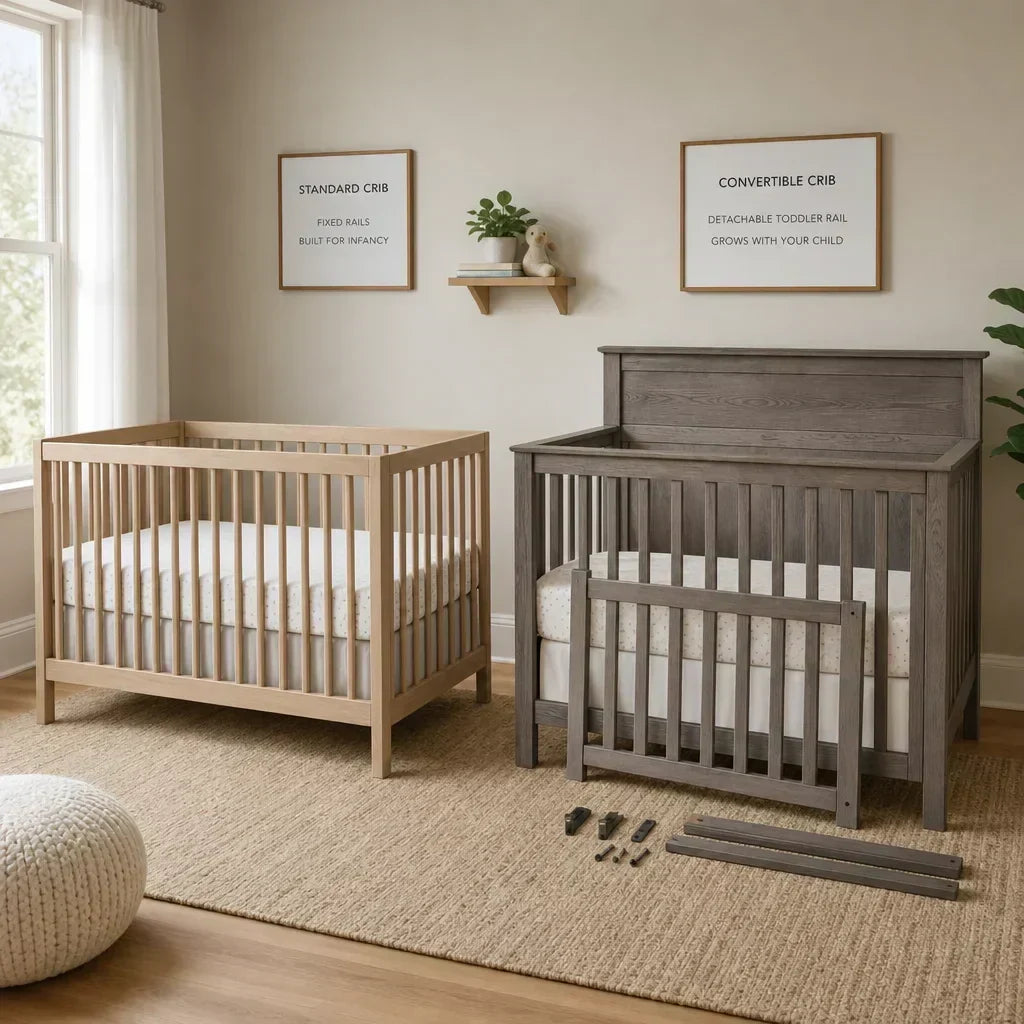
Most people think a convertible crib is automatically the smarter buy. They’re wrong. The right convertible crib vs standard crib choice depends on four things: your budget now, your room size, whether you will really use later conversions, and how long you want the same furniture to stay in the room.
Convertible Crib vs Standard Crib: Quick Answer
Neither crib type is better for every family. A convertible crib usually suits parents who want longer use from one piece of furniture and like the idea of crib-to-toddler-bed or crib-to-full-bed flexibility. A standard crib usually suits parents who want a simpler setup, a lower upfront spend, and no need to think about future conversion parts.
A convertible crib is usually the better fit if you:
- want one nursery piece to last through more than one stage
- prefer a coordinated room look over several years
- are willing to verify rails, kits, and future part availability
A standard crib is usually the better fit if you:
- want the lowest initial cost in the category
- plan to buy a separate toddler or kids’ bed later
- do not want to store hardware for future conversions
A mini crib is a third option, not a smaller version of the same decision. It is mainly for tighter spaces, shared rooms, grandparents’ homes, or short-term setups.
What Is the Difference Between a Convertible Crib and a Standard Crib?
A standard crib is built for crib use only, then it gets replaced when your child outgrows it. In practice, crib use often lasts from birth to about 18–36 months , depending on the child’s development, climbing behaviour, and the manufacturer’s limits.
A convertible crib is built to change into one or more later stages. Those stages can include a toddler bed, a daybed, and sometimes a full-size bed . The exact path depends on the model, not the label alone.
The practical difference is lifespan and planning. A standard crib solves the infant stage well, but usually ends there. A convertible crib can stay in use for years longer if the model supports later stages and the family actually completes those conversions.
The parts list is usually different too. A standard crib is often more straightforward to assemble because it has one main job. A convertible crib may need extra hardware later, such as a toddler rail or full-size bed rails, and those parts are sometimes sold separately rather than included.
Side-by-Side Comparison Table
The fastest way to compare them is to look at upfront cost, total lifespan, room fit, and future extras together. That is where most crib decisions are actually made.
| Factor | Standard Crib | Convertible Crib |
|---|---|---|
| Main purpose | Infant crib only | Crib plus later bed stages |
| Upfront price | Usually lower in the category | Usually higher in the category |
| Long-term value | Good if you plan to replace later | Better if you complete the conversions |
| Typical use in crib mode | Birth to about 18–36 months | Birth to about 18–36 months in crib mode |
| Use beyond crib stage | No built-in conversion | Often toddler bed, daybed, or full-size bed depending on model |
| Hidden costs | Later toddler/kids’ bed purchase | Toddler rail, conversion kit, or full-size rails may cost extra |
| Nursery footprint | Often straightforward | Often similar mattress footprint, but bulkier exterior panels on some models |
| Storage burden later | You may store, sell, or pass it on once outgrown | You may keep using it instead of storing it |
| Resale/hand-me-down logic | Easier to pass on sooner | Better if kept in the family and converted as planned |
| Assembly simplicity | Usually simpler | Usually more planning and more parts to track |
| What to verify | Mattress fit, dimensions, safety compliance | All of the standard checks plus included parts and future conversion part availability |
| Best for | Tight budgets, simpler planning, shorter-term nursery plans | Long-term planners, style continuity, fewer major furniture changes |
Pros and Cons of a Convertible Crib
Convertible cribs are a good idea when a family wants longer use from one purchase. Their biggest benefit is longevity. Instead of buying a crib now and another bed later, you may get several stages from the same frame if the model supports it and you keep the hardware.
The biggest value point is fewer furniture transitions. A 3-in-1 or 4-in-1 design can reduce how often you need to replace the main bed frame . That can help with room continuity, hand-me-down planning, and waste reduction if you truly use the later stages.
The biggest drawback is the higher upfront spend and the possibility of extra conversion costs later. A convertible crib often looks like a money saver on day one, but that only holds if you do not switch styles, move and lose hardware, or decide later that you want a different bed anyway.
The other drawback is complexity. Some families never use the full conversion path. In those homes, the “future value” stays theoretical, while the higher purchase price was real from the start.
Pros and Cons of a Standard Crib
A standard crib is often the smarter buy when simplicity matters more than long-term conversion. It handles the crib years without asking you to plan for toddler rails, full-size rails, or future assembly changes.
The biggest advantage is lower upfront cost. In the Canadian market, standard cribs often start in the low-to-mid hundreds of dollars, while convertible cribs often begin higher and can run into the upper hundreds or beyond depending on materials and brand . Exact prices vary by collection, so it is better to compare within the same quality tier.
The second advantage is cleaner decision-making. You buy the crib, the matching mattress, and you are done for that stage. For grandparents, secondary nurseries, or families who prefer to refresh the room later, that can be a better value than paying now for conversions you may never use.
The tradeoff is shorter total use. Once your child is no longer safe in crib mode, a standard crib usually does not continue into the next stage. You then need another sleep setup, which adds a later cost even if the first crib was cheaper.
Cost Breakdown: Upfront Price vs Total Cost of Ownership

Convertible cribs do not always save money in the long run. They can save money, but only under the right conditions. The honest comparison is total cost of ownership, not the sticker price alone.
The full cost of a standard crib usually includes the crib, a compatible crib mattress, and a later toddler or kids’ bed purchase. The full cost of a convertible crib may include the crib, mattress, toddler rail, conversion kit, full-size rails, and sometimes a different mattress for a later full-size stage.
The biggest hidden cost is missing conversion parts. A convertible crib conversion kit is not always included, and a full-size conversion often needs more than just one extra rail set. Some models also require a standard full-size mattress later rather than the crib mattress used in the nursery stage.
A realistic worked example looks like this. Family A buys a standard crib at a lower upfront price, then adds a separate toddler or twin bed a few years later. Family B buys a convertible crib at a higher starting price, then later buys a toddler rail and keeps the same frame in the room. Family B may come out ahead if they complete the conversion path. Family A may spend less overall if they find a lower-cost next bed later or decide they want a different style anyway.
The most useful rule is this: a convertible crib saves money only if you expect to use at least one later conversion stage and the required parts stay available. If you are unlikely to do that, the cheaper standard crib is often the better financial decision.
How Long Does Each Crib Last?

A crib’s lifespan is better measured in stages than in one number. In crib mode, both standard and convertible cribs are commonly used from birth to roughly 18–36 months , but the actual transition point depends on the manufacturer’s instructions, your child’s height, and whether climbing has started.
A convertible crib lasts longer because crib mode is only the first stage. Toddler bed mode commonly carries children through early childhood, often around age 5–7 on many models , while full-size bed conversions can extend use far beyond that if the crib is designed for it.
The safest time to transition out of crib mode is not based on age alone. It is usually triggered by climbing attempts, height limits in the manual, or any clear sign your child can get out unsafely. Manufacturer guidance should decide the timing, not a generic online milestone.
The phrase when to switch to toddler bed usually means one of two things. It may mean converting a convertible crib to toddler mode, or replacing a standard crib with a separate toddler bed. In both cases, the cue is the same: follow the crib’s limits and move before climbing becomes a fall risk.
Size and Space: Standard Crib vs Convertible Crib vs Mini Crib

For mattress space, standard and convertible cribs are often closer than people expect. Many use the same standard crib mattress size, which is about 28 x 52 inches . The bigger difference is often the outside frame, because convertible designs may have thicker end panels, decorative headboards, or wider side profiles.
A mini crib is meaningfully smaller. Mini crib mattresses are often around 24 x 38 inches , which is why the crib vs mini crib size decision matters so much in condos, shared bedrooms, and smaller nurseries.
The most practical comparison looks like this. A standard crib gives you the usual crib footprint without adding future bed complexity. A convertible crib often takes a similar mattress footprint but can look and feel larger in the room. A mini crib saves floor space, but it usually offers less long-term use than a full-size crib.
A convertible crib vs standard crib vs mini crib decision usually comes down to room flow first. Measure the crib footprint, then add walking space, dresser clearance, and door swing before you buy. A crib that technically fits the room can still make the nursery frustrating to use every day.
For small spaces, the ranking is usually simple. Mini crib first for tightest rooms. Standard crib next for straightforward value. Convertible crib after that if the room can handle the frame and you truly want the longer use.
Safety: What Standards and Materials Should Parents Look For?
Both crib types can be safe when they meet current requirements and are assembled correctly. A convertible crib is not less safe because it converts, and a standard crib is not safer just because it is simpler. Safety comes from current compliance, sturdy construction, proper assembly, and correct mattress fit.
In Canada, parents should look for a crib that complies with current Canadian crib regulations and product guidance from Health Canada . That matters more than broad marketing terms. If a product page mentions third-party certifications, those should be verified model by model rather than assumed across an entire brand.
One established safety detail is slat spacing. Traditional crib slats should not be more than 2 3/8 inches apart . Another key point is that drop-side cribs are no longer accepted under modern safety expectations in Canada and the U.S. markets .
A GREENGUARD Gold crib or other low-emission certification can be useful for families who want added screening for chemical emissions, but the label has to be product-specific. The same goes for “non-toxic crib” claims. Those words only mean something when backed by actual material, finish, or certification details.
The safest real-world setup is usually boring in the best way. Tight assembly. A firm, compatible mattress. No missing hardware. No improvised repairs. And no assumption that a used or gifted crib is safe just because it still looks solid.
Crib Mattress Questions: Fit, Allergies, and What to Avoid

The most important mattress rule is fit. Crib mattress compatibility is not optional. A standard crib needs a standard-size crib mattress, and a mini crib needs a mini crib mattress. A poor fit can create unsafe gaps, even if the mattress quality itself is good.
A crib mattress can contribute to comfort concerns for sensitive children, but allergy questions are not one-size-fits-all. Families who are worried about odours or material sensitivity often prefer low-emission materials and easy-to-clean covers. For medical allergy concerns, a pediatrician should guide that decision.
The clearest things to avoid in a crib mattress are poor fit, sagging surfaces, damaged covers, strong lingering chemical odours, and products with unclear compliance or unknown sourcing. The mattress should be firm and appropriate for infant sleep, not soft or cushioned like an adult comfort mattress.
Memory foam comes up in crib mattress searches because parents compare firmness, breathability claims, and emissions concerns. The practical point is not that one material is always bad. The point is to choose a firm mattress made for cribs, with a proper fit and clear product information, instead of chasing vague trend claims.
3-in-1 vs 4-in-1 vs 5-in-1: What These Labels Actually Mean

These labels are helpful, but they are not universal across every brand. In most cases, a 3-in-1 crib vs 4-in-1 crib comparison means this: 3-in-1 often covers crib, toddler bed, and daybed, while 4-in-1 often adds a full-size bed conversion . The exact setup still has to be checked on the product page.
A 5-in-1 label does not always mean dramatically more useful years. Sometimes it reflects extra configuration combinations rather than a truly different long-term outcome. Marketing labels can sound bigger than the practical difference.
The real buying question is not the number in the name. It is the conversion path, the included hardware, and whether future parts can still be bought later. That is why the phrase convertible crib conversion kit matters more than the label on the box.
Do not assume rails are included just because a crib is called convertible. That single mistake causes a lot of budget surprises later.
What to Check on the Product Page Before You Buy
The best product page tells you exactly what the crib becomes, what is included, and what you still need to buy. If that information is vague, treat it as a warning sign.
Check the exact exterior dimensions first. That answers the real convertible crib vs standard crib size question better than category labels do. Two cribs can use the same mattress size and still take up noticeably different floor space.
Check the conversion path next. Confirm whether the crib becomes a toddler bed only, a toddler bed plus daybed, or all the way to a full-size bed. Then confirm whether the toddler rail, full-size rails, or other parts are included or sold separately.
Check mattress size compatibility, adjustable mattress height positions, finish and material details, safety certifications if listed, and any posted height or weight guidance. Save the manual too. Future conversions are much easier when the original instructions and hardware notes are still in the drawer.
Replacement-part availability and warranty terms also matter more than people expect. A convertible crib has more long-term value when you can still get the needed parts a few years later.
Best Crib Type for Different Family Scenarios
For a small condo or shared room, a mini crib is often the cleanest answer. It saves the most floor space, and that matters every day more than theoretical future conversions.
For renters or families who move often, a standard crib often makes more sense. It is usually simpler to assemble, simpler to move on from, and less dependent on keeping extra rails and hardware together over time.
For grandparents’ homes or occasional sleep spaces, a standard crib or mini crib is usually the better fit. Paying more for future conversion stages rarely adds much value in a secondary nursery.
For a one-child family planning a long-term nursery look, a convertible crib is often the better choice. It can keep the room consistent for years and reduce the need to shop for a new bed frame later.
For families planning multiple children close together, a standard crib can still be excellent value. One child may move to a separate toddler or twin bed while the crib returns to nursery duty sooner for the next baby.
For style-focused buyers, convertible cribs often have the edge because they are designed to stay visually relevant beyond the baby stage. That only pays off, though, if you still like the look years later.
For strict budgets, a standard crib is often the best answer. The lower upfront cost can leave room in the budget for a better mattress, dresser, or other essentials that get used right away.
For long-term planners, convertibles usually win. They reward families who think ahead, keep manuals and hardware, and actually want one frame to carry forward into the next stage.
Can You Buy a Crib Secondhand Safely?
You can consider a secondhand crib, but caution matters more than price. The biggest risks are unknown assembly history, missing hardware, older safety standards, recalls, damage, and poor mattress fit.
The safest secondhand check starts with the model number. Then verify recall history through Canadian recall resources, inspect for cracks or repairs, and confirm that all original hardware is present. If any of that is unclear, the savings usually are not worth it.
Used convertible cribs carry an extra layer of uncertainty because future conversion parts may be missing or no longer available. A low used price is not a bargain if you cannot safely complete the next stage later.
A secondhand crib should never be accepted on looks alone. Safety depends on the exact model, condition, hardware, and current compliance, not the finish or brand reputation.
FAQ
Are convertible cribs a good idea?
Yes, when you want longer use from one crib and are likely to use at least one later conversion stage. They are less compelling if you want the lowest upfront price or prefer to change furniture styles later.
What is the difference between a convertible crib and a standard crib?
A standard crib is for crib use only. A convertible crib is designed to change into one or more later bed stages, such as toddler bed, daybed, or full-size bed depending on the model.
Are convertible cribs worth it?
They are worth it when you use the conversion path. If you never buy the rail, lose the hardware, or decide on a different bed later, the value drops fast.
How long can a toddler stay in a convertible crib?
In crib mode, many children use it until roughly 18–36 months , but the real limit is the manufacturer’s guidance and your child’s development. In toddler-bed mode, use often continues through early childhood on many models .
When should you switch from a crib to a toddler bed?
Switch when the manufacturer’s limits say to, or sooner if your child starts climbing out. Safety signs matter more than the birthday calendar.
Which crib is better for a small nursery?
A mini crib is usually best for the tightest rooms. Between full-size options, a standard crib often feels easier in smaller spaces unless the convertible model has a compact exterior design.
Do convertible cribs need conversion kits?
Often, yes. Some need a toddler rail, full-size rails, or both. Included parts vary by model, so always verify before buying.
What is the difference between a 3-in-1 crib and a 4-in-1 crib?
Usually, a 3-in-1 includes crib, toddler bed, and daybed, while a 4-in-1 adds a full-size bed stage . Brand definitions can vary, so the product page matters more than the headline.
Can a standard crib be converted later?
Not unless that exact model was built for conversion. A standard crib is usually not made convertible through accessories alone.
Can I buy a crib secondhand safely?
Possibly, but only with careful checks for recalls, missing parts, damage, and current safety compliance. If the model history is unclear, it is safer to pass.
Can a crib mattress cause allergies?
It can contribute to odour or sensitivity concerns for some families, but that is not a simple yes-or-no issue. Choose clear, well-made materials and ask your pediatrician about any health-specific concerns.
What should I avoid in a crib mattress?
Avoid poor fit, sagging, damaged covers, unclear sourcing, and any mattress that is not firm and intended for crib use.
Bottom Line: Which Crib Should You Choose?
Choose a convertible crib if you want longer-term use, a consistent room look, and you are willing to verify conversion parts before buying. Choose a standard crib if you want lower upfront cost, a simpler setup, and the freedom to choose a different bed later. Choose a mini crib if space is your biggest constraint.
The best crib choice is usually not about marketing labels. It is about verified dimensions, mattress fit, safety compliance, and whether the crib matches your real budget and room plan.
If you are comparing cribs for a Toronto nursery, it helps to see the sizes and finishes in person or narrow them down online first. Bring your room measurements, check the conversion details, and compare the crib with the mattress at the same time. That is usually where the right answer becomes obvious.


